


Instability dependency of osteoarthritis development in a rabbit model of graded anterior cruciate ligament transection
- PMID: 21471417
- PMCID: PMC3064002
- DOI: 10.2106/JBJS.J.00150
Instability dependency of osteoarthritis development in a rabbit model of graded anterior cruciate ligament transection
Abstract
Background: Joint instability has long been empirically recognized as a leading risk factor for osteoarthritis. However, formal mechanistic linkage of instability to osteoarthritis development has not been established. This study aimed to support a clinically accepted, but heretofore scientifically unproven, concept that the severity and rapidity of osteoarthritis development in unstable joints is dependent on the degree of instability. In a survival rabbit knee model of graded joint instability, the relationship between the magnitude of instability and the intensity of cartilage degeneration was studied at the organ level in vivo.
Methods: Sixty New Zealand White rabbits received either complete or partial (medial half) transection of the anterior cruciate ligament or sham surgery (control) on the left knee. At the time that the animals were killed at eight or sixteen weeks postoperatively (ten animals for each treatment and/or test-period combination), the experimental knees were subjected to sagittal plane stability measurement, followed by whole-joint cartilage histological evaluation with use of the Mankin score.
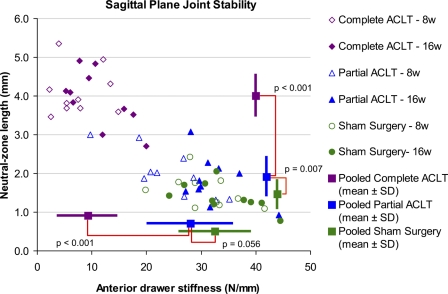
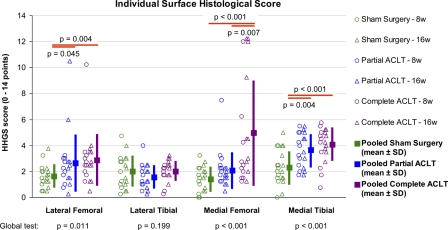
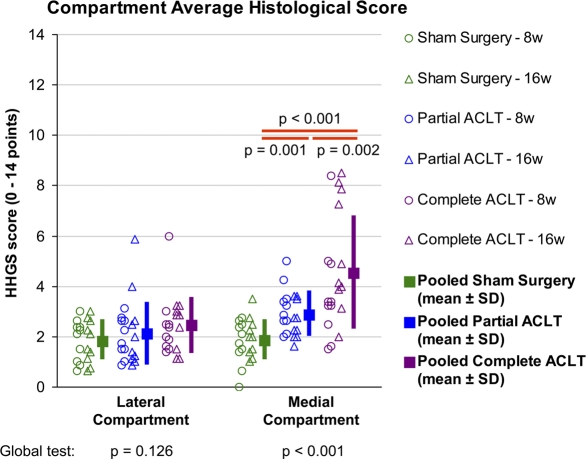
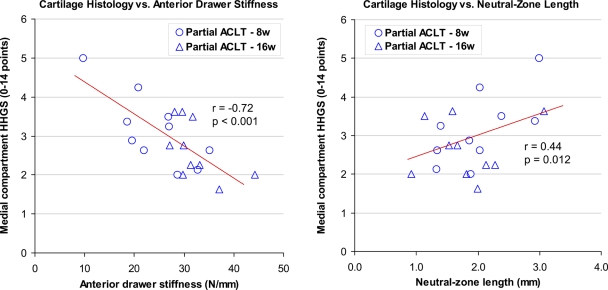
Results: Sagittal plane instability created in the partial transection group was intermediate between those in the complete transection and sham surgery groups. The partial and complete transection groups exhibited cartilage degeneration on the medial femoral and/or medial tibial surfaces. The average histological score (and standard deviation) for the medial compartment in the partial transection group (2.9 ± 0.9) was again intermediate, significantly higher than for the sham surgery group (1.9 ± 0.8) and significantly lower than for the complete transection group (4.5 ± 2.3). The average histological scores for the medial compartment in the partial transection group correlated significantly with the magnitude of instability, with no threshold effect being evident. The significance level of alpha was set at 0.05 for all tests.
Conclusions: The severity of cartilage degeneration increased continuously with the degree of instability in this survival rabbit knee model of graded instability.
© 2011 by the Journal of Bone and Joint Surgery, Incorporated
Figures
References
-
- Sommerlath K, Lysholm J, Gillquist J. The long-term course after treatment of acute anterior cruciate ligament ruptures. A 9 to 16 year followup. Am J Sports Med. 1991;19:156-62 - PubMed
-
- Sommerlath K, Odensten M, Lysholm J. The late course of acute partial anterior cruciate ligament tears. A nine to 15-year follow-up evaluation. Clin Orthop Relat Res. 1992;281:152-8 - PubMed
-
- Lohmander LS, Englund PM, Dahl LL, Roos EM. The long-term consequence of anterior cruciate ligament and meniscus injuries: osteoarthritis. Am J Sports Med. 2007;35:1756-69 - PubMed
-
- Valderrabano V, Hintermann B, Horisberger M, Fung TS. Ligamentous posttraumatic ankle osteoarthritis. Am J Sports Med. 2006;34:612-20 - PubMed
Publication types
MeSH terms
Grants and funding
LinkOut - more resources
Full Text Sources
Other Literature Sources
