


Reduced uptake of [¹⁸F]FDOPA PET in asymptomatic welders with occupational manganese exposure
- PMID: 21471467
- PMCID: PMC3090062
- DOI: 10.1212/WNL.0b013e3182152830
Reduced uptake of [¹⁸F]FDOPA PET in asymptomatic welders with occupational manganese exposure
Abstract
Background: Welding exposes workers to manganese (Mn) fumes, but it is unclear if this exposure damages dopaminergic neurons in the basal ganglia and predisposes individuals to develop parkinsonism. PET imaging with 6-[(18)F]fluoro-l-dopa (FDOPA) is a noninvasive measure of nigrostriatal dopaminergic neuron integrity. The purpose of this study is to determine whether welding exposure is associated with damage to nigrostriatal neurons in asymptomatic workers.
Methods: We imaged 20 asymptomatic welders exposed to Mn fumes, 20 subjects with idiopathic Parkinson disease (IPD), and 20 normal controls using FDOPA PET. All subjects were examined by a movement disorders specialist. Basal ganglia volumes of interest were identified for each subject. The specific uptake of FDOPA, K(i), was generated for each region using graphical analysis method.
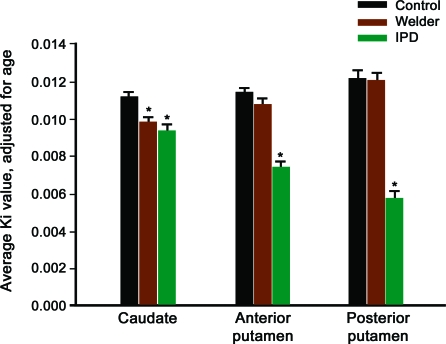
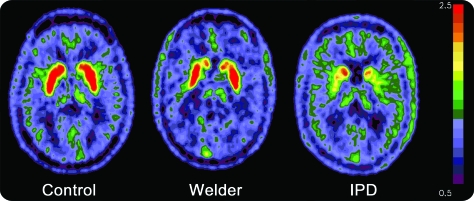
Results: Repeated measures general linear model (GLM) analysis demonstrated a strong interaction between diagnostic group and region (F(4,112) = 15.36, p < 0.001). Caudate K(i)s were lower in asymptomatic welders (0.0098 + 0.0013 minutes(-1)) compared to control subjects (0.0111 + 0.0012 minutes(-1), p = 0.002). The regional pattern of uptake in welders was most affected in the caudate > anterior putamen > posterior putamen. This uptake pattern was anatomically reversed from the pattern found in subjects with IPD.
Conclusions: Active, asymptomatic welders with Mn exposure demonstrate reduced FDOPA PET uptake indicating dysfunction in the nigrostriatal dopamine system. The caudate K(i) reduction in welders may represent an early (asymptomatic) marker of Mn neurotoxicity and appears to be distinct from the pattern of dysfunction found in symptomatic IPD.
Figures
Comment in
-
Fuming over Parkinson disease: are welders at risk?Neurology. 2011 Apr 12;76(15):1286-7. doi: 10.1212/WNL.0b013e31821528ab. Epub 2011 Apr 6. Neurology. 2011. PMID: 21471465 No abstract available.
-
Reduced uptake of [18F]FDOPA PET in asymptomatic welders with occupational manganese exposure.Neurology. 2011 Nov 15;77(20):e120; author reply e120. doi: 10.1212/WNL.0b013e318239bfeb. Neurology. 2011. PMID: 22084283 No abstract available.
References
-
- Welding, soldering, and brazing workers: United States Department of Labor, Bureau of Labor Statistics 2009. Available at: http://www.bls.gov/oco/ocos226.htm Accessed July 15, 2010
-
- Antonini JM. Health effects of welding. Crit Rev Toxicol 2003;33:61–103 - PubMed
-
- Meeker JD, Susi P, Flynn MR. Manganese and welding fume exposure and control in construction. J Occup Environ Hyg 2007;4:943–951 - PubMed
-
- Korczynski RE. Occupational health concerns in the welding industry. Appl Occup Environ Hyg 2000;15:936–945 - PubMed
-
- Susi P, Goldberg M, Barnes P, Stafford E. The use of a task-based exposure assessment model (T-BEAM) for assessment of metal fume exposures during welding and thermal cutting. Appl Occup Environ Hyg 2000;15:26–38 - PubMed
Publication types
MeSH terms
Substances
Grants and funding
LinkOut - more resources
Full Text Sources
Other Literature Sources
Medical
