


Poor physical function in elderly women in low-level aged care is related to muscle strength rather than to measures of sarcopenia
- PMID: 21472094
- PMCID: PMC3066255
- DOI: 10.2147/CIA.S16979
Poor physical function in elderly women in low-level aged care is related to muscle strength rather than to measures of sarcopenia
Abstract
Purpose: To determine the prevalence of sarcopenia and investigate relationships among body composition, muscle strength, and physical function in elderly women in low-level aged care.
Subjects and methods: Sixty-three ambulatory women (mean age 86 years) participated in this cross-sectional study where body composition was determined by dual energy X-ray absorptiometry (DXA); ankle, knee, and hip strength by the Nicholas Manual Muscle Tester; and physical function by 'timed up and go' (TUG) and walking speed (WS) over 6 meters. Body composition data from a female reference group (n = 62, mean age 29 years) provided cut-off values for defining sarcopenia.
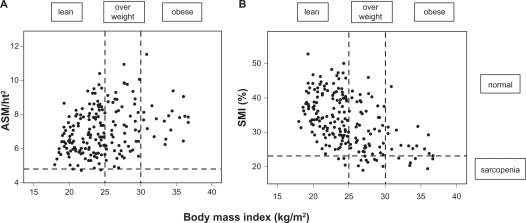
Results: Elderly women had higher body mass index (P < 0.001), lower lean mass (P < 0.001), and higher fat mass (P < 0.01) than the young reference group. Only a small proportion (3.2%) had absolute sarcopenia (defined by appendicular skeletal muscle mass/height squared) whereas 37% had relative sarcopenia class II (defined by percentage skeletal muscle mass). Scores for TUG and WS indicated relatively poor physical function, yet these measures were not associated with muscle mass or indices of sarcopenia. In multivariate analysis, only hip abductor strength predicted both TUG and WS (both P = 0.01).
Conclusion: Hip strength is a more important indicator of physical functioning than lean mass. Measurement of hip strength may therefore be a useful screening tool to detect those at risk of functional decline and requirement for additional care. Further longitudinal studies with a range of other strength measures are warranted.
Keywords: aged care; body composition; muscle strength; sarcopenia.
Figures
References
-
- Seidell JC, Visscher TL. Body weight and weight change and their health implications for the elderly. Eur J Clin Nutr. 2000;54(Suppl 3):S33–S39. - PubMed
-
- Kyle UG, Genton L, Hans D, Karsegard L, Slosman DO, Pichard C. Age-related differences in fat-free mass, skeletal muscle, body cell mass and fat mass between 18 and 94 years. Eur J Clin Nutr. 2001;55(8):663–672. - PubMed
-
- Baumgartner RN, Stauber PM, McHugh D, Koehler KM, Garry PJ. Cross-sectional age differences in body composition in persons 60+ years of age. J Gerontol A Biol Sci Med Sci. 1995;50(6):M307–M316. - PubMed
-
- Gallagher D, Visser M, De Meersman RE, et al. Appendicular skeletal muscle mass: effects of age, gender, and ethnicity. J Appl Physiol. 1997;83(1):229–239. - PubMed
-
- Roubenoff R, Hughes VA. Sarcopenia: current concepts. J Gerontol A Biol Sci Med Sci. 2000 Dec;55(12):M716–M724. - PubMed
