


An eating disorder randomized clinical trial and attrition: profiles and determinants of dropout
- PMID: 21472754
- PMCID: PMC3107987
- DOI: 10.1002/eat.20800
An eating disorder randomized clinical trial and attrition: profiles and determinants of dropout
Abstract
Objective: This study sought to determine whether differential treatment effects in the targeted mechanisms of change and eating disorder (ED) symptoms are associated with patterns of attrition from a RCT.
Method: The main study was a RCT of a psychotherapy designed to alter the non-weight related self-cognitions as the means to promote recovery and health in a sample of 69 women with AN or BN. Four groups based on point of dropout were compared on demographic, self-cognitions and ED symptoms using logit and piecewise mixed effects modeling.
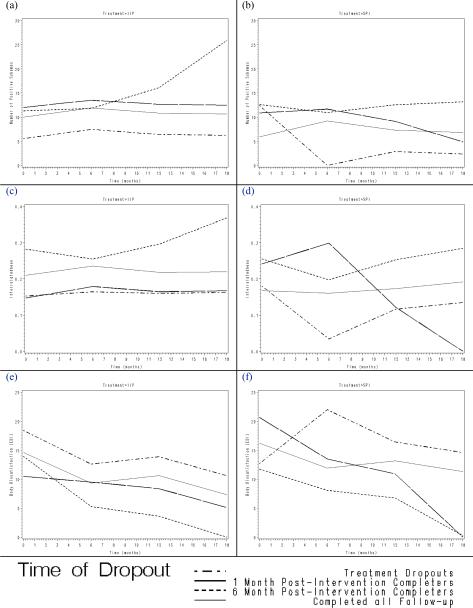
Results: Attrition was highest during treatment phase but no significant predictors were found. During the measurement phase, the direction and amount of change in self-cognition interrelatedness and body dissatisfaction differed according to point of dropout and treatment group.
Discussion: Attention to changes both in symptoms and mediating factors that occur during treatment and follow-up may help to identify those who are at risk for dropout and to develop strategies to promote RCT participant retention.
Copyright © 2009 Wiley Periodicals, Inc.
Figures
References
-
- Birmingham C, Su J, Hlynsky J, Goldner E, Gao M. The mortality rate of anorexia nervosa. Int J Eat Disord. 2005;38(2):143–6. - PubMed
-
- Keel P, Dorer D, Eddy K, Franko D, Charatan D, Herzog D. Predictors of mortality in eating disorders. Arch Gen Psychology. 2003;60(2):179–83. - PubMed
-
- Bowers WA, Andersen AE. Cognitive-behavior therapy with eating disorders: The role of medications in treatment. J Cognitive Psycho. 2007;21(1):16–27.
-
- Wilson GT, Grilo CM, Vitousek KM. Psychological treatment of eating disorders. Am Psychol. 2007;62(3):199–216. - PubMed
-
- Shadish WR, Cook TD, Campbell D. Experimental and quasi-experimental designs for generalized causal inference. Houghton-Mifflin; New York: 2002.
