Prevalence and patterns of nitrosatable drug use among U.S. women during early pregnancy
- PMID: 21472845
- PMCID: PMC3107676
- DOI: 10.1002/bdra.20808
Prevalence and patterns of nitrosatable drug use among U.S. women during early pregnancy
Abstract
Background: Experimental evidence indicates that certain drugs, that are secondary or tertiary amines or amides, form N-nitroso compounds in the presence of nitrite in an acidic environment. Nitrosatable drugs have been associated with birth defects in a few epidemiologic studies. This study describes the prevalence and patterns of nitrosatable drug use among U.S. women during early pregnancy and examines maternal factors associated with such use.
Methods: Data were analyzed from the National Birth Defects Prevention Study and included 6807 mothers who gave birth to babies without major congenital malformations during 1997 to 2005. Information was collected by telephone interview about medication use, demographic factors, and maternal health. Drugs taken during the first trimester were classified according to nitrosatability, amine and amide functional groups, and primary indication of use.
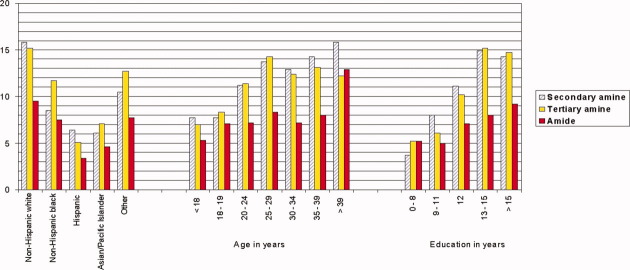
Results: Approximately 24% of the women took one or more nitrosatable drugs during the first trimester, including 12.4%, 12.2%, and 7.6% who respectively took secondary amines, tertiary amines, or amides. Five of the ten most commonly taken drugs were available over the counter. Women who were non-Hispanic white (29.5%), with 1 year or more college education (27.3%) or 40 years or older (28.8%) had the highest prevalence of use. Supplemental vitamin C, an inhibitor of nitrosation, was not taken by 41.6% and 19.3% of nitrosatable drug users during the first and second months of pregnancy, respectively.
Conclusions: In this U.S. population, ingestion of drugs classified as nitrosatable was common during the first trimester of pregnancy, especially among non-Hispanic white, more educated, and older mothers.
Copyright © 2011 Wiley-Liss, Inc.
Figures
References
-
- Alba MA, Espinosa J, Cortinas de Nava C, et al. Mutagenicity of products generated by the reaction between several antiparasitic drugs and nitrite. Environ Mol Mutagen. 1988;12:65–73. - PubMed
-
- Andrews AW, Fornwald JA, Lijinsky W. Nitrosation and mutagenicity of some amine drugs. Toxicol Appl Pharmacol. 1980;52:237–244. - PubMed
-
- Brambilla G, Cajelli E, Finollo R, et al. Formation of DNA-damaging nitroso compounds by interaction of drugs with nitrite. A preliminary screening for detecting potentially hazardous drugs. J Toxicol Environ Health. 1985;15:1–24. - PubMed
-
- Brambilla G, Martelli A. Genotoxic and carcinogenic risk to humans of drug-nitrite interaction products. Mutat Res. 2007;635:17–52. - PubMed
-
- Brender JD, Olive JM, Felkner M, et al. Dietary nitrites and nitrates, nitrosatable drugs, and neural tube defects. Epidemiology. 2004;15:330–336. - PubMed
MeSH terms
Substances
Grants and funding
LinkOut - more resources
Full Text Sources
Medical