


Progression from prehypertension to hypertension in a Jamaican cohort: incident hypertension and its predictors
- PMID: 21473394
- PMCID: PMC4295618
Progression from prehypertension to hypertension in a Jamaican cohort: incident hypertension and its predictors
Abstract
Objectives: To estimate the incidence of hypertension in people with and without prehypertension and determine the factors that predict progression to hypertension.
Methods: Data from a cohort of 25-74-year-old residents of Spanish Town, Jamaica, were analysed. All participants completed a structured questionnaire and had blood pressure (BP), anthropometric measurements and venous blood sampling performed by trained personnel. Blood Pressure was classified using the Seventh Report of the Joint National Committee on the Prevention, Detection, Evaluation and Treatment of High Blood Pressure (JNC-7) criteria.
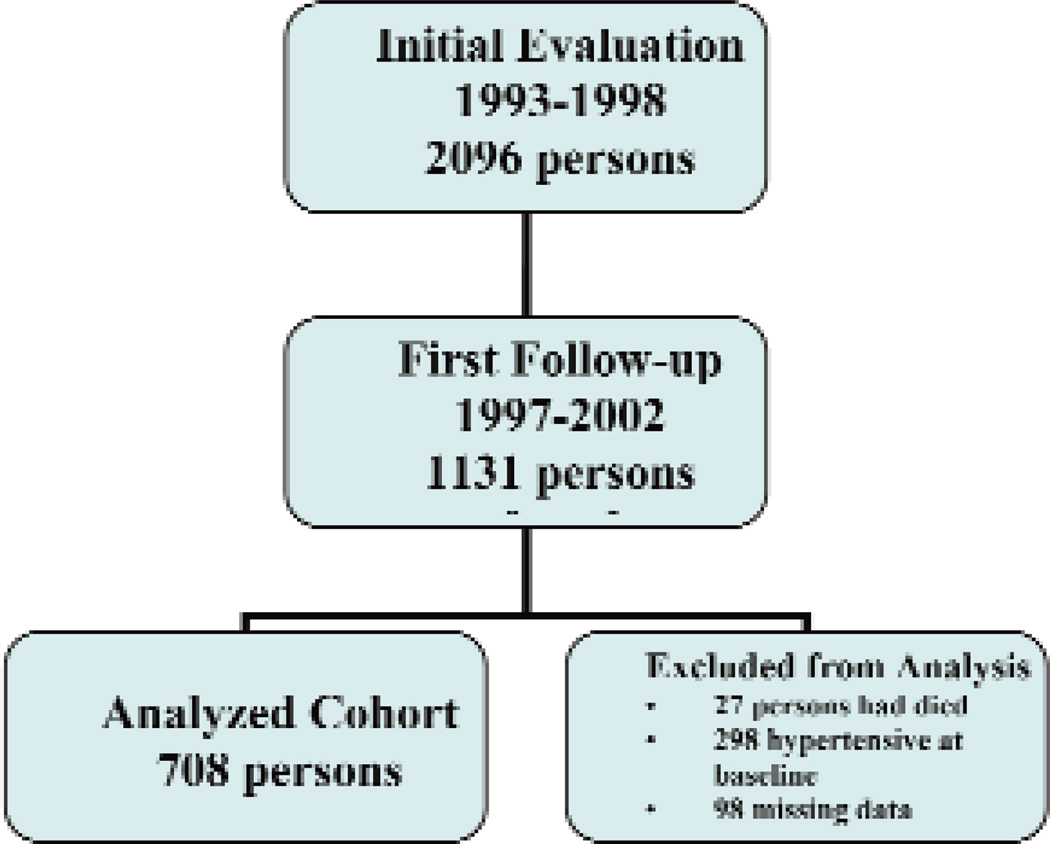
Results: 708 persons who had the required data and were not hypertensive at baseline were included in this analysis. Mean follow-up time was 4.1 years; 28.7% of prehypertensive participants developed hypertension compared to 6.2% of normotensive participants. The unadjusted incidence rate ratio (IRR [95% CI]) for progression among prehypertensive compared to normotensive participants was 4.62 [2.96, 7.43]. Among males, the rate of progression to hypertension was significantly higher for those 45-64 years old and those who were current smokers. Among females, progression was higher for age groups 25-44 years, 45-64 years, those who were overweight (BMI > or =25), obese (BMI > or =30) and current smokers. In multivariate models, prehypertension, female gender overweight status and older age remained significantly associated with progression to hypertension among the combined prehypertensive and normotensive groups. IRR [95% CI] were: prehypertension, 3.45 [2.18-5.45]; female gender 1.81 [1.12, 2.94]; overweight, 1.87 [1.15, 2.94]; age 45-64 years, 1.73 [1.08, 2.76]; age > 65 years 2.39 [1.31, 4.34].
Conclusions: Prehypertension is associated with a three-fold increase in the incidence of hypertension. Higher BMI, age and female gender also independently predict the development of hypertension.
Figures
References
-
- Chobanian AV, Bakris GL, Black HR, Cushman WC, Green LA, Izzo JL, Jr, et al. The Seventh Report of the Joint National Committee on Prevention, Detection, Evaluation, and Treatment of High Blood - PubMed
-
- Wang Y, Wang QJ. The prevalence of prehypertension and hypertension among US adults according to the new joint national committee guidelines: new challenges of the old problem. Arch Intern Med. 2004;164:2126–2134. - PubMed
-
- Yu D, Huang J, Hu D, Chen J, Cao J, Li J, et al. Prevalence and risk factors of prehypertension among Chinese adults. J Cardiovasc Pharmacol. 2008;52:363–368. - PubMed
-
- Tsai PS, Ke TL, Huang CJ, Tsai JC, Chen PL, Wang SY, et al. Prevalence and determinants of prehypertension status in the Taiwanese general population. J Hypertens. 2005;23:1355–1360. - PubMed
Publication types
MeSH terms
Grants and funding
LinkOut - more resources
Full Text Sources
Medical