Review
. 2011 Apr 8;88(4):402-21.
doi: 10.1016/j.ajhg.2011.03.005.

Insights into the pathogenesis and treatment of cancer from inborn errors of metabolism

Affiliations
Review

Insights into the pathogenesis and treatment of cancer from inborn errors of metabolism

Ayelet Erez et al. Am J Hum Genet. .

Abstract

Mutations in genes that play fundamental roles in metabolic pathways have been found to also play a role in tumor development and susceptibility to cancer. At the same time, significant progress has been made in the treatment of patients with inborn errors of metabolism (IEM),(1) resulting in increased longevity and the unmasking of cancer predisposition, frequently hepatocellular carcinoma, in these conditions. These patients offer a potential opportunity to deepen our understanding of how intermediary metabolism impacts tumorigenesis. We provide an overview from the perspective of cancers in patients affected with IEM and discuss how dysregulation of these specific metabolic pathways might contribute to the mechanisms of cancer development and treatment.


Figures

Figure 1
Figure 1
Diverse Mechanisms of Tumorigenesis in Primary Liver Cancer Biochemically diverse metabolic disorders have primary liver cancer (HCC), which can occur even in the absence of discernible liver fibrosis or cirrhosis, as one of their later complications. Unique biochemical signatures in each metabolic disorder provide us with important clues regarding the dysregulation of major pathways instigating the transformation of healthy tissue into a tumor. Several common mechanisms emerge including (1) direct mutagenesis via interaction of intermediate metabolites with DNA, (2) imbalances in the nucleotide pool resulting in mitochondrial DNA damage, (3) dysregulation of ROS biology, and (4) diversion of the metabolic flux imitating Warburg effect. Although each mechanism alone is unlikely to be directly responsible for primary liver cancer, collectively they lower the threshold required for tissue transformation. The following abbreviations are used: 4,5-DOV, 4,5-dioxovalerate; 5-ALA, 5-aminolevulinate; ATP7B, ATPase Cu++ transporting beta polypeptide (Wilson disease); DGUOK, deoxyguanosine kinase; FAA, fumarylacetoacetate; FAH, fumarylacetoacetate hydrolase; G6PC, glucose-6-phosphatase, catalytic subunit (GSD Ia); HFE, hemochromatosis protein (HFE-related hereditary hemochromatosis); HMBS, hydroxymethylbilane synthase (dominant disease acute intermittent porphyria); MAA, maleylacetoacetate; MPV17, MPV17 mitochondrial inner membrane protein (hepatocerebral form of mitochondrial DNA depletion syndrome); ROS, reactive oxygen species; SA, succinylacetone; SLC25A13, solute carrier family 25, member 13 (mitochondrial aspartate-glutamate carrier protein, citrin deficiency); SLC37A4, solute carrier family 37, member 4 (G6PT, GSD Ib); UROD, uroporphyrinogen decarboxylase (familial PCT and hepatoerythropoetic porphyria).
Figure 2
Figure 2
Warburg Effect and Metabolic Disorders with Features of Metabolite Shunting (A) The observed Warburg effect in cancerous cells is a metabolic phenomenon of aerobic glycolysis, that is, diversion of glucose via pyruvate to lactate even in the presence of abundant oxygen. In addition to the Warburg effect, other important features of metabolism in cancerous cells include increased synthesis of nucleotides to synthesize DNA, diversion of citrate to cytosolic acetyl-CoA for fatty acid synthesis, and increased need for glutamine, a precursor for alpha-ketoglutarate (α-KG), intrinsically linked to the HIF-pathway. (B) The sum of metabolic derangements observed in GSD Ia, where the inability to convert G6P to glucose results in increased shunting of G6P to P5P pathway. G6P is also used as a substrate for fatty acid and triglyceride synthesis. Oversupply of lactate and pyruvate through Cori cycle and hepatic gluconeogenesis could result in alteration of the ATP/ADP and NADH/NAD+ ratios in favor of tumorigenesis. (C) Metabolic abnormalities highlighting the role of Krebs cycle intermediates—succinate, fumarate, and α-KG—in the regulation of the HIF-dependent pathway. Impaired function of Krebs cycle might adversely affect oxidative phosphorylation and thus lead to cell-autonomous shunting of glucose to pyruvate and lactate. (D) Citrin deficiency is characterized by increased metabolism of simple carbohydrates resulting in high NADH/NAD+ and lactate/pyruvate ratios, which can also be observed under the Warburg effect. Fatty liver in citrin deficiency implies increased flux of citrin via acetyl-CoA for fatty acid synthesis.
Figure 3
Figure 3
The Role of Tricarboxylic Acid Cycle Intermediates in the Regulation of HIF Function Deficiencies of FH and SDH in the tricarboxylic acid cycle results in the accumulation of fumarate and succinate, respectively. Accumulation of fumarate and succinate results in inhibition of the α-KG-dependent dioxygenases (α-KG DO) responsible for hydroxylation of the HIF, which further impairs the recruitment of VHL protein necessary in the HIF degradation. Isocitrate dehydrogenase deficiency results in the depletion of α-KG, thus decreasing the activity of some α-KG DO. Some unique mutant alleles, IDH2 and IDH1, which are the result of modification of the arginine at position 140 or position 172 in IDH2 (NP_002159.2) or the arginine at position 132 of IDH1 (NP_005887.2), confer the enzymes a novel function of converting α-KG into D-2-hydroxyglutarate (D-2-HGA). This conversion results in depletion of α-KG and an increase in the concentration of D-2-HGA, a unique oncometabolite and a possible competitive inhibitor of α-KG-dependent enzymes. Collectively, these changes result in dysregulation of the HIF-induced apoptosis, proliferation, and differentiation underlying cancer mechanisms.
Figure 4
Figure 4
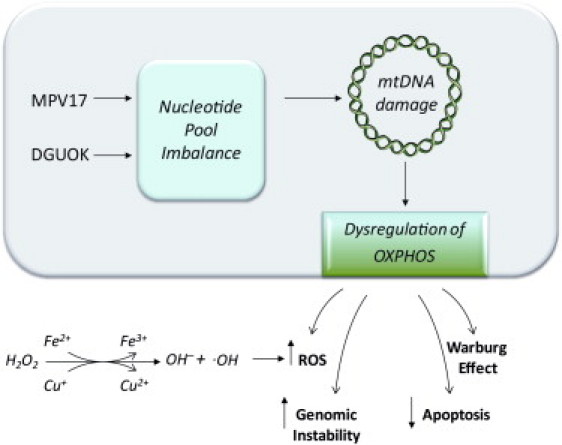
Mitochondria as the Target and Amplifier of the Tumorigenic Biochemical Signals Mutations in MPV17 and DGUOK result in imbalance of the nucleotide pool thus increasing mtDNA instability. Accumulating mtDNA damage eventually culminates in the impairment of oxidative phosphorylation (OXPHOS). Impaired OXPHOS causes dysregulation of the ROS biology, propagates further genomic and mtDNA instability, decreases apoptosis, and creates the biochemical environment reminiscent of Warburg effect. Metabolic disorders resulting in accumulation of copper (Wilson disease) and iron (hemochromatosis) increase ROS presumably through Fenton reaction.
Figure 5
Figure 5
The Summary of Converging Mechanisms in IEM Underlying Tumorigenesis Abnormal cell energy metabolism encompasses Warburg effect, increased flux through P5P shunt, increased synthesis of fatty acids and triglycerides, and glutamine dependence, which can be seen patients with IEMs. Alterations in the nucleotide pools, mtDNA mutations, and direct mutagenesis by abnormal intermediate metabolites come under the general mechanism of genomic instability. Finally, alterations in the ROS biology can either promote or inhibit cellular growth depending on the intracellular context. Abnormalities in the energy metabolism, genomic instability, and altered ROS biology interact and might amplify each other. Each disorder might have one or more mechanisms involved in tumorigenesis. The net effect of these changes is not necessarily direct tumorigenesis, but rather decreased threshold for tumor transformation.

References

    1. Alexander F.E., Patheal S.L., Biondi A., Brandalise S., Cabrera M.E., Chan L.C., Chen Z., Cimino G., Cordoba J.C., Gu L.J. Transplacental chemical exposure and risk of infant leukemia with MLL gene fusion. Cancer Res. 2001;61:2542–2546. - PubMed
    1. Warburg O. On the origin of cancer cells. Science. 1956;123:309–314. - PubMed
    1. Vander Heiden M.G., Cantley L.C., Thompson C.B. Understanding the Warburg effect: The metabolic requirements of cell proliferation. Science. 2009;324:1029–1033. - PMC - PubMed
    1. Luo J., Manning B.D., Cantley L.C. Targeting the PI3K-Akt pathway in human cancer: Rationale and promise. Cancer Cell. 2003;4:257–262. - PubMed
    1. Lanpher B., Brunetti-Pierri N., Lee B. Inborn errors of metabolism: The flux from Mendelian to complex diseases. Nat. Rev. Genet. 2006;7:449–460. - PubMed

Publication types

Substances

LinkOut - more resources