Distress in the radiology waiting room
- PMID: 21474702
- PMCID: PMC3121015
- DOI: 10.1148/radiol.11102211
Distress in the radiology waiting room
Abstract
Purpose: To assess the level of distress in women awaiting radiologic procedures.
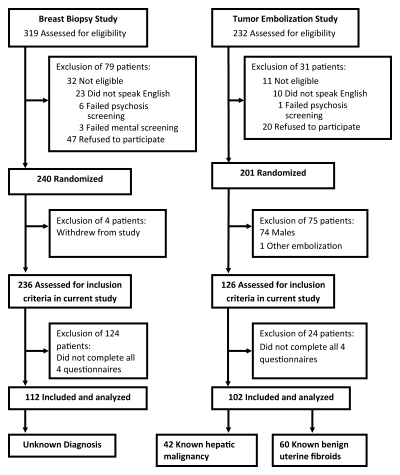
Materials and methods: In this institutional review board-approved and HIPAA-compliant study, 214 women between 18 and 86 (mean, 47.9) years of age completed the State Trait Anxiety Inventory (STAI), Impact of Events Scale (IES), Center for Epidemiologic Studies Depression Scale (CES-D), and Perceived Stress Scale (PSS) immediately prior to their procedures. One hundred twelve women awaited breast biopsy; 42, hepatic chemoembolization for cancer; and 60, uterine fibroid embolization. Data were analyzed with multivariate analysis of variance and post hoc Tukey tests. Results are reported as means and 95% confidence intervals (CIs).
Results: All three patient groups experienced abnormally high mean PSS, IES, and CES-D scores, but only the breast biopsy group had highly abnormal anxiety levels. Breast biopsy patients had a significantly higher mean STAI score of 48 (95% CI: 45, 50) than did women awaiting hepatic chemoembolization (mean score, 26; 95% CI: 22, 29; P < .001) and fibroid embolization (mean score, 24; 95% CI: 21, 27; P < .001). IES ratings did not differ significantly among the groups, with a mean score of 26 (95% CI: 23, 29) for breast biopsy patients, 23 (95% CI: 18, 28) for hepatic chemoembolization patients, and 23 (95% CI: 18, 27) for fibroid embolization patients. The CES-D score did not differ significantly among breast biopsy (mean score, 15; 95% CI: 13, 17), hepatic chemoembolization (mean score, 14; 95% CI: 11, 18), and fibroid embolization (mean score, 12; 95% CI: 9, 15) patients. PSS ratings of breast biopsy patients were significantly higher (mean score, 18; 95% CI: 16, 19) than those of hepatic chemoembolization patients (mean, 15; 95% CI: 13, 17; P < .01), but they were not significantly different from those of women awaiting fibroid embolization (mean, 16; 95% CI: 14, 18; P = .23).
Conclusion: Uncertainty of diagnosis can be associated with greater stress than is awaiting more invasive and potentially risky treatment.
References
-
- Peteet JR, Stomper PC, Ross DM, Cotton V, Truesdell P, Moczynski W. Emotional support for patients with cancer who are undergoing CT: semistructured interviews of patients at a cancer institute. Radiology 1992;182(1):99–102 - PubMed
-
- Bugbee ME, Wellisch DK, Arnott IM, et al. Breast core-needle biopsy: clinical trial of relaxation technique versus medication versus no intervention for anxiety reduction. Radiology 2005;234(1):73–78 - PubMed
-
- Lang EV, Benotsch EG, Fick LJ, et al. Adjunctive non-pharmacological analgesia for invasive medical procedures: a randomised trial. Lancet 2000;355(9214):1486–1490 - PubMed
Publication types
MeSH terms
Grants and funding
LinkOut - more resources
Full Text Sources
Medical