


Imaging the endothelial glycocalyx in vitro by rapid freezing/freeze substitution transmission electron microscopy
- PMID: 21474821
- PMCID: PMC3141106
- DOI: 10.1161/ATVBAHA.111.225268
Imaging the endothelial glycocalyx in vitro by rapid freezing/freeze substitution transmission electron microscopy
Abstract
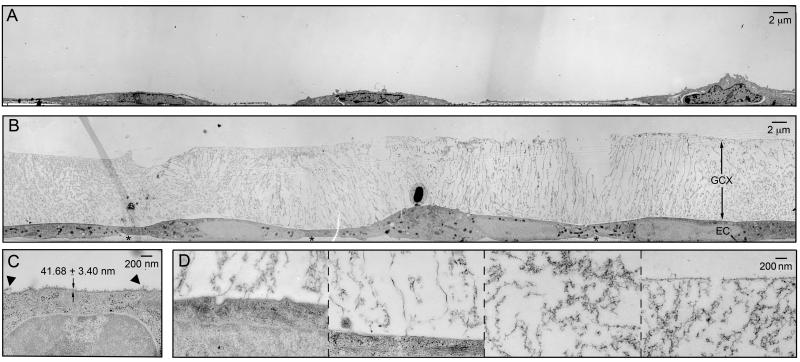
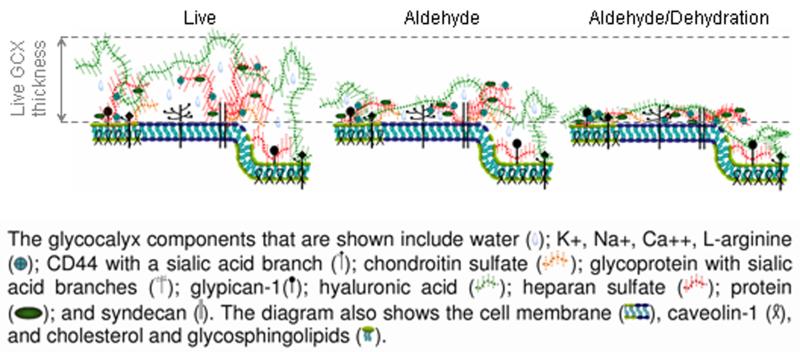
Objective: Recent publications questioned the validity of endothelial cell (EC) culture studies of glycocalyx (GCX) function because of findings that GCX in vitro may be substantially thinner than GCX in vivo. The assessment of thickness differences is complicated by GCX collapse during dehydration for traditional electron microscopy. We measured in vitro GCX thickness using rapid freezing/freeze substitution (RF/FS) transmission electron microscopy (TEM), taking advantage of the high spatial resolution provided by TEM and the capability to stably preserve the GCX in its hydrated configuration by RF/FS.
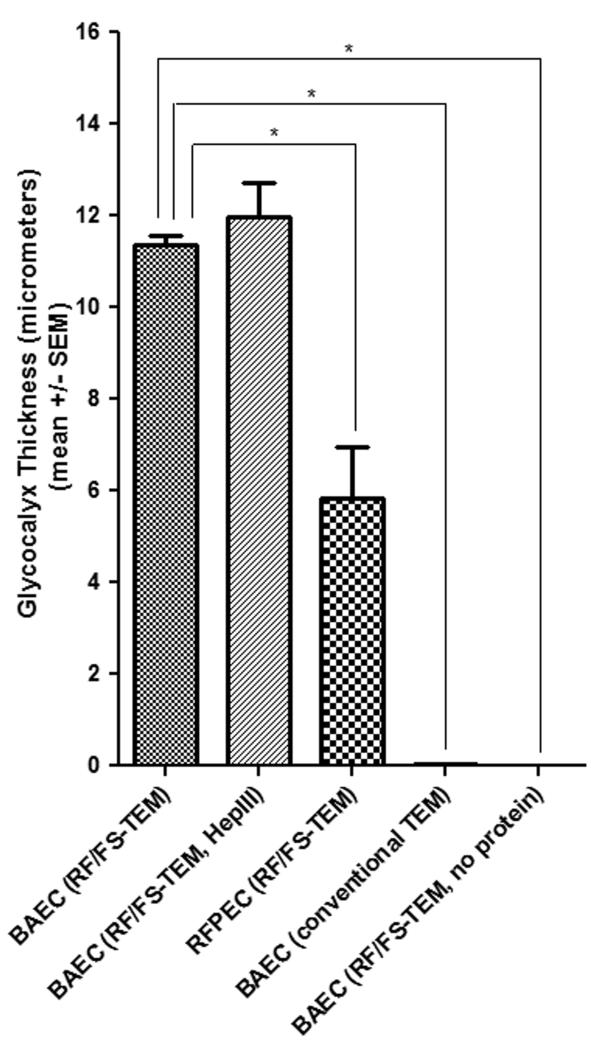
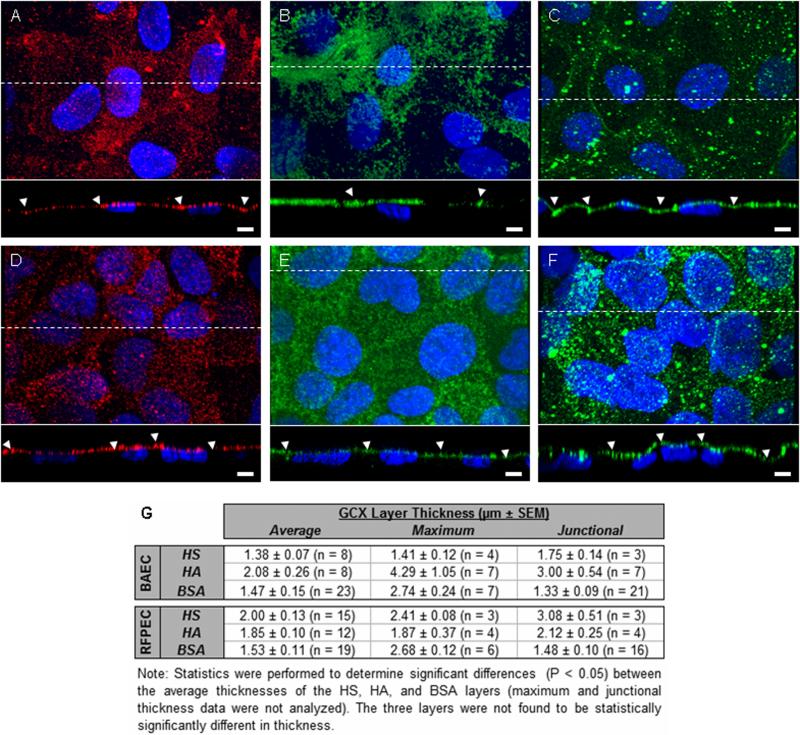
Methods and results: Bovine aortic EC (BAEC) and rat fat pad EC were subjected to conventional or RF/FS-TEM. Conventionally preserved BAEC GCX was ≈0.040 μm in thickness. RF/FS-TEM revealed impressively thick BAEC GCX of ≈11 μm and rat fat pad EC GCX of ≈5 μm. RF/FS-TEM also discerned GCX structure and thickness variations due to heparinase III enzyme treatment and extracellular protein removal, respectively. Immunoconfocal studies confirmed that the in vitro GCX is several micrometers thick and is composed of extensive and well-integrated heparan sulfate, hyaluronic acid, and protein layers.
Conclusions: New observations by RF/FS-TEM reveal substantial GCX layers on cultured EC, supporting their continued use for fundamental studies of GCX and its function in the vasculature.
Figures

Comment in
-
An 11-μm-thick glycocalyx?: it's all in the technique!Arterioscler Thromb Vasc Biol. 2011 Aug;31(8):1712-3. doi: 10.1161/ATVBAHA.111.229849. Arterioscler Thromb Vasc Biol. 2011. PMID: 21775768 No abstract available.
References
-
- Florian JA, Kosky JR, Ainslie K, Pang Z, Dull RO, Tarbell JM. Heparan sulfate proteoglycan is a mechanosensor on endothelial cells. Circ Res. 2003;93:e136–142. - PubMed
-
- Yao Y, Rabodzey A, Dewey CF., Jr. Glycocalyx modulates the motility and proliferative response of vascular endothelium to fluid shear stress. Am J Physiol Heart Circ Physiol. 2007;293:H1023–1030. - PubMed
Publication types
MeSH terms
Grants and funding
LinkOut - more resources
Full Text Sources
Other Literature Sources
