


The role of PML in the control of apoptotic cell fate: a new key player at ER-mitochondria sites
- PMID: 21475307
- PMCID: PMC3178429
- DOI: 10.1038/cdd.2011.31
The role of PML in the control of apoptotic cell fate: a new key player at ER-mitochondria sites
Abstract
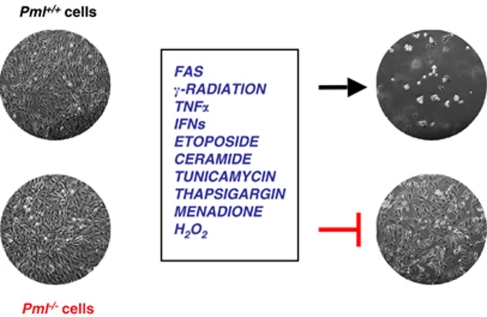
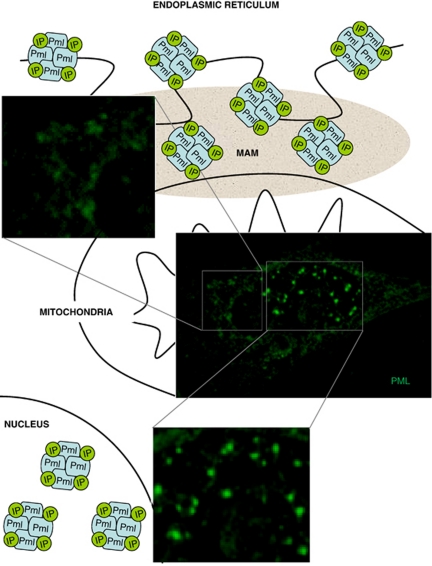
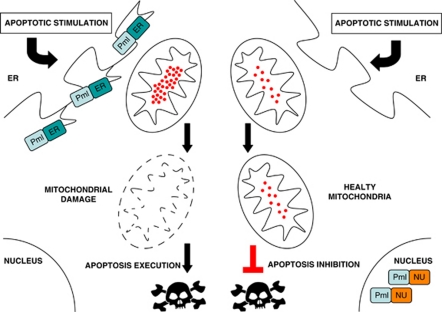
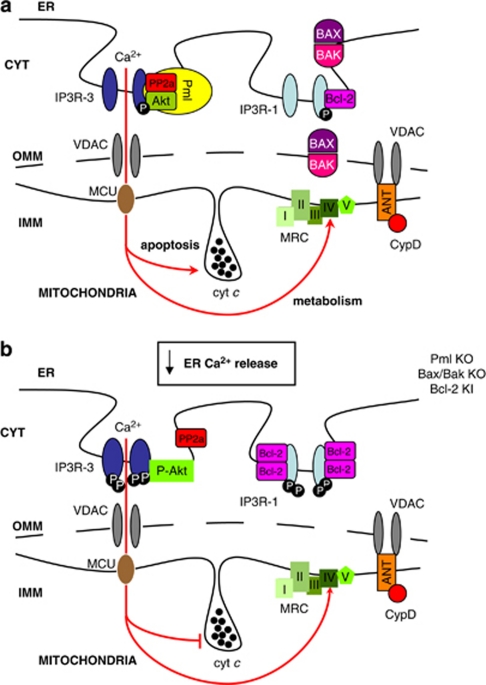
The development of malignant tumors results from deregulated proliferation or an inability of cells to undergo apoptotic cell death. Experimental works of the past decade have highlighted the importance of calcium (Ca(2+)) in the regulation of apoptosis. Several studies indicate that the Ca(2+) content of the endoplasmic reticulum (ER) determines the cell's sensitivity to apoptotic stress and perturbation of ER Ca(2+) homeostasis appears to be a key component in the development of several pathological situations. Sensitivity to apoptosis depends on the ability of cells to transfer Ca(2+) from the ER to the mitochondria. The physical platform for the interplay between the ER and mitochondria is a domain of the ER called the mitochondria-associated membranes (MAMs). The disruption of these contact sites has profound consequences for cellular function, such as imbalances of intracellular Ca(2+) signaling, cellular stress, and disrupted apoptosis progression. The promyelocytic leukemia (PML) protein has been previously recognized as a critical and essential regulator of multiple apoptotic response. Nevertheless, how PML would exert such broad and fundamental role in apoptosis remained for long time a mystery. In this review, we will discuss how recent results demonstrate that the elusive mechanism whereby the PML tumor suppressor exerts its essential role in apoptosis triggered by Ca(2+)-dependent stimuli can be attributed to its unexpected and fundamental role at MAMs in the control of the functional cross-talk between ER and mitochondria.
Figures
References
-
- Pandolfi PP. Oncogenes and tumor suppressors in the molecular pathogenesis of acute promyelocytic leukemia. Hum Mol Genet. 2001;10:769–775. - PubMed
-
- Salomoni P, Pandolfi PP. The role of PML in tumor suppression. Cell. 2002;108:165–170. - PubMed
-
- Salomoni P, Ferguson BJ, Wyllie AH, Rich T. New insights into the role of PML in tumour suppression. Cell Res. 2008;18:622–640. - PubMed
-
- Bernardi R, Pandolfi PP. Structure, dynamics and functions of promyelocytic leukaemia nuclear bodies. Nat Rev Mol Cell Biol. 2007;8:1006–1016. - PubMed
-
- Jensen K, Shiels C, Freemont PS. PML protein isoforms and the RBCC/TRIM motif. Oncogene. 2001;20:7223–7233. - PubMed
Publication types
MeSH terms
Substances
Grants and funding
LinkOut - more resources
Full Text Sources
Medical
Molecular Biology Databases
Miscellaneous
