


A national survey of medical education fellowships
- PMID: 21475643
- PMCID: PMC3071874
- DOI: 10.3402/meo.v16i0.5642
A national survey of medical education fellowships
Abstract
Purpose: The purpose of our study was to determine the prevalence, focus, time commitment, graduation requirements and programme evaluation methods of medical education fellowships throughout the United States. Medical education fellowships are defined as a single cohort of medical teaching faculty who participate in an extended faculty development programme.
Methods: A 26-item online questionnaire was distributed to all US medical schools (n=127) in 2005 and 2006. The questionnaire asked each school if it had a medical education fellowship and the characteristics of the fellowship programme.
Results: Almost half (n=55) of the participating schools (n=120, response rate 94.5 %) reported having fellowships. Duration (10-584 hours) and length (<1 month-48 months) varied; most focused on teaching skills, scholarly dissemination and curriculum design, and required the completion of a scholarly project. A majority collected participant satisfaction; few used other programme evaluation strategies.
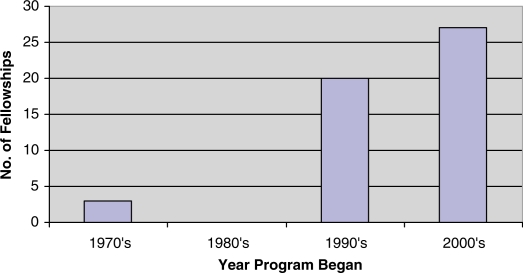
Conclusions: The number of medical education fellowships increased rapidly during the 1990s and 2000s. Across the US, programmes are similar in participant characteristics and curricular focus but unique in completion requirements. Fellowships collect limited programme evaluation data, indicating a need for better outcome data. These results provide benchmark data for those implementing or revising existing medical education fellowships.
Keywords: faculty development; medical education; medical faculty.
Figures
References
-
- McLean M, Cilliers F, Van Wyk JM. Faculty development: yesterday, today and tomorrow. Med Teach. 2008;30:555–84. - PubMed
-
- Steinert Y, Mann K, Centeno A, Dolmans D, Spencer J, Gelula M, et al. A systematic review of faculty development initiatives designed to improve teaching effectiveness in medical education: BEME Guide No. 8. Med Teach. 2006 Sep;28:497–526. - PubMed
-
- Searle NS, Hatem CJ, Perkowski L, Wilkerson L. Why invest in an educational fellowship program? Acad Med. 2006;81:936–40. - PubMed
-
- Hackbarth GM, Haddy FJ, Ajluni PB, Iglehart JK. Pursuit of an expanded physician supply. NEJM. 2008;359:764–5. - PubMed
-
- Fleming VM, Schindler N, Martin GJ, DaRosa DA. Separate and equitable promotion tracks for clinician-educators. JAMA. 2005;249:1101–4. - PubMed
MeSH terms
LinkOut - more resources
Full Text Sources
