


Glatiramer acetate in the treatment of multiple sclerosis: emerging concepts regarding its mechanism of action
- PMID: 21476611
- PMCID: PMC3963480
- DOI: 10.2165/11588120-000000000-00000
Glatiramer acetate in the treatment of multiple sclerosis: emerging concepts regarding its mechanism of action
Abstract
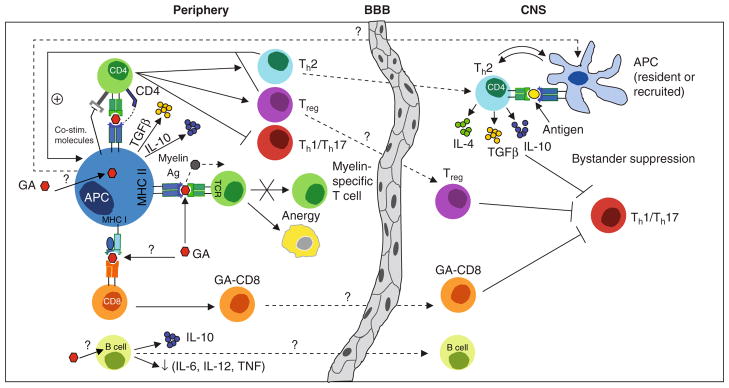
Glatiramer acetate is a synthetic, random copolymer widely used as a first-line agent for the treatment of relapsing-remitting multiple sclerosis (MS). While earlier studies primarily attributed its clinical effect to a shift in the cytokine secretion of CD4+ T helper (T(h)) cells, growing evidence in MS and its animal model, experimental autoimmune encephalomyelitis (EAE), suggests that glatiramer acetate treatment is associated with a broader immunomodulatory effect on cells of both the innate and adaptive immune system. To date, glatiramer acetate-mediated modulation of antigen-presenting cells (APC) such as monocytes and dendritic cells, CD4+ T(h) cells, CD8+ T cells, Foxp3+ regulatory T cells and antibody production by plasma cells have been reported; in addition, most recent investigations indicate that glatiramer acetate treatment may also promote regulatory B-cell properties. Experimental evidence suggests that, among these diverse effects, a fostering interplay between anti-inflammatory T-cell populations and regulatory type II APC may be the central axis in glatiramer acetate-mediated immune modulation of CNS autoimmune disease. Besides altering inflammatory processes, glatiramer acetate could exert direct neuroprotective and/or neuroregenerative properties, which could be of relevance for the treatment of MS, but even more so for primarily neurodegenerative disorders, such as Alzheimer's or Parkinson's disease. In this review, we provide a comprehensive and critical overview of established and recent findings aiming to elucidate the complex mechanism of action of glatiramer acetate.
Conflict of interest statement
The other authors have no conflicts of interest to declare.
Figures
References
-
- Teitelbaum D, Meshorer A, Hirshfeld T, et al. Suppression of experimental allergic encephalomyelitis by a synthetic polypeptide. Eur J Immunol. 1971 Aug;1( 4):242–8. - PubMed
-
- Teitelbaum D, Webb C, Bree M, et al. Suppression of experimental allergic encephalomyelitis in Rhesus monkeys by a synthetic basic copolymer. Clin Immunol Immunopathol. 1974 Nov;3( 2):256–62. - PubMed
-
- Lisak RP, Zweiman B, Blanchard N, et al. Effect of treatment with Copolymer 1 (Cop-1) on the in vivo and in vitro manifestations of experimental allergic encephalomyelitis (EAE) J Neurol Sci. 1983 Dec;62( 1–3):281–93. - PubMed
-
- Teitelbaum D, Fridkis-Hareli M, Arnon R, et al. Copolymer 1 inhibits chronic relapsing experimental allergic encephalomyelitis induced by proteolipid protein (PLP) peptides in mice and interferes with PLP-specific T cell responses. J Neuroimmunol. 1996 Feb;64( 2):209–17. - PubMed
-
- Johnson KP, Brooks BR, Cohen JA, et al. Copolymer 1 reduces relapse rate and improves disability in relapsing-remitting multiple sclerosis: results of a phase III multicenter, double-blind, placebo-controlled trial. Neurology. 1995;45:1268–76. - PubMed
Publication types
MeSH terms
Substances
Grants and funding
LinkOut - more resources
Full Text Sources
Other Literature Sources
Medical
Research Materials
