The large quadrupole of water molecules
- PMID: 21476758
- PMCID: PMC3081860
- DOI: 10.1063/1.3569563
The large quadrupole of water molecules
Abstract
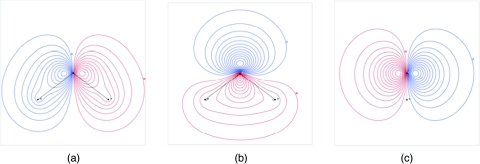
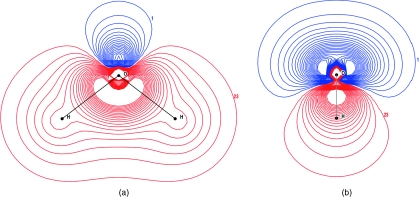
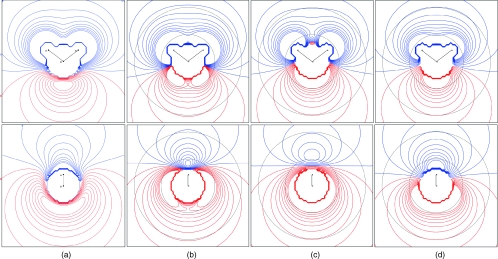
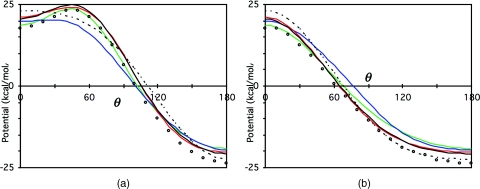
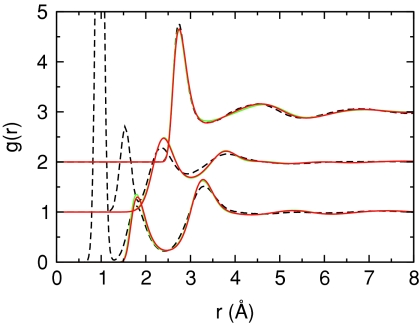
Many quantum mechanical calculations indicate water molecules in the gas and liquid phase have much larger quadrupole moments than any of the common site models of water for computer simulations. Here, comparisons of multipoles from quantum mechanical∕molecular mechanical (QM∕MM) calculations at the MP2∕aug-cc-pVQZ level on a B3LYP∕aug-cc-pVQZ level geometry of a waterlike cluster and from various site models show that the increased square planar quadrupole can be attributed to the p-orbital character perpendicular to the molecular plane of the highest occupied molecular orbital as well as a slight shift of negative charge toward the hydrogens. The common site models do not account for the p-orbital type electron density and fitting partial charges of TIP4P- or TIP5P-type models to the QM∕MM dipole and quadrupole give unreasonable higher moments. Furthermore, six partial charge sites are necessary to account reasonably for the large quadrupole, and polarizable site models will not remedy the problem unless they account for the p-orbital in the gas phase since the QM calculations show it is present there too. On the other hand, multipole models by definition can use the correct multipoles and the electrostatic potential from the QM∕MM multipoles is much closer than that from the site models to the potential from the QM∕MM electron density. Finally, Monte Carlo simulations show that increasing the quadrupole in the soft-sticky dipole-quadrupole-octupole multipole model gives radial distribution functions that are in good agreement with experiment.
Figures

References
-
- Maréchal Y., The Hydrogen Bond and the Water Molecule: The Physics and Chemistry of Water, Aqueous and Bio Media (Elsevier, Oxford, 2007).
-
- Stone A. J., The Theory of Intermolecular Forces (Clarendon, Oxford, 1996).
-
- Reed A. E., Curtiss L. A., and Weinhold F., Chem. Rev. 88(6), 899 (1988).10.1021/cr00088a005 - DOI
-
- Bader R. W. F., Chem. Rev. 91, 893 (1991).10.1021/cr00005a013 - DOI
Publication types
MeSH terms
Substances
Grants and funding
LinkOut - more resources
Full Text Sources