


Metastatic dormancy and progression in thyroid cancer: targeting cells in the metastatic frontier
- PMID: 21476892
- PMCID: PMC3092721
- DOI: 10.1089/thy.2011.2121
Metastatic dormancy and progression in thyroid cancer: targeting cells in the metastatic frontier
Abstract
Background: Metastatic dormancy, or the ability of cancer cells to survive but not progress in metastatic environments, is now recognized to be a common occurrence in cancer.
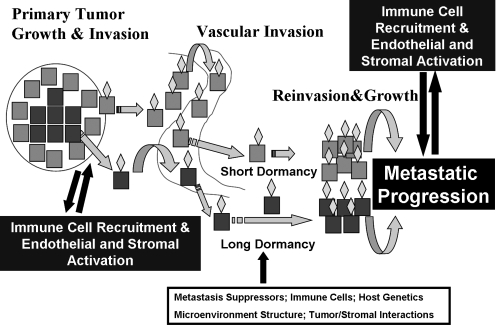
Summary: From a clinical perspective, this phenomenon is common in metastatic well-differentiated thyroid cancer, whereby patients often present with distant metastases that remain stable for years after removal of the primary tumor and subsequent treatment. Experimental data suggest that metastases can develop throughout the life of a cancer and that progression in the distant environment depends on the biology of the cancer cells that metastasize as well as that of the various microenvironments they encounter. A firm understanding of how thyroid cancer cell progression is regulated in different metastatic environments is necessary to devise effective therapies targeting progressive metastatic thyroid cancer.
Conclusion: In this review, current models of metastatic progression and factors that regulate late-stage metastatic progression that are particularly relevant for thyroid cancer are discussed.
Figures
References
-
- Paget S. The distribution of secondary growths in cancer of the breasts. Lancet. 1889;1:571–573. - PubMed
-
- Nguyen DX. Bos PD. Massague J. Metastasis: from dissemination to organ-specific colonization. Nat Rev Cancer. 2009;9:274–284. - PubMed
-
- Shachaf CM. Kopelman AM. Arvanitis C. Karlsson A. Beer S. Mandl S. Bachmann MH. Borowsky AD. Ruebner B. Cardiff RD. Yang Q. Bishop JM. Contag CH. Felsher DW. MYC inactivation uncovers pluripotent differentiation and tumour dormancy in hepatocellular cancer. Nature. 2004;431:1112–1117. - PubMed
-
- Gardner RE. Tuttle RM. Burman KD. Haddady S. Truman C. Sparling YH. Wartofsky L. Sessions RB. Ringel MD. Prognostic importance of vascular invasion in papillary thyroid carcinoma. Arch Otolaryngol Head Neck Surg. 2000;126:309–312. - PubMed
Publication types
MeSH terms
Substances
Grants and funding
LinkOut - more resources
Full Text Sources
Other Literature Sources
Medical
