


Increased proportions of outdoor feeding among residual malaria vector populations following increased use of insecticide-treated nets in rural Tanzania
- PMID: 21477321
- PMCID: PMC3084176
- DOI: 10.1186/1475-2875-10-80
Increased proportions of outdoor feeding among residual malaria vector populations following increased use of insecticide-treated nets in rural Tanzania
Abstract
Background: Insecticide-treated nets (ITNs) and indoor residual spraying (IRS) represent the front-line tools for malaria vector control globally, but are optimally effective where the majority of baseline transmission occurs indoors. In the surveyed area of rural southern Tanzania, bed net use steadily increased over the last decade, reducing malaria transmission intensity by 94%.
Methods: Starting before bed nets were introduced (1997), and then after two milestones of net use had been reached-75% community-wide use of untreated nets (2004) and then 47% use of ITNs (2009)-hourly biting rates of malaria vectors from the Anopheles gambiae complex and Anopheles funestus group were surveyed.
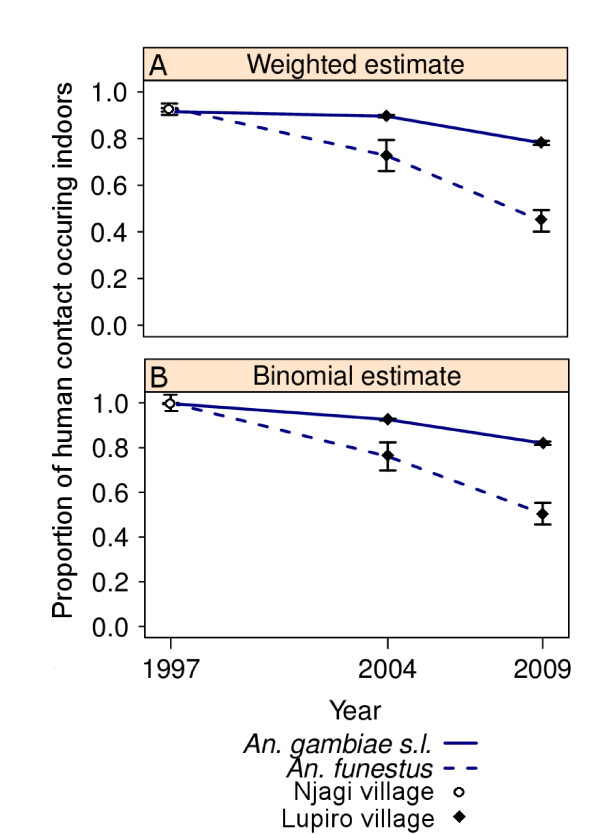
Results: In 1997, An. gambiae s.l. and An. funestus mosquitoes exhibited a tendency to bite humans inside houses late at night. For An. gambiae s.l., by 2009, nocturnal activity was less (p = 0.0018). At this time, the sibling species composition of the complex had shifted from predominantly An. gambiae s.s. to predominantly An. arabiensis. For An. funestus, by 2009, nocturnal activity was less (p = 0.0054) as well as the proportion biting indoors (p < 0.0001). At this time, An. funestus s.s. remained the predominant species within this group. As a consequence of these altered feeding patterns, the proportion (mean ± standard error) of human contact with mosquitoes (bites per person per night) occurring indoors dropped from 0.99 ± 0.002 in 1997 to 0.82 ± 0.008 in 2009 for the An. gambiae complex (p = 0.0143) and from 1.00 ± <0.001 to only 0.50 ± 0.048 for the An. funestus complex (p = 0.0004) over the same time period.
Conclusions: High usage of ITNs can dramatically alter African vector populations so that intense, predominantly indoor transmission is replaced by greatly lowered residual transmission, a greater proportion of which occurs outdoors. Regardless of the underlying mechanism, the residual, self-sustaining transmission will respond poorly to further insecticidal measures within houses. Additional vector control tools which target outdoor biting mosquitoes at the adult or immature stages are required to complement ITNs and IRS.
Figures



References
-
- Killeen GF, Kihonda J, Lyimo E, Oketch FR, Kotas ME, Mathenge E, Schellenberg JA, Lengeler C, Smith TA, Drakeley CJ. Quantifying behavioural interactions between humans and mosquitoes: evaluating the protective efficacy of insecticidal nets against malaria transmission in rural Tanzania. BMC Infect Dis. 2006;6:161. doi: 10.1186/1471-2334-6-161. - DOI - PMC - PubMed
-
- Lengeler C. Insecticide-treated bednets and curtains for preventing malaria (Review) Cochrane Database Syst Rev. 2004;2:CD000363. - PubMed
Publication types
MeSH terms
Grants and funding
LinkOut - more resources
Full Text Sources
Medical
Research Materials
