. 2011 Jun 3;409(2):101-12.
doi: 10.1016/j.jmb.2011.03.071. Epub 2011 Apr 6.

Study of arachidonoyl specificity in two enzymes of the PI cycle

Affiliations

Study of arachidonoyl specificity in two enzymes of the PI cycle

Yulia V Shulga et al. J Mol Biol. .

Abstract

We identified a conserved pattern of residues L-X((3-4))-R-X((2))-L-X((4))-G, in which -X((n))- is n residues of any amino acid, in two enzymes acting on the polyunsaturated fatty acids, diacylglycerol kinase epsilon (DGKɛ) and phosphatidylinositol-4-phosphate-5-kinase Iα (PIP5K Iα). DGKɛ is the only one of the 10 mammalian isoforms of DGK that exhibits arachidonoyl specificity and is the only isoform with the motif mentioned above. Mutations of the essential residues in this motif result in the loss of arachidonoyl specificity. Furthermore, DGKα can be converted to an enzyme having this motif by substituting only one residue. When DGKα was mutated so that it gained the motif, the enzyme also gained some specificity for arachidonoyl-containing diacylglycerol. This motif is present also in an isoform of phosphatidylinositol-4-phosphate-5-kinase that we demonstrated had arachidonoyl specificity for its substrate. Single residue mutations within the identified motif of this isoform result in the loss of activity against an arachidonoyl substrate. The importance of acyl chain specificity for the phosphatidic acid activation of phosphatidylinositol-4-phosphate-5-kinase is also shown. We demonstrate that the acyl chain dependence of this phosphatidic acid activation is dependent on the substrate. This is the first demonstration of a motif that endows specificity for an acyl chain in enzymes DGKε and PIP5K Iα.


Figures

Figure 1
Figure 1
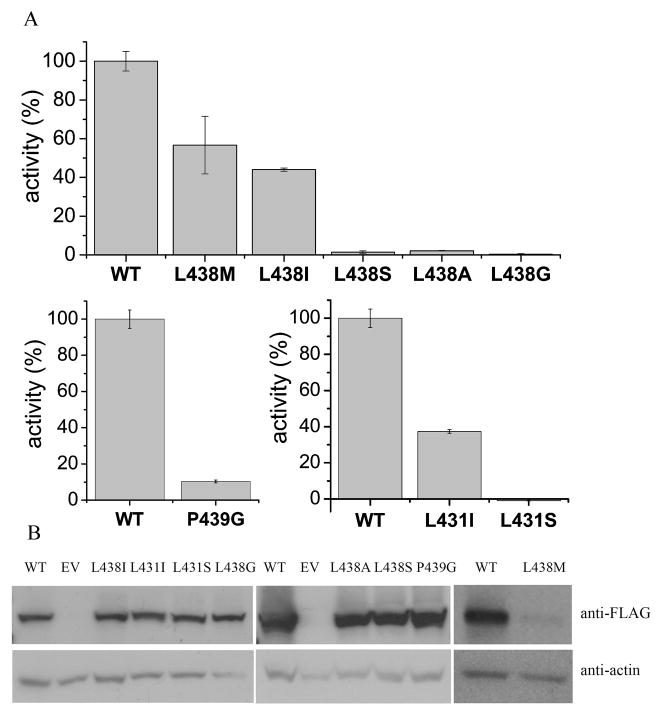
A. Comparison of the enzyme activities for FLAG-DGKε WT and mutants L438M, L438I, L438S, L438A, L438G, L431I, L431S, P439G. Enzyme activity is expressed as a percentage of the activity of FLAG-DGKε WT protein with SAG as a substrate. B. Western blots showing the expression levels of DGKε WT and mutants (anti-FLAG panel), and the expression levels of actin (anti-actin panel) in the transfected cells. Enzyme activity was normalized for the amount of protein in the lysates. The activity measured with mock-transfected cells was normalized for the amount of actin and subtracted from the values obtained using cells overexpressing one of the DGKε constructs. The activity measured with mock-transfected cells was on average 5–10% of the activity measured with DGKε WT.
Figure 2
Figure 2
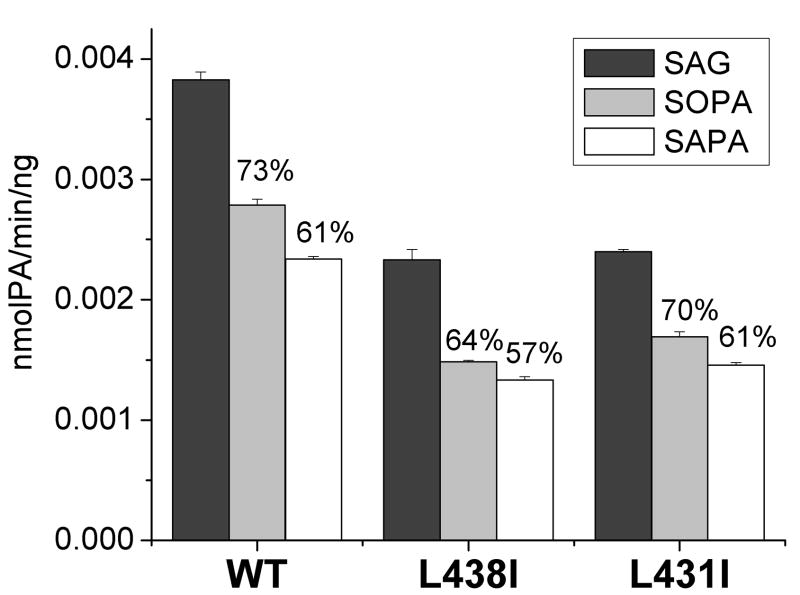
Comparison of inhibition of DGKε by PA. DGK enzymatic activity was measured with 15 mM Triton X-100, 0.1 mM [γ-32P]-ATP, and 2 mol % SAG (shown as dark grey bars) or with the addition of either 2 mol % SAPA (light grey bars) or SOPA (white bars). The numbers above the bars show the enzymatic activity of proteins in presence of PA as a percentage of the enzymatic activity in the absence of PA.
Figure 3
Figure 3
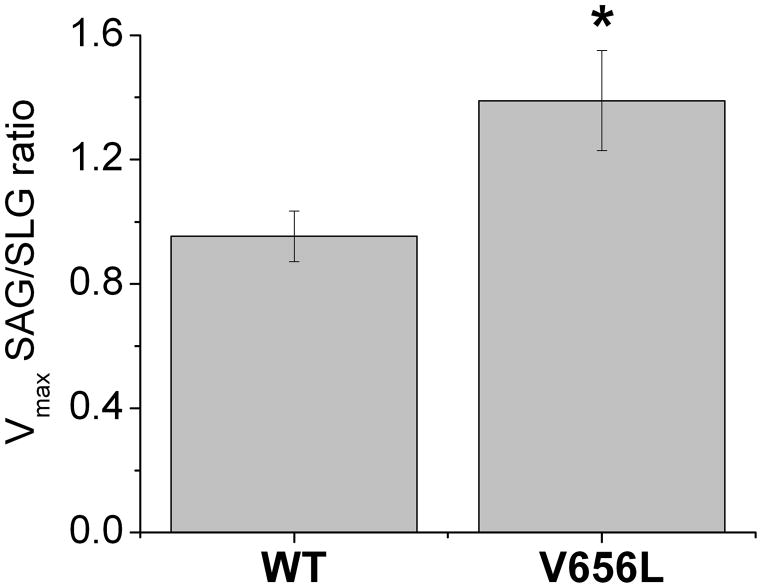
Comparison of SAG to SLG ratios for Vmax parameters for 3×HA-DGKα WT and V656L mutant proteins. V656L mutation of DGKα increases the arachidonoyl preference of the enzyme. *The difference between Vmaxratios of SAG to SLG for DGKα WT and V656L mutant is statistically significant with P < 0.05.
Figure 4
Figure 4
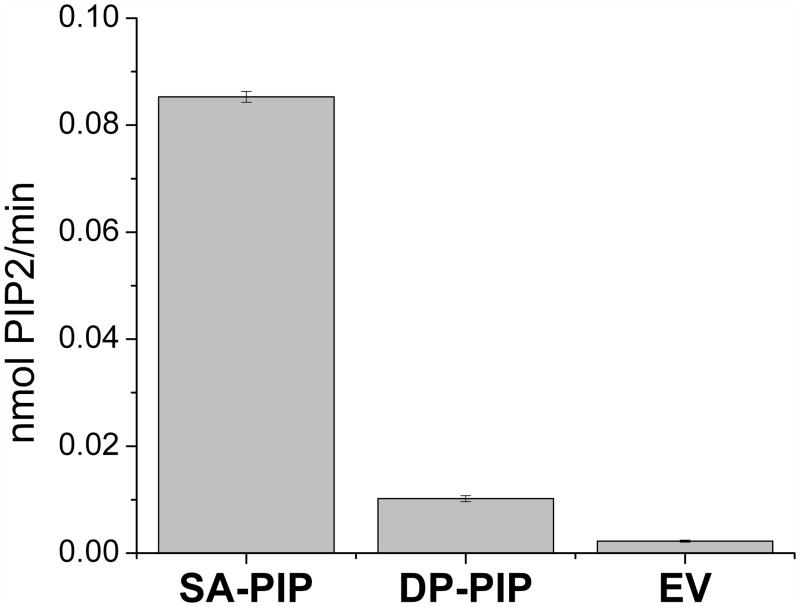
Comparison of the enzyme activities for c-myc-PIP5K Iα with SA-PI(4)P and DP-PI(4)P as a substrate. As source of SA-PI(4)P, brain PI(4)P (Avanti Polar Lipids) was used. Only SA-PI(4)P and DP-PI(4)P were compared, since other PI(4)P are not commercially available. Negativ e control (EV) is performedwith SA -PI(4)P as a substratewith the addition of beads immunoprecipitated from mock -transfected COS-7 cells.
Fig. 5
Fig. 5
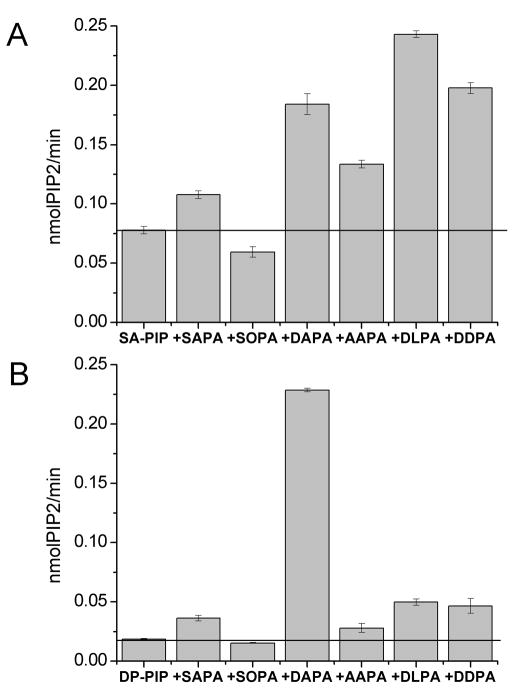
Activation of PIP5K by PA with A) SA-PI(4)P and B) DP-PI(4)P as substrate. As source of SA-PI(4)P, brain PI(4)P (Avanti Polar Lipids) was used. PIP5K enzymatic activity was measured with 20 μM PI(4)P and 50 μM PA.
Figure 6
Figure 6
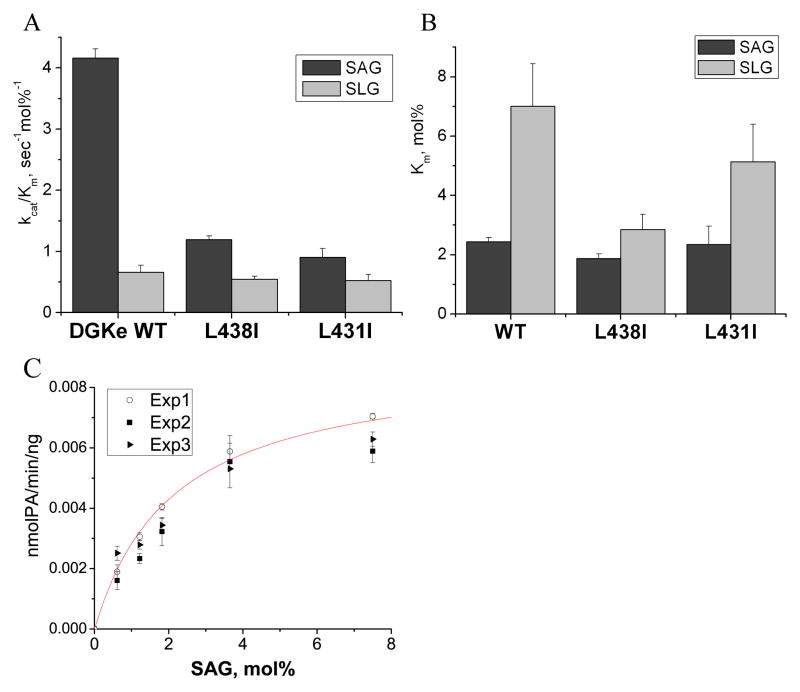
Graphic presentation of the kinetic parameters for FLAG-DGKε WT and its L438I and L431I mutants. Results are presented as the mean ± S.D. A. Results show that kcat/Km is greatly affected (about 4-fold decrease) by L438I and L431I mutations of DGKε for SAG, but not SLG substrate. B. Comparison of Km parameters shows that L438I and L431I mutations of DGKε slightly affect the substrate affinity of the enzyme, decreasing the preference for SAG over SLG. C. An example of kinetic data of 3 independent experiments (Exp1, Exp2 and Exp3) is shown for FLAG-DGKε WT with SAG as a substrate. Every experiment is performed in triplicate. A nonlinear regression curve fitting Exp1 data is shown in red.
Figure 7
Figure 7
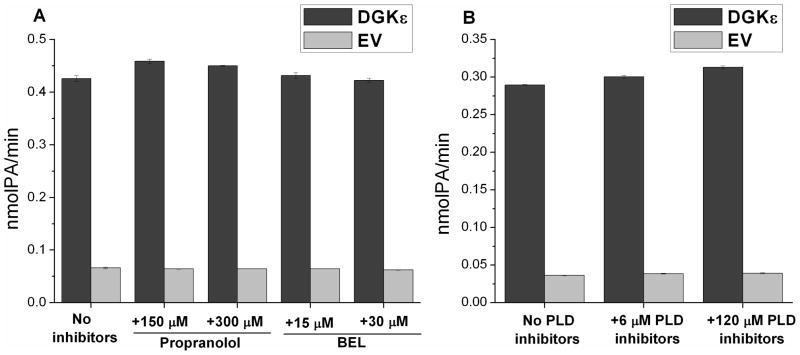
Comparison of the FLAG-DGKε enzyme activities in the absence and presence of PA phosphatase (PAP) inhibitors, protein kinase C (PKC) and phospholipase D (PLD) inhibitors. A. Propranolol (PAP and PKC inhibitor) and bromoenol lactone (BEL, PAP inhibitor) do not affect the measured DGKε activity. B. 6 μM or 120 μM PLD inhibitors (Avanti Polar Lipids, equimolar mix of VU0359595, VU0155056 and VU0285655-1 inhibitors) do not significantly affect the measured DGKε activity. Negative control (EV) is performed with the lysates from COS-7 cells transfected with empty vector (p3XFLAG-CMV-7.1, Sigma-Aldrich).

References

    1. Laye S. Polyunsaturated fatty acids, neuroinflammation and wellbeing. Prostaglandins Leukot Essent Fatty Acids. 2010;82(4–6):295–303. - PubMed
    1. Back M. Leukotriene signaling in atherosclerosis and ischemia. Cardiovasc Drugs Ther. 2009;23:41–48. - PMC - PubMed
    1. Chen X, Wang S, Wu N, Yang CS. Leukotriene A4 hydrolase as a target for cancer prevention and therapy. Curr Cancer Drug Targets. 2004;4:267–283. - PubMed
    1. Rådmark O, Samuelsson B. 5-lipoxygenase: mechanisms of regulation. J Lipid Res. 2009;50:S40–S45. - PMC - PubMed
    1. Funk CD. Prostaglandins and leukotrienes: advances in eicosanoid biology. Science. 2001;294:1871–1875. - PubMed

Publication types

MeSH terms