


Breast cancer, sickness absence, income and marital status. A study on life situation 1 year prior diagnosis compared to 3 and 5 years after diagnosis
- PMID: 21479209
- PMCID: PMC3068139
- DOI: 10.1371/journal.pone.0018040
Breast cancer, sickness absence, income and marital status. A study on life situation 1 year prior diagnosis compared to 3 and 5 years after diagnosis
Abstract
Background: Improved cancer survival poses important questions about future life conditions of the survivor. We examined the possible influence of a breast cancer diagnosis on subsequent working and marital status, sickness absence and income.
Materials: We conducted a matched cohort study including 4,761 women 40-59 years of age and registered with primary breast cancer in a Swedish population-based clinical register during 1993-2003, and 2,3805 women without breast cancer. Information on socioeconomic standing was obtained from a social database 1 year prior and 3 and 5 years following the diagnosis. In Conditional Poisson Regression models, risk ratios (RRs) and 95% confidence intervals (CIs) were estimated to assess the impact of a breast cancer diagnosis.
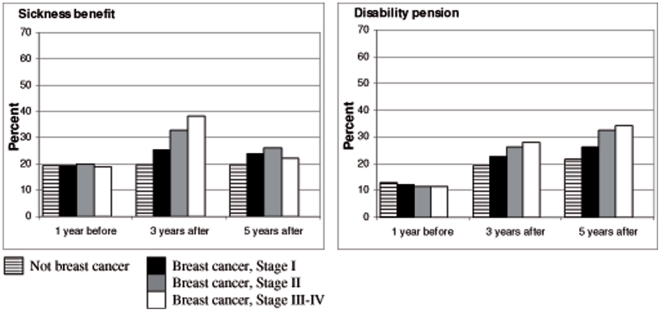
Findings: Three years after diagnosis, women who had had breast cancer more often had received sickness benefits (RR = 1.49, 95% CI 1.40-1.58) or disability pension (RR = 1.47, 95% CI 1.37-1.58) than had women without breast cancer. We found no effect on income (RR = 0.99), welfare payments (RR = 0.98), or marital status (RR = 1.02). A higher use of sickness benefits and disability pension was evident in all stages of the disease, although the difference in use of sickness benefits decreased after 5 years, whereas the difference in disability pension increased. For woman with early stage breast cancer, the sickness absence was higher following diagnosis among those with low education, who had undergone mastectomy, and had received chemo- or hormonal therapy. Neither tumour size nor presence of lymph nodes metastasis was associated with sickness absence after adjustment for treatment.
Interpretation: Even in early stage breast cancer, a diagnosis negatively influences working capacity both 3 and 5 years after diagnosis, and it seems that the type of treatment received had the largest impact. A greater focus needs to be put on rehabilitation of breast cancer patients, work-place adaptations and research on long-term sequelae of treatment.
Conflict of interest statement
Figures
References
-
- Talback M, Stenbeck M, Rosen M, Barlow L, Glimelius B. Cancer survival in Sweden 1960-1998–developments across four decades. Acta Oncol. 2003;42:637–659. - PubMed
-
- Verdecchia A, Guzzinati S, Francisci S, De Angelis R, Bray F, et al. Survival trends in European cancer patients diagnosed from 1988 to 1999. Eur J Cancer. 2009;45:1042–1066. - PubMed
-
- Bergh J, Jonsson PE, Glimelius B, Nygren P. A systematic overview of chemotherapy effects in breast cancer. Acta Oncol. 2001;40:253–281. - PubMed
-
- Effects of chemotherapy and hormonal therapy for early breast cancer on recurrence and 15-year survival: an overview of the randomised trials. Lancet. 2005;365:1687–1717. - PubMed
-
- Clarke M, Collins R, Darby S, Davies C, Elphinstone P, et al. Effects of radiotherapy and of differences in the extent of surgery for early breast cancer on local recurrence and 15-year survival: an overview of the randomised trials. Lancet. 2005;366:2087–2106. - PubMed
Publication types
MeSH terms
LinkOut - more resources
Full Text Sources
Medical
