. 2011 Apr;53(4):1333-41.
doi: 10.1002/hep.24178.

Evidence for distinct pathways of hepcidin regulation by acute and chronic iron loading in mice

Affiliations

Evidence for distinct pathways of hepcidin regulation by acute and chronic iron loading in mice

Emilio Ramos et al. Hepatology. 2011 Apr.

Abstract

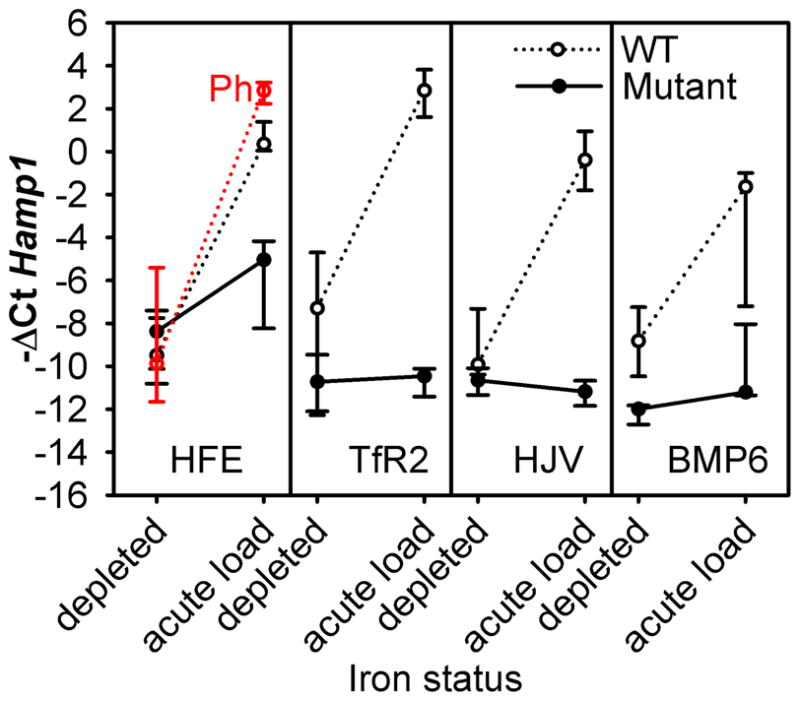
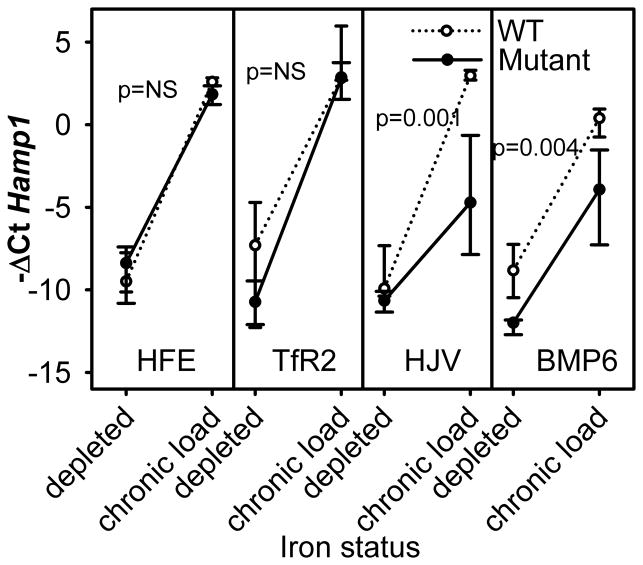
In response to iron loading, hepcidin synthesis is homeostatically increased to limit further absorption of dietary iron and its release from stores. Mutations in HFE, transferrin receptor 2 (Tfr2), hemojuvelin (HJV), or bone morphogenetic protein 6 (BMP6) prevent appropriate hepcidin response to iron, allowing increased absorption of dietary iron, and eventually iron overload. To understand the role each of these proteins plays in hepcidin regulation by iron, we analyzed hepcidin messenger RNA (mRNA) responsiveness to short and long-term iron challenge in iron-depleted Hfe, Tfr2, Hjv, and Bmp6 mutant mice. After 1-day (acute) iron challenge, Hfe(-/-) mice showed a smaller hepcidin increase than their wild-type strain-matched controls, Bmp6(-/-) mice showed nearly no increase, and Tfr2 and Hjv mutant mice showed no increase in hepcidin expression, indicating that all four proteins participate in hepcidin regulation by acute iron changes. After a 21-day (chronic) iron challenge, Hfe and Tfr2 mutant mice increased hepcidin expression to nearly wild-type levels, but a blunted increase of hepcidin was seen in Bmp6(-/-) and Hjv(-/-) mice. BMP6, whose expression is also regulated by iron, may mediate hepcidin regulation by iron stores. None of the mutant strains (except Bmp6(-/-) mice) had impaired BMP6 mRNA response to chronic iron loading.

Conclusion: TfR2, HJV, BMP6, and, to a lesser extent, HFE are required for the hepcidin response to acute iron loading, but are partially redundant for hepcidin regulation during chronic iron loading and are not involved in the regulation of BMP6 expression. Our findings support a model in which acute increases in holotransferrin concentrations transmitted through HFE, TfR2, and HJV augment BMP receptor sensitivity to BMPs. A distinct regulatory mechanism that senses hepatic iron may modulate hepcidin response to chronic iron loading.


Figures

Figure 1
Figure 1. Serum iron and nonheme liver iron increase after acute dietary iron challenge
To deplete iron stores (“iron-depleted” condition), mutant mice (Hfe, Tfr2, Hjv and Bmp6) were placed on a low-iron diet and weekly phlebotomies, and strain-matched WT mice (C57BL/6, 129S6, FVB and CD1) were placed on low iron diet for two weeks. An additional control group of C57BL/6 mice (“Ph”) were subjected to low iron diet and phlebotomy. Acute iron challenge consisted of placing the mice on standard chow for 1 day. The values in the graphs represent median and interquartile range. For comparison to chronic liver iron loading (Figure 4, bottom panel), note that the scale for acute iron loading is 5-fold smaller..
Figure 2
Figure 2. Hepcidin response to acute dietary iron challenge is impaired in hemochromatotic mice
Animals were iron-depleted as described in Figure 1. Hamp1 mRNA levels were measured either after iron depletion alone or after an additional 1-day dietary iron challenge (standard diet, 336 ppm iron). The values in the graphs represent median and interquartile range.
Figure 3
Figure 3. Hepcidin response to chronic dietary iron challenge
Medians and interquartile range are shown. Hepcidin mRNA expression was measured by qRT-PCR in iron-depleted and iron-loaded mutant mice and their respective WT strains.
Figure 4
Figure 4. Serum and liver iron after acute vs chronic dietary iron loading
Serum iron concentrations after chronic iron challenge were similar or lower than those reached after acute iron challenge, in both WT and mutant mice. Liver non-heme iron content in mutants increased after chronic iron loading when compared to acute challenge (p values for the difference of medians shown above the line connecting the acute and chronic loading values). The order of hepatic iron loading was Hjv = Bmp6 > Tfr2 > Hfe. The p values for the comparison of mutant and WT iron loading are shown near or between the corresponding points on the graph.
Figure 5
Figure 5. HFE, Tfr2, HJV and BMP6 mutations differentially alter the sensitivity of hepcidin response to iron
In the absence of HFE or TfR2, modestly higher liver concentrations were needed to reach the increase in hepcidin mRNA comparable to the WT strain. BMP6 and HJV loss dramatically decreased hepcidin responses to iron loading, and hepcidin mRNA remained low even at 10-fold higher liver iron concentrations. The values in the graphs represent median and interquartile range.
Figure 6
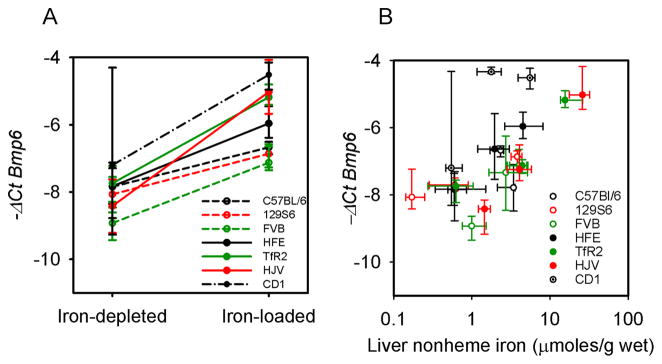
Figure 6. BMP6 expression reflects iron load in wt and mutant strains
A. BMP6 mRNA levels were measured by qRT-PCR in mutants and in their respective WT strains before and after chronic iron loading. Expression increased significantly in all the groups tested (p values: C57BL/6=0.018, 129S6=0.026, FVB<0.001, Hfe p=0.037, Tfr2 =0.001, and Hjv =0.003). Medians and interquartile range are shown. BMP6 was also measured in mice before and after 1 day iron feeding, but the increase did not reach statistical significance. B. BMP6 mRNA expression is proportional to the liver iron load (non-heme iron) in WT and mutant mice.

References

    1. Nemeth E, Tuttle MS, Powelson J, Vaughn MB, Donovan A, Ward DM, et al. Hepcidin regulates cellular iron efflux by binding to ferroportin and inducing its internalization. Science. 2004;306:2090–2093. - PubMed
    1. Lin L, Valore EV, Nemeth E, Goodnough JB, Gabayan V, Ganz T. Iron transferrin regulates hepcidin synthesis in primary hepatocyte culture through hemojuvelin and BMP2/4. Blood. 2007;110:2182–2189. - PMC - PubMed
    1. Ganz T, Olbina G, Girelli D, Nemeth E, Westerman M. Immunoassay for human serum hepcidin. Blood. 2008;112:4292–4297. - PubMed
    1. Nemeth E, Rivera S, Gabayan V, Keller C, Taudorf S, Pedersen BK, et al. IL-6 mediates hypoferremia of inflammation by inducing the synthesis of the iron regulatory hormone hepcidin. J Clin Invest. 2004;113:1271–1276. - PMC - PubMed
    1. Flanagan JM, Truksa J, Peng H, Lee P, Beutler E. In vivo imaging of hepcidin promoter stimulation by iron and inflammation. Blood Cells Mol Dis. 2007;38:253–257. - PMC - PubMed

Publication types