


Evaluation of a hospital-based tobacco treatment service: outcomes and lessons learned
- PMID: 21480493
- PMCID: PMC3081657
- DOI: 10.1002/jhm.835
Evaluation of a hospital-based tobacco treatment service: outcomes and lessons learned
Abstract
Background: The efficacy of smoking cessation interventions for hospital patients has been well described, but we know little regarding implementation and outcomes of real-world programs.
Objective: To describe the services provided and outcomes of an academic medical center-based tobacco treatment service (UKanQuit) located in the Midwestern United States.
Method: This is a descriptive observational study. Both quantitative and qualitative data of all patients treated by UKanQuit over a 1-year period were analyzed.
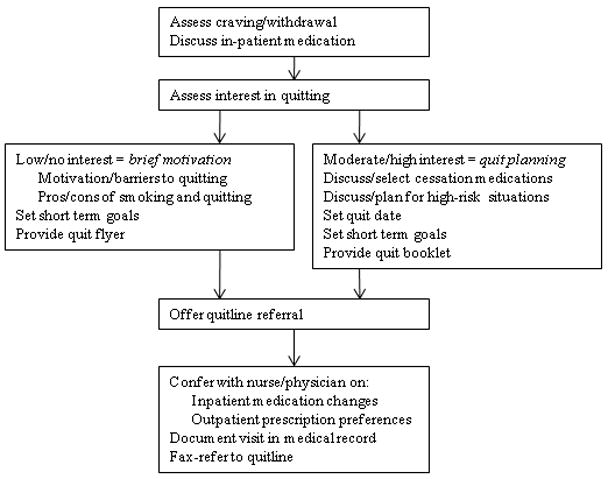
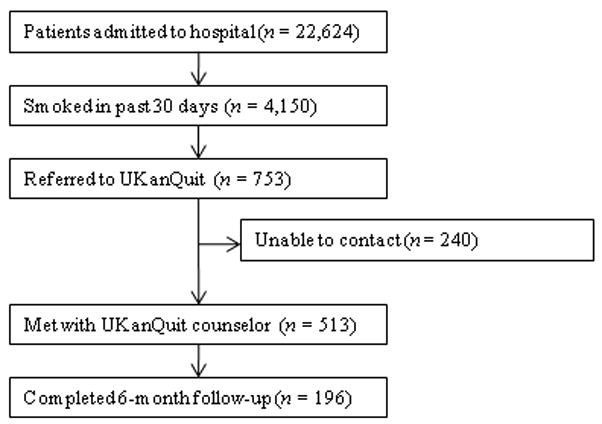
Results: Among 513 patients served, average interest in quitting was 7.9, standard deviation (SD) 2.9 on a scale of 0 to 10. More than 1 in 4 had been given an in-hospital medication to ameliorate withdrawal prior to seeing a counselor. Counselors recommended medication changes for 1 in 3 patients, helped 73% set a goal for quitting or reducing tobacco use, and fax referred 56% to quitlines. Six-month follow-up (response rate, 46%) found a 7-day abstinence rate of 32% among respondents for an intent-to-treat abstinence rate of 15%. Post-discharge, 74% made at least one serious quit attempt, 34% had used a quit smoking medication, but only 5% of those referred to the quitline reported using it.
Conclusions: In a hospital setting, interest in quitting is high among smokers who requested to see a tobacco counselor but administration of inpatient medications remains low. Many smokers are making unassisted quit attempts post-discharge because utilization of cessation medications and quitline counseling were low. Fax-referral to quitline may not, on its own, fulfill guideline recommendations for post-discharge follow-up.
Copyright © 2010 Society of Hospital Medicine.
Figures
References
-
- Emmons KM, Goldstein MG. Smokers who are hospitalized: A window of opportunity for cessation interventions. Preventive Medicine. 1992;21:262–269. - PubMed
-
- McBride CM, Emmons KM, Lipkus IM. Understanding the potential of teachable moments: the case of smoking cessation. Health Educ Res. 2003 Apr;18(2):156–170. - PubMed
-
- McBride CM, Ostroff JS. Teachable moments for promoting smoking cessation: the context of cancer care and survivorship. Cancer Control. 2003 Jul–Aug;10(4):325–333. - PubMed
-
- Orleans CT, Kristeller JL, Gritz ER. Helping hospitalized smokers quit: New directions for treatment and research. J of Consulting & Clinical Psychology. 1993;61(5):778–789. - PubMed
Publication types
MeSH terms
Grants and funding
LinkOut - more resources
Full Text Sources
Medical
