


The relationship between components of metabolic syndrome and open-angle glaucoma
- PMID: 21481477
- PMCID: PMC3129406
- DOI: 10.1016/j.ophtha.2010.11.022
The relationship between components of metabolic syndrome and open-angle glaucoma
Abstract
Purpose: To determine whether an association exists between various components of metabolic syndrome (diabetes mellitus [DM], systemic arterial hypertension [HTN], hyperlipidemia, and obesity) and open-angle glaucoma (OAG) in a large, diverse group of individuals throughout the United States.
Design: Longitudinal cohort study.
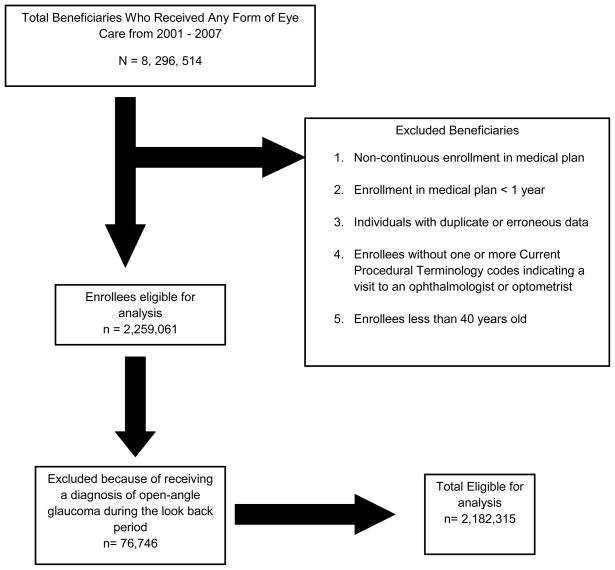
Participants: All beneficiaries aged ≥40 years continuously enrolled in a managed care network who had 1 or more visits to an eye care provider during 2001 to 2007 were identified.
Methods: Billing codes were used to identify individuals with OAG and those with components of metabolic syndrome. Cox regression was used to determine the hazard of developing OAG in enrollees with individual components or combinations of components of metabolic syndrome, with adjustment for sociodemographic factors, systemic medical conditions, and other ocular diseases.
Main outcome measures: Hazard of developing OAG.
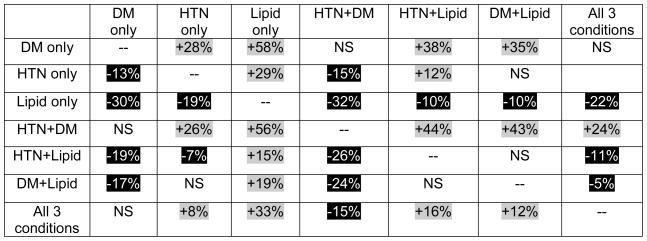
Results: Of the 2 182 315 enrollees who met the inclusion criteria, 55090 (2.5%) had OAG. After adjustment for confounding factors, those with DM (hazard ratio [HR] = 1.35 [95% confidence interval [CI], 1.21-1.50]) or HTN (HR = 1.17 [95% CI, 1.13-1.22]) alone or in combination (HR = 1.48 [95% CI, 1.39-1.58]) had an increased hazard of developing OAG relative to persons with neither of these conditions. By contrast, persons with hyperlipidemia alone had a 5% decreased hazard of OAG (HR = 0.95 [95% CI, 0.91-0.98]). Comorbid hyperlipidemia attenuated the increased hazard between HTN (HR = 1.09 [95% CI, 1.05-1.12]) or DM (HR = 1.13 [95% CI, 1.05-1.21]) and OAG.
Conclusions: At a time when the prevalence of metabolic disorders in the United States, is increasing this study furthers our understanding of risk factors associated with OAG and helps identify persons who may be at increased risk for this condition.
Copyright © 2011 American Academy of Ophthalmology. Published by Elsevier Inc. All rights reserved.
Conflict of interest statement
The authors have no proprietary interest in any material discussed in this manuscript
Figures
References
-
- Dielemans I, Vingerling JR, Algra D, et al. Primary open-angle glaucoma, intraocular pressure, and systemic blood pressure in the general elderly population: the Rotterdam Study. Ophthalmology. 1995;102:54–60. - PubMed
-
- Tielsch JM, Katz J, Sommer A, et al. Hypertension, perfusion pressure, and primary open-angle glaucoma: a population-based assessment. Arch Ophthalmol. 1995;113:216–21. - PubMed
-
- Bonomi L, Marchini G, Marraffa M, et al. Vascular risk factors for primary open angle glaucoma: the Egna-Neumarkt Study. Ophthalmology. 2000;107:1287–93. - PubMed
Publication types
MeSH terms
Grants and funding
LinkOut - more resources
Full Text Sources
Medical
Miscellaneous
