


Low-serum carotenoid concentrations and carotenoid interactions predict mortality in US adults: the Third National Health and Nutrition Examination Survey
- PMID: 21481711
- PMCID: PMC3081783
- DOI: 10.1016/j.nutres.2011.03.003
Low-serum carotenoid concentrations and carotenoid interactions predict mortality in US adults: the Third National Health and Nutrition Examination Survey
Abstract
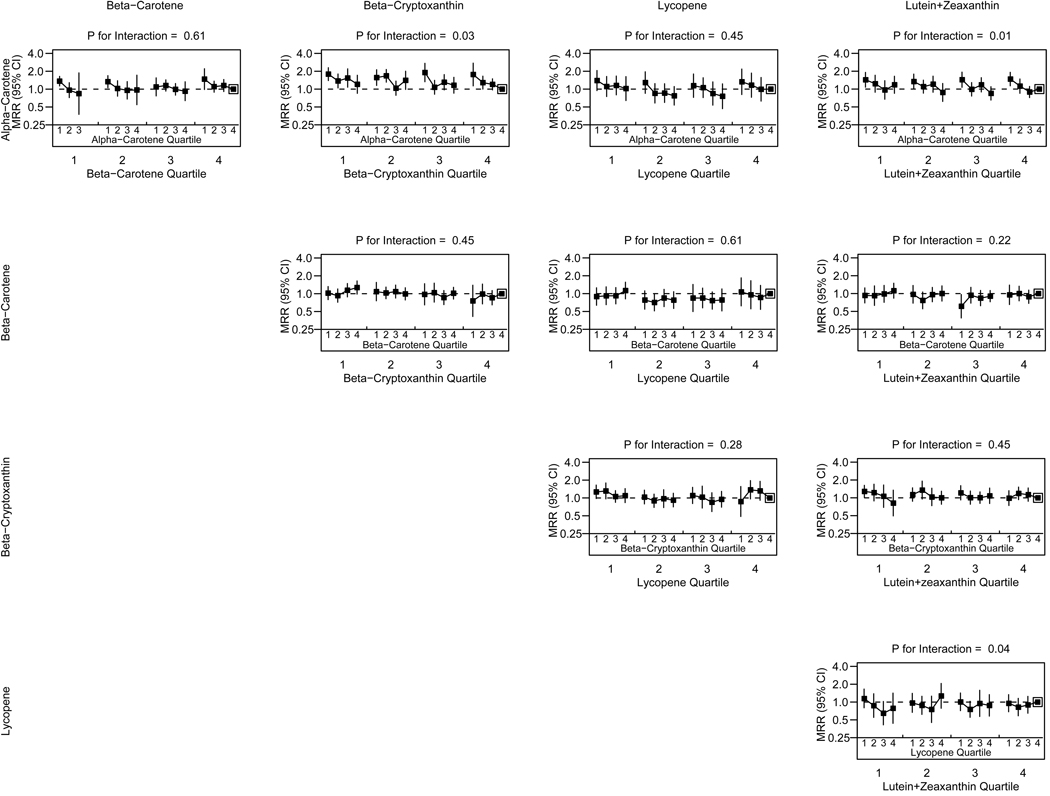
Evidence regarding the health benefits of carotenoids is controversial. Effects of serum carotenoids and their interactions on mortality have not been examined in a representative sample of US adults. The objective was to examine whether serum carotenoid concentrations predict mortality among US adults. The study consisted of adults aged ≥20 years enrolled in the Third National Health and Nutrition Examination Survey, 1988 to 1994, with measured serum carotenoids and mortality follow-up through 2006 (N = 13,293). Outcomes were all-cause, cardiovascular disease, and cancer mortality. In adjusted Cox proportional hazards models, participants in the lowest total carotenoid quartile (<1.01 μmol/L) had significantly higher all-cause mortality (mortality rate ratio, 1.38; 95% confidence interval, 1.15-1.65; P = .005) than those in the highest total carotenoid quartile (>1.75 μmol/L). For α-carotene, the highest quartile (>0.11 μmol/L) had the lowest all-cause mortality rates (P < .001). For lycopene, the middle 2 quartiles (0.29-0.58 μmol/L) had the lowest all-cause mortality rates (P = .047). Analyses with continuous carotenoids confirmed associations of serum total carotenoids, α-carotene, and lycopene with all-cause mortality (P < .001). In a random survival forest analysis, very low lycopene was the carotenoid most strongly predictive of all-cause mortality, followed by very low total carotenoids. α-Carotene/β-cryptoxanthin, α-carotene/lutein+zeaxanthin and lycopene/lutein+zeaxanthin interactions were significantly related to all-cause mortality (P < .05). Low α-carotene was the only carotenoid associated with cardiovascular disease mortality (P = .002). No carotenoids were significantly associated with cancer mortality. Very low serum total carotenoid, α-carotene, and lycopene concentrations may be risk factors for mortality, but carotenoids show interaction effects on mortality. Interventions of balanced carotenoid combinations are needed for confirmation.
Copyright © 2011 Elsevier Inc. All rights reserved.
Conflict of interest statement
The authors have no conflicts of interest to report.
Figures

References
-
- Bazzano LA, He J, Ogden LG, et al. Fruit and vegetable intake and risk of cardiovascular disease in US adults: the first National Health and Nutrition Examination Survey Epidemiologic Follow-up Study. Am J Clin Nutr. 2002;76:93–99. - PubMed
-
- Agudo A, Cabrera L, Amiano P, et al. Fruit and vegetable intakes, dietary antioxidant nutrients, and total mortality in Spanish adults: findings from the Spanish cohort of the European Prospective Investigation into Cancer and Nutrition (EPIC-Spain) Am J Clin Nutr. 2007;85:1634–1642. - PubMed
-
- Krinsky NI, Johnson EJ. Carotenoid actions and their relation to health and disease. Mol Aspects Med. 2005;26:459–516. - PubMed
-
- Knoops KT, de Groot LC, Kromhout D, et al. Mediterranean diet, lifestyle factors, and 10-year mortality in elderly European men and women: the HALE project. JAMA. 2004;292:1433–1439. - PubMed
-
- Mitrou PN, Kipnis V, Thiebaut AC, et al. Mediterranean dietary pattern and prediction of all-cause mortality in a US population: results from the NIH-AARP Diet and Health Study. Arch Intern Med. 2007;167:2461–2468. - PubMed
Publication types
MeSH terms
Substances
Grants and funding
LinkOut - more resources
Full Text Sources
