. 2011 Jun 3;44(9):1654-9.
doi: 10.1016/j.jbiomech.2011.03.026. Epub 2011 Apr 8.

Dynamic loading of immature epiphyseal cartilage pumps nutrients out of vascular canals

Affiliations

Dynamic loading of immature epiphyseal cartilage pumps nutrients out of vascular canals

Michael B Albro et al. J Biomech. .

Abstract

The potential influence of mechanical loading on transvascular transport in vascularized soft tissues has not been explored extensively. This experimental investigation introduced and explored the hypothesis that dynamic mechanical loading can pump solutes out of blood vessels and into the surrounding tissue, leading to faster uptake and higher solute concentrations than could otherwise be achieved under unloaded conditions. Immature epiphyseal cartilage was used as a model tissue system, with fluorescein (332 Da), dextran (3, 10, and 70 kDa) and transferrin (80 kDa) as model solutes. Cartilage disks were either dynamically loaded (± 10% compression over a 10% static offset strain, at 0.2 Hz) or maintained unloaded in solution for up to 20 h. Results demonstrated statistically significant solute uptake in dynamically loaded (DL) explants relative to passive diffusion (PD) controls for all solutes except unbound fluorescein, as evidenced by the DL:PD concentration ratios after 20 h (1.0 ± 0.2, 2.4 ± 1.1, 6.1 ± 3.3, 9.0 ± 4.0, and 5.5 ± 1.6 for fluorescein, 3, 10, and 70 kDa dextran, and transferrin). Significant uptake enhancements were also observed within the first 30s of loading. Termination of dynamic loading produced dissipation of enhanced solute uptake back to PD control values. Confocal images confirmed that solute uptake occurred from cartilage canals into their surrounding extracellular matrix. The incidence of this loading-induced transvascular solute pumping mechanism may significantly alter our understanding of the interaction of mechanical loading and tissue metabolism.


Conflict of interest statement

Conflict of interest statement

We do not have any conflicts of interest with regard to this study and the materials contained herein.

Figures
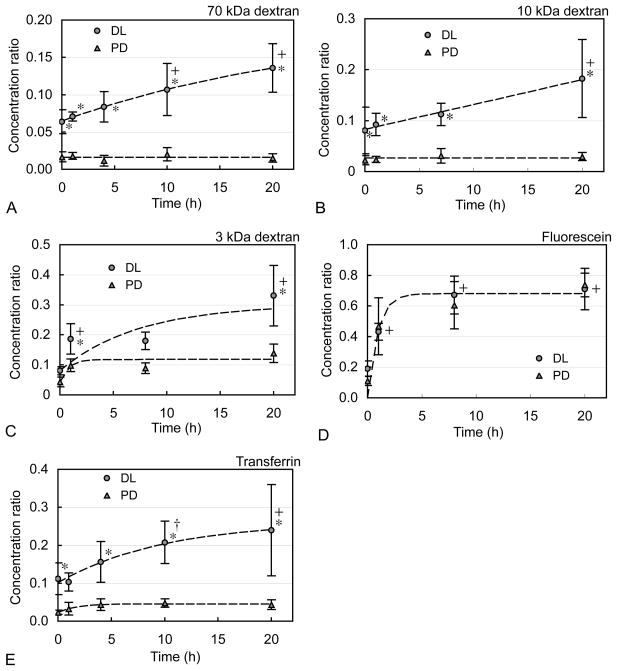
Figure 1
Figure 1
Ratio cö of internal to external solute concentration over time in cartilage disks for (A) 70 kDa dextran, (B) 10 kDa dextran, (C) 3 kDa dextran, (D) fluorescein (332 Da), and (E) transferrin (80 kDa) under dynamic loading (DL) and unloaded passive diffusion (PD) conditions (mean ± standard deviation). Results demonstrate that DL progressively pumps solutes into cartilage at concentrations that significantly exceed those achieved under PD; this pumping mechanism is most effective for larger molecular weight solutes, but insignificant for unconjugated fluorescein. *p<0.02: significant increase above respective PD time point. +p<0.001, †p<0.05: significant increase above initial DL time point.
Figure 2
Figure 2
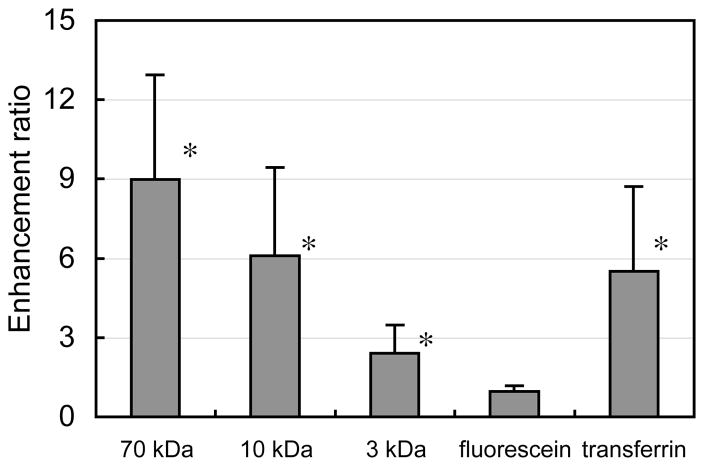
Enhancement ratios (ĉDL / ĉPD) of 70 kDa dextran, 10 kDa dextran, 3 kDa dextran, fluorescein, and transferrin in cartilage disks after 20 hours of dynamic loading (mean ± standard deviation). These ratios demonstrate that the pumping mechanism is more effective with larger solutes, for a given molecular species. *p<0.01: significant increase above unity.
Figure 3
Figure 3
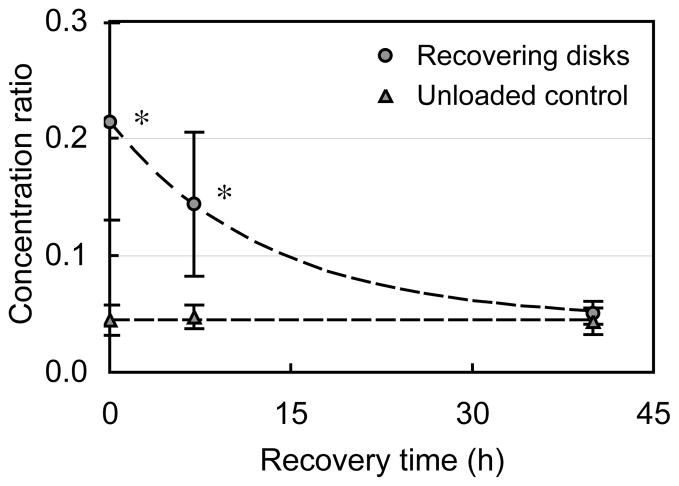
Recovery response of cartilage disks in transferrin following 20 hours of dynamic loading (DL) and corresponding response in never-loaded control samples (mean ± standard deviation). These results demonstrate that DL is the primary cause for increased solute uptake, since termination of loading returns solute concentration back to PD levels. *p<0.02: significant increase above respective PD time point.
Figure 4
Figure 4
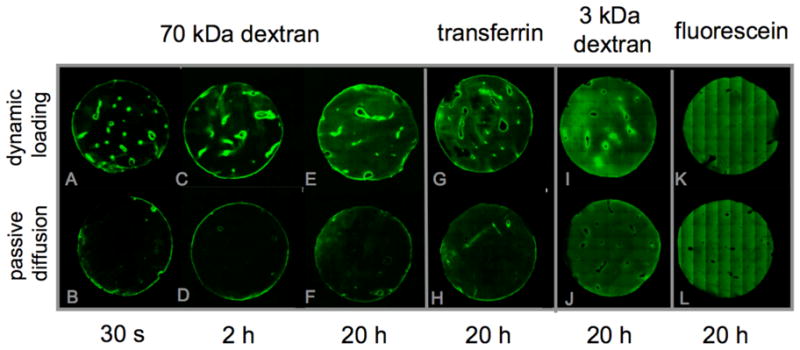
Confocal images of various solutes in cartilage sections after testing under dynamic loading or passive diffusion conditions. These images demonstrate that solute pumping under DL occurs at cartilage canals as well as the outer boundaries of the explant, as evidenced from the narrow boundary layers of high solute concentrations at 30 s and 2 h (70 kDa dextran). Over time, solute concentration spreads out from the canals into the surrounding ECM (20 h). In contrast, PD results in much lower solute concentrations for dextrans and transferrin. Only fluorescein shows no visible difference between DL and PD.

References

    1. Albro MB, Chahine NO, Li R, Yeager K, Hung CT, Ateshian GA. Dynamic loading of deformable porous media can induce active solute transport. J Biomech. 2008;41:3152–3157. - PMC - PubMed
    1. Albro MB, Li R, Banerjee RE, Hung CT, Ateshian GA. Validation of theoretical framework explaining active solute uptake in dynamically loaded porous media. J Biomech. 2010;43:2267–2273. - PMC - PubMed
    1. Blumer MJ, Longato S, Fritsch H. Structure, formation and role of cartilage canals in the developing bone. Ann Anat. 2008;190:305–315. - PubMed
    1. Blumer MJ, Longato S, Richter E, Perez MT, Konakci KZ, Fritsch H. The role of cartilage canals in endochondral and perichondral bone formation: are there similarities between these two processes? J Anat. 2005;206:359–372. - PMC - PubMed
    1. Bonassar LJ, Grodzinsky AJ, Frank EH, Davila SG, Bhaktav NR, Trippel SB. The effect of dynamic compression on the response of articular cartilage to insulin-like growth factor-I. J Orthop Res. 2001;19:11–17. - PubMed

Publication types