


Phytosterol ester processing in the small intestine: impact on cholesterol availability for absorption and chylomicron cholesterol incorporation in healthy humans
- PMID: 21482714
- PMCID: PMC3090246
- DOI: 10.1194/jlr.M013730
Phytosterol ester processing in the small intestine: impact on cholesterol availability for absorption and chylomicron cholesterol incorporation in healthy humans
Abstract
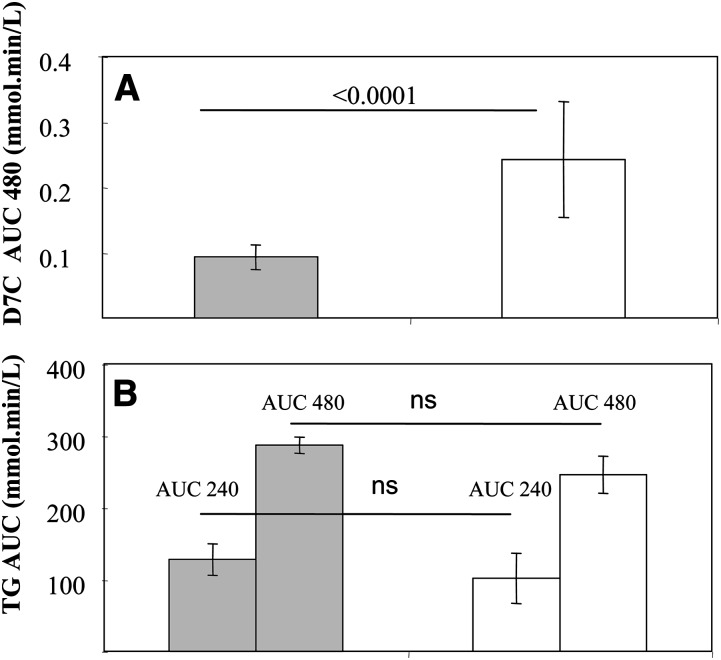
Phytosterols (plant sterols and stanols) can lower intestinal cholesterol absorption, but the complex dynamics of the lipid digestion process in the presence of phytosterol esters (PEs) are not fully understood. We performed a clinical experiment in intubated healthy subjects to study the time course of changes in the distribution of all lipid moieties present in duodenal phases during 4 h of digestion of meals with 3.2 g PE (PE meal) or without (control meal) PE. In vitro experiments under simulated gastrointestinal conditions were also performed. The addition of PE did not alter triglyceride (TG) hydrolysis in the duodenum or subsequent chylomicron TG occurrence in the circulation. In contrast, cholesterol accumulation in the duodenum aqueous phase was markedly reduced in the presence of PE (-32%, P < 0.10). In vitro experiments confirmed that PE reduces cholesterol transfer into the aqueous phase. The addition of PE resulted in a markedly reduced presence of meal-derived hepta-deuterated cholesterol in the circulation, i.e., in chylomicrons (-43%, PE meal vs. control; P < 0.0001) and plasma (-54%, PE meal vs. control; P < 0.0001). The present data show that addition of PE to a meal does not alter TG hydrolysis but displaces cholesterol from the intestinal aqueous phase and lowers chylomicron cholesterol occurrence in humans.
Figures



References
-
- Demonty I., Ras R. T., van der Knaap H. C., Duchateau G. S., Meijer L., Zock P. L., Geleijnse J. M., Trautwein E. A. 2009. Continuous dose-response relationship of the LDL-cholesterol-lowering effect of phytosterol intake. J. Nutr. 139: 271–284. - PubMed
-
- Normen L., Dutta P., Lia A., Andersson H. 2000. Soy sterol esters and beta-sitostanol ester as inhibitors of cholesterol absorption in human small bowel. Am. J. Clin. Nutr. 71: 908–913. - PubMed
-
- Nissinen M., Gylling H., Vuoristo M., Miettinen T. A. 2002. Micellar distribution of cholesterol and phytosterols after duodenal plant stanol ester infusion. Am. J. Physiol. Gastrointest. Liver Physiol. 282: G1009–G1015. - PubMed
-
- Richelle M., Enslen M., Hager C., Groux M., Tavazzi I., Godin J. P., Berger A., Metairon S., Quaile S., Piguet-Welsch C., et al. 2004. Both free and esterified plant sterols reduce cholesterol absorption and the bioavailability of beta-carotene and alpha-tocopherol in normocholesterolemic humans. Am. J. Clin. Nutr. 80: 171–177. - PubMed
-
- Armand M., Borel P., Pasquier B., Dubois C., Senft M., Andre M., Peyrot J., Salducci J., Lairon D. 1996. Physicochemical characteristics of emulsions during fat digestion in human stomach and duodenum. Am. J. Physiol. 271: G172–G183. - PubMed
MeSH terms
Substances
LinkOut - more resources
Full Text Sources
Medical
Miscellaneous
