


Rescue of expression and signaling of human luteinizing hormone G protein-coupled receptor mutants with an allosterically binding small-molecule agonist
- PMID: 21482767
- PMCID: PMC3084114
- DOI: 10.1073/pnas.1015723108
Rescue of expression and signaling of human luteinizing hormone G protein-coupled receptor mutants with an allosterically binding small-molecule agonist
Abstract
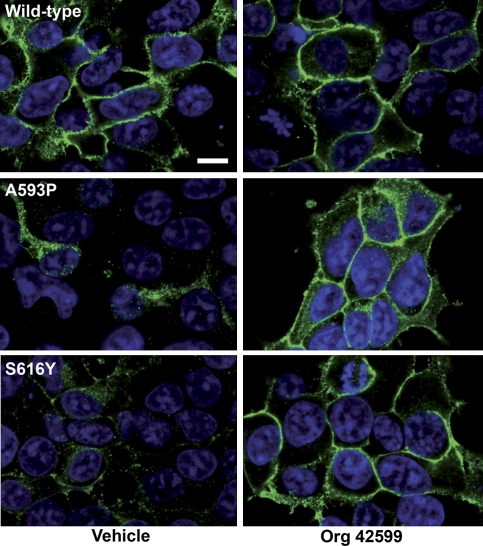
Naturally occurring mutations of G protein-coupled receptors (GPCRs) causing misfolding and failure to traffic to the cell surface can result in disease states. Some small-molecule orthosteric ligands can rescue such misfolded receptors, presumably by facilitating their correct folding and shuttling to the plasma membrane. Here we show that a cell-permeant, allosterically binding small-molecule agonist (Org 42599) rescues the folding and cell surface expression, and therefore target cell signaling, of mutant human luteinizing hormone (LH) receptors (A593P and S616Y) that cause Leydig cell hypoplasia in man. Both mutant receptors were retained in the cytoplasm whereas WT receptor localized at the cell membrane, and binding of LH to cells expressing the mutant receptors was markedly lower than to those expressing the WT receptor. Incubation with Org 42599 increased mutant receptor expression, cell surface localization, and the proportion of mutant receptor in the mature glycosylated form. Importantly, although LH stimulated little (S616Y) or no (A593P) activation of cells expressing mutant receptors, incubation of cells with Org 42599 facilitated rescue of expression and stimulation by the native ligand, LH. Although Org 42599 could activate these receptors, it could not displace (125)I-labeled human LH binding to the WT receptor, indicating that it acts in an allosteric manner. Here we demonstrate a small-molecule GPCR allosteric agonist that functionally rescues intracellularly retained mutant LH receptors by facilitating their cell surface expression. This approach may have application for treatment of infertile patients bearing such mutations and, more broadly, for other misfolded GPCR mutants resulting in human pathologic processes.
Conflict of interest statement
Conflict of interest statement: C.J.v.K. and R.v.d.L. are paid employees of Merck Sharp and Dohme.
Figures


References
-
- Kremer H, et al. Male pseudohermaphroditism due to a homozygous missense mutation of the luteinizing hormone receptor gene. Nat Genet. 1995;9:160–164. - PubMed
-
- Misrahi M, et al. Comparison of immunocytochemical and molecular features with the phenotype in a case of incomplete male pseudohermaphroditism associated with a mutation of the luteinizing hormone receptor. J Clin Endocrinol Metab. 1997;82:2159–2165. - PubMed
-
- Leung MY, et al. Biological effect of a novel mutation in the third leucine-rich repeat of human luteinizing hormone receptor. Mol Endocrinol. 2006;20:2493–2503. - PubMed
-
- Huhtaniemi I, Alevizaki M. Gonadotrophin resistance. Best Pract Res Clin Endocrinol Metab. 2006;20:561–576. - PubMed
Publication types
MeSH terms
Substances
Grants and funding
LinkOut - more resources
Full Text Sources
