. 2011 Jul;16(7):738-50.
doi: 10.1038/mp.2011.26. Epub 2011 Apr 12.

Antidepressants increase human hippocampal neurogenesis by activating the glucocorticoid receptor

Affiliations
Free PMC article

Antidepressants increase human hippocampal neurogenesis by activating the glucocorticoid receptor

C Anacker et al. Mol Psychiatry. 2011 Jul.
Free PMC article

Abstract

Antidepressants increase adult hippocampal neurogenesis in animal models, but the underlying molecular mechanisms are unknown. In this study, we used human hippocampal progenitor cells to investigate the molecular pathways involved in the antidepressant-induced modulation of neurogenesis. Because our previous studies have shown that antidepressants regulate glucocorticoid receptor (GR) function, we specifically tested whether the GR may be involved in the effects of these drugs on neurogenesis. We found that treatment (for 3-10 days) with the antidepressant, sertraline, increased neuronal differentiation via a GR-dependent mechanism. Specifically, sertraline increased both immature, doublecortin (Dcx)-positive neuroblasts (+16%) and mature, microtubulin-associated protein-2 (MAP2)-positive neurons (+26%). This effect was abolished by the GR-antagonist, RU486. Interestingly, progenitor cell proliferation, as investigated by 5'-bromodeoxyuridine (BrdU) incorporation, was only increased when cells were co-treated with sertraline and the GR-agonist, dexamethasone, (+14%) an effect which was also abolished by RU486. Furthermore, the phosphodiesterase type 4 (PDE4)-inhibitor, rolipram, enhanced the effects of sertraline, whereas the protein kinase A (PKA)-inhibitor, H89, suppressed the effects of sertraline. Indeed, sertraline increased GR transactivation, modified GR phosphorylation and increased expression of the GR-regulated cyclin-dependent kinase-2 (CDK2) inhibitors, p27(Kip1) and p57(Kip2). In conclusion, our data suggest that the antidepressant, sertraline, increases human hippocampal neurogenesis via a GR-dependent mechanism that requires PKA signaling, GR phosphorylation and activation of a specific set of genes. Our data point toward an important role for the GR in the antidepressant-induced modulation of neurogenesis in humans.


Figures

Figure 1
Figure 1
Antidepressants induce differentiation and neuronal maturation of HPC03A/07 human hippocampal progenitor cells. Immunocytochemistry (ICC) for doublecortin (Dcx) and microtubulin-associated protein-2 (MAP2) was used to assess neuronal differentiation and maturation, respectively. 5′-bromodeoxyuridine (BrdU) incorporation and immunocytochemistry were used to assess progenitor cell proliferation (a). When HPC03A/07 cells were treated during the proliferation phase (72 h) and the subsequent differentiation phase (7 days), drug treatment had a significant effect on MAP2-positive neurons (one-way analysis of variance, P<0.0001, F1,4=62.22, R2=0.9120, n=5) and on Dcx-positive neuroblasts (one-way analysis of variance, P=0.0007, F1,4=13.28, R2=0.6713, n=5). Sertraline (SERT, 1 μ) increased the number of MAP2-positive neurons but did not alter the number of Dcx-positive neuroblasts, whereas dexamethasone (DEX, 1 μ) decreased both. No effect was observed upon co-treatment with SERT and DEX (b). When HPC03A/07 cells were treated only during the proliferation phase, drug treatment had a significant effect on MAP2-positive neurons (one-way analysis of variance, P=0.0022, F1,4=9.764, R2=0.5824, n=5) and on Dcx-positive neuroblasts (one-way analysis of variance, P<0.0001, F1,4=44.44, R2=0.8724, n=5). SERT increased the number of Dcx-positive neuroblasts, without an effect on MAP2-positive neurons (c). Treatment only during the differentiation phase did not have an effect on MAP2-positive neurons (one-way analysis of variance, P=0.5699, F1,4=0.6184, R2=0.1709, n=5) or on Dcx-positive neuroblasts (one-way analysis of variance, P=0.2146, F1,4=2.127, R2=0.4596, n=5) (d). Five independent experiments were conducted on five independent cultures (n=5), four wells were analyzed per treatment condition in each experiment and three random, non-overlapping pictures were analyzed for each well. All data are mean±s.e.m. *P<0.05, **P<0.01 and ***P<0.001 compared with the corresponding vehicle-treated control.
Figure 2
Figure 2
The effects of sertraline on neuronal differentiation are dependent on the glucocorticoid receptor (GR). The GR-antagonist RU486 (50 n) abolished the effect of SERT (1 μ) and of DEX (1 μ) on the number of microtubulin-associated protein-2 (MAP2)-positive neurons (a) and on the number of doublecortin (Dcx)-positive neuroblasts (b). Three independent experiments were conducted on three independent cultures (n=3), four wells were analyzed per treatment condition in each experiment, and three non-overlapping pictures were analyzed per well. All data are mean±s.e.m. *P<0.05, **P<0.01 compared with SERT or DEX-treatment alone.
Figure 3
Figure 3
The effects of sertraline on neuronal differentiation are mediated by phosphodiesterase type 4 (PDE4)/protein kinase A (PKA) signaling. Rolipram (100 n) increased the effect of SERT (1 μ) on the number of microtubulin-associated protein-2 (MAP2)-positive neurons, whereas H89 abolished it. Rolipram and H89 also counteracted the effect of DEX (1 μ) on MAP2-positive neurons (a). Rolipram increased the effect of SERT on the number of doublecortin (Dcx)-positive neuroblasts, whereas H89 abolished it. Rolipram also counteracted the effect of DEX (1 μ) on Dcx-positive neuroblasts (b). Five independent experiments were conducted on five independent cultures (n=5), four wells were analyzed per treatment condition in each experiment and three random, non-overlapping pictures were analyzed for each well. All data are mean±s.e.m. *P<0.05, **P<0.01 compared with SERT or DEX alone.
Figure 4
Figure 4
Effects of sertraline on progenitor cell proliferation. SERT (1 μ) and DEX (1 μ) decreased the number of 5′-bromodeoxyuridine (BrdU)-positive cells. These effects were abolished by the glucocorticoid receptor (GR)-antagonist RU486 (50 n). Co-treatment of DEX and SERT increased the number of BrdU-positive cells. This effect was also abolished by RU486 (*P<0.05, **P<0.01) (a). Rolipram (100 n) enhanced the effect of SERT (b, white columns), and of SERT and DEX co-treatment (b, squared columns), whereas H89 (50 n) abolished both effects. The number of BrdU-positive cells was significantly increased when cells were co-treated with rolipram and DEX (b, striped columns). Six independent experiments were conducted on six independent cultures (n=6), four wells were analyzed per treatment condition in each experiment and three random, non-overlapping pictures were analyzed for each well. All data are mean±s.e.m. *P<0.05, **P<0.01 and ***P<0.001 compared with the respective vehicle or as indicated.
Figure 5
Figure 5
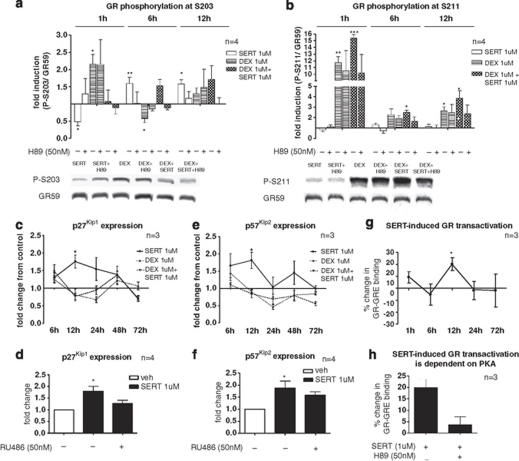
Sertraline regulates glucocorticoid receptor (GR) phosphorylation, GR-mediated expression of p27Kip1 and p57Kip2 and GR transactivation. During progenitor cell proliferation, SERT (1 μ) decreases GR phosphorylation at S203 after 1 h of treatment, but increases S203 phosphorylation after 6 h and 12 h (a, white columns). These effects are counteracted by H89. DEX increases S203 phosphorylation after 1 h and decreases S203 phosphorylation after 6 h (a, striped columns). DEX+SERT co-treatment does not change S203 phosphorylation at 1 h, but increases S203 phosphorylation at 6 h and 12 h (a, squared columns). These effects of DEX+SERT are also abolished by H89. SERT does not change GR phosphorylation at S211 (b, white columns). DEX increases S211 phosphorylation after 1, 6 and 12 h (b, striped columns). DEX+SERT co-treatment induces hyperphosphorylation at S211, which exceeds the phosphorylation induced by DEX alone, and this effect is also abolished by H89 (b, squared columns). Western blots for the GR-phosphoisoforms S203 and S211 are shown after 1 h of treatment (a,b). SERT increased the expression of p27Kip1 (c) and p57Kip2 (e). The increased expression of p27Kip1 and p57Kip2 after 12 h of sertraline treatment was abolished by RU486 (d,f). SERT increased GR transactivation after 12 h of treatment (g), an effect which was abolished by H89 (h). S203 and S211 phosphorylation are normalized to the expression of the unphosphorylated, total GR protein. Gene expression of p27Kip1 and p57Kip2 is normalized to the housekeeping genes ACTB, GAPDH and B2M. All data are mean±s.e.m. *P<0.05, **P<0.01 and ***P<0.001 compared with the respective vehicle.

References

    1. Duman RS. Role of neurotrophic factors in the etiology and treatment of mood disorders. Neuromolecular Med. 2004;5:11–25. - PubMed
    1. Wang JW, David DJ, Monckton JE, Battaglia F, Hen R. Chronic fluoxetine stimulates maturation and synaptic plasticity of adult-born hippocampal granule cells. J Neurosci. 2008;28:1374–1384. - PMC - PubMed
    1. Malberg JE, Eisch AJ, Nestler EJ, Duman RS. Chronic antidepressant treatment increases neurogenesis in adult rat hippocampus. J Neurosci. 2000;20:9104–9110. - PMC - PubMed
    1. Boldrini M, Underwood MD, Hen R, Rosoklija GB, Dwork AJ, John Mann J, et al. Antidepressants increase neural progenitor cells in the human hippocampus. Neuropsychopharmacology. 2009;34:2376–2389. - PMC - PubMed
    1. Jacobs BL, van Praag H, Gage FH. Adult brain neurogenesis and psychiatry: a novel theory of depression. Mol Psychiatry. 2000;5:262–269. - PubMed

Publication types

MeSH terms