Effect of pneumococcal conjugate vaccination on serotype-specific carriage and invasive disease in England: a cross-sectional study
- PMID: 21483718
- PMCID: PMC3071372
- DOI: 10.1371/journal.pmed.1001017
Effect of pneumococcal conjugate vaccination on serotype-specific carriage and invasive disease in England: a cross-sectional study
Abstract
Background: We investigated the effect of the 7-valent pneumococcal conjugate vaccine (PCV7) programme in England on serotype-specific carriage and invasive disease to help understand its role in serotype replacement and predict the impact of higher valency vaccines.
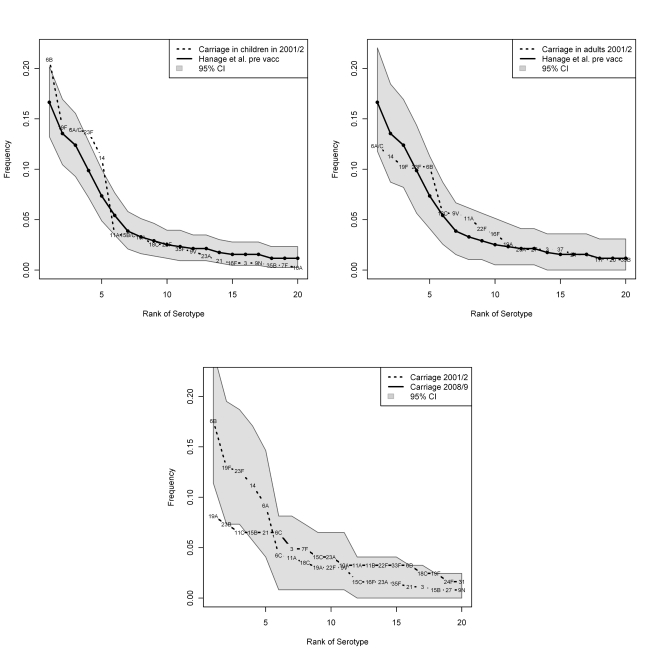
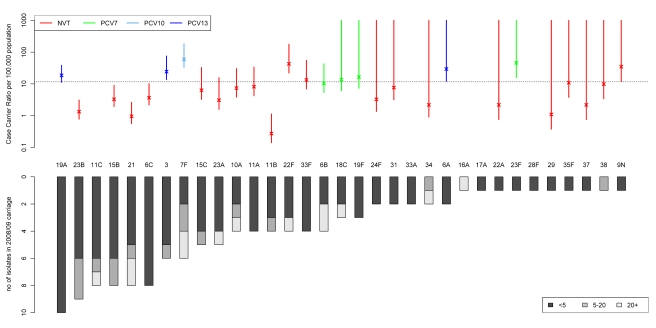
Methods and findings: Nasopharyngeal swabs were taken from children <5 y old and family members (n=400) 2 y after introduction of PCV7 into routine immunization programs. Proportions carrying Streptococcus pneumoniae and serotype distribution among carried isolates were compared with a similar population prior to PCV7 introduction. Serotype-specific case carrier ratios (CCRs) were estimated using national data on invasive disease. In vaccinated children and their contacts vaccine-type (VT) carriage decreased, but was offset by an increase in non-VT carriage, with no significant overall change in carriage prevalence, odds ratio 1.06 (95% confidence interval 0.76-1.49). The lower CCRs of the replacing serotypes resulted in a net reduction in invasive disease in children. The additional serotypes covered by higher valency vaccines had low carriage but high disease prevalence. Serotype 11C emerged as predominant in carriage but caused no invasive disease whereas 8, 12F, and 22F emerged in disease but had very low carriage prevalence.
Conclusion: Because the additional serotypes included in PCV10/13 have high CCRs but low carriage prevalence, vaccinating against them is likely to significantly reduce invasive disease with less risk of serotype replacement. However, a few serotypes with high CCRs could mitigate the benefits of higher valency vaccines. Assessment of the effect of PCV on carriage as well as invasive disease should be part of enhanced surveillance activities for PCVs. Please see later in the article for the Editors' Summary.
Conflict of interest statement
RG and CS have received support from Wyeth vaccines (now Pfizer) for conference attendance. SF, PW, AJVH, ES, NA, and EM declare no competing interests.
Figures
References
-
- Brueggemann AB, Griffiths DT, Meats E, Peto T, Crook DW, et al. Clonal relationships between invasive and carriage Streptococcus pneumoniae and serotype- and clone-specific differences in invasive disease potential. J Infect Dis. 2003;187:1424–1432. - PubMed
-
- Weinberger DM, Trzcinski K, Lu Y-J, Bogaert D, Brandes A, et al. Pneumococcal capsular polysaccharide structure predicts serotype prevalence. PLoS Pathog. 2009;5:e1000476. doi: 10.1371/journal.ppat.1000476. - DOI - PMC - PubMed
-
- Black S, Shinefield H, Fireman B, Lewis E, Ray P, et al. Efficacy, safety and immunogenicity of heptavalent pneumococcal conjugate vaccine in children. Northern California Kaiser Permanente Vaccine Study Center Group. Pediatr Infect Dis J. 2000;19:187–195. - PubMed
-
- Dagan R, Melamed R, Muallem M, Piglansky L, Greenberg D, et al. Reduction of nasopharyngeal carriage of pneumococci during the second year of life by a heptavalent conjugate pneumococcal vaccine. J Infect Dis. 1996;174:1271–1278. - PubMed
Publication types
MeSH terms
Substances
LinkOut - more resources
Full Text Sources
Other Literature Sources
Medical