


Risk factors associated with positive QuantiFERON-TB Gold In-Tube and tuberculin skin tests results in Zambia and South Africa
- PMID: 21483746
- PMCID: PMC3070723
- DOI: 10.1371/journal.pone.0018206
Risk factors associated with positive QuantiFERON-TB Gold In-Tube and tuberculin skin tests results in Zambia and South Africa
Abstract
Introduction: The utility of T-cell based interferon-gamma release assays for the diagnosis of latent tuberculosis infection remains unclear in settings with a high burden of tuberculosis.
Objectives: To determine risk factors associated with positive QuantiFERON-TB Gold In-Tube (QFT-GIT) and tuberculin skin test (TST) results and the level of agreement between the tests; to explore the hypotheses that positivity in QFT-GIT is more related to recent infection and less affected by HIV than the TST.
Methods: Adult household contacts of tuberculosis patients were invited to participate in a cross-sectional study across 24 communities in Zambia and South Africa. HIV, QFT-GIT and TST tests were done. A questionnaire was used to assess risk factors.
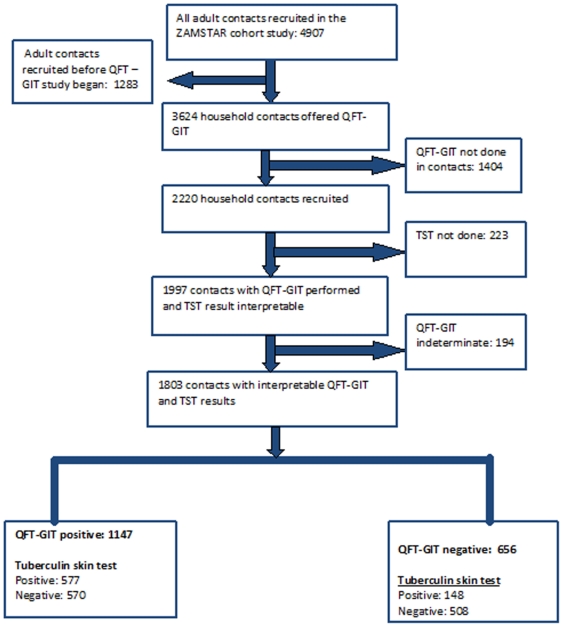
Results: A total of 2,220 contacts were seen. 1,803 individuals had interpretable results for both tests, 1,147 (63.6%) were QFT-GIT positive while 725 (40.2%) were TST positive. Agreement between the tests was low (kappa = 0.24). QFT-GIT and TST results were associated with increasing age (adjusted OR [aOR] for each 10 year increase for QFT-GIT 1.15; 95% CI: 1.06-1.25, and for TST aOR: 1.10; 95% CI 1.01-1.20). HIV positivity was less common among those with positive results on QFT-GIT (aOR: 0.51; 95% CI: 0.39-0.67) and TST (aOR: 0.61; 95% CI: 0.46-0.82). Smear positivity of the index case was associated with QFT-GIT (aOR: 1.25; 95% CI: 0.90-1.74) and TST (aOR: 1.39; 95% CI: 0.98-1.98) results. We found little evidence in our data to support our hypotheses.
Conclusion: QFT-GIT may not be more sensitive than the TST to detect risk factors associated with tuberculous infection. We found little evidence to support the hypotheses that positivity in QFT-GIT is more related to recent infection and less affected by HIV than the TST.
Conflict of interest statement
Figures
References
-
- Dye C, Watt CJ, Bleed DM, Hosseini SM, Raviglione MC. Evolution of Tuberculosis Control and Prospects for Reducing Tuberculosis Incidence, Prevalence, and Deaths Globally. JAMA. 2005;293:2767–2775. - PubMed
-
- Daley CL, Small PM, Schecter GF, Schoolnik GK, McAdam RA, et al. An Outbreak of Tuberculosis with Accelerated Progression among Persons Infected with the Human Immunodeficiency Virus. New England Journal of Medicine. 1992;326:231–235. - PubMed
-
- Guelar A, Gatell JM, Verdejo J, Podzamczer D, Lozano L, et al. A prospective study of the risk of tuberculosis among HIV-infected patients. Aids. 1993;7:1345–1349. - PubMed
-
- Centers for Disease Control and Prevention. Targeted tuberculin testing and treatment of latent tuberculosis infection. MMWR. 2000;49(No. RR-6)) - PubMed
-
- World Health Organization, Department of HIV/AIDS, Stop TB Department. Guidelines for intensified tuberculosis case finding and isoniazid preventive therapy for people living with HIV in resource constrained settings. 2011.
Publication types
MeSH terms
Substances
Grants and funding
LinkOut - more resources
Full Text Sources
