. 2011 Mar 31;6(3):e18219.
doi: 10.1371/journal.pone.0018219.

The accumulation and prognosis value of tumor infiltrating IL-17 producing cells in esophageal squamous cell carcinoma

Affiliations

The accumulation and prognosis value of tumor infiltrating IL-17 producing cells in esophageal squamous cell carcinoma

Lin Lv et al. PLoS One. .

Abstract

Background: The role of IL-17 producing cells in tumors is controversial. In the present study, we investigated the prognostic value of measuring tumor-infiltrating IL-17 producing cell levels in human esophageal squamous cell carcinoma (ESCC).

Methodology/principal findings: Immunohistochemical staining was performed to investigate the levels of IL-17+ tumor infiltrating lymphocytes (TILs), as well as CD8+ cytotoxic T lymphocytes (CTLs) and CD57+ natural killer (NK) cells from 181 ESCC patients. The prognostic value of measuring the densities of IL-17+TILs and the correlation with CTLs and NK was evaluated. IL-17 producing cells were detected in esophageal squamous cell carcinoma tissues. The IL-17 producing cells were major CD4 positive, but Foxp3 negative. The median level of IL-17+TILs was 3.90 cells/high power microscopic field (HPF). The density of IL-17 producing cells correlated negatively with T stage (P=0.042). The higher densities of tumor infiltrating IL-17+ lymphocytes were associated with better overall survival (P=0.031). Furthermore, we found that there were positive correlations between levels of IL-17 producing cells and the densities of CD8+cells, as well as CD57+cells (r=0.198, P=0.008 for CD8+ cells and r=0.261, P<0.001 for CD57+ cells, respectively). The prognosis analysis also showed that the higher levels of CD8+ CTLs and CD57+ NK cells correlated with better overall survival of ESCC patients.

Conclusions: Our study suggests that tumor infiltrating IL-17 producing cells in ESCC patients may have protective roles in the tumor microenvironment and may be treated as a prognostic marker for ESCC patients.


Conflict of interest statement

Competing Interests: The authors have declared that no competing interests exist.

Figures

Figure 1
Figure 1. Representative immunohistochemical staining photomicrographs of IL-17 producing cells in tumor tissues of ESCC.
Positive staining of IL-17 was detected in cellular cytoplasm of tumor tissues. (A), (B), (E) and (F): Low density of IL-17+ TILs. (C), (D), (G) and (H): High density of IL-17+ TILs. (J) and (K): Double stainings of CD4 (green, on the menbrane) and IL-17 (red, in the cytoplasm), IL-17 (green, in the cytoplasm) and FOXP3 (red, nuclei) in paraffin-embedded specimens were analyzed by immunofiuorescence. Original magnification: A–D×200; E–K×400.
Figure 2
Figure 2. Kaplan–Meier survival curves of ESCC patients (n = 181) after surgical resection.
Increased IL-17-producing cells correlate with improved patient survival. Patients in high IL-17-producing cell density group exhibited significantly better survival than the low IL-17-producing cell density group (log-rank test: P = 0.031).
Figure 3
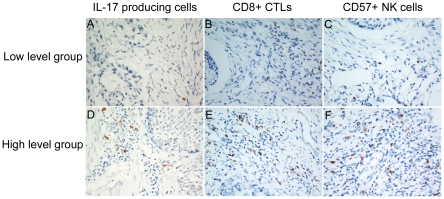
Figure 3. Representative photomicrographs showing immunohistochemical staining of IL-17, CD8 and CD57 in the same ESCC tissues.
(A) Low density of IL-17 producing cells. (B) Low density of CD8+ CTLs cells. (C) Low density of CD57+ NK cells. (D) High density of IL-17 producing cells. (E) High density of CD8+ CTLs cells. (F) High density of CD57+ NK cells (original magnification ×400).
Figure 4
Figure 4. IL-17 producing cells correlated positively with the densities of CD8+ CTLs and CD57+ NK cells.
The correlation between the densities of IL-17 producing cells and CD8+T lymphocytes (A), CD57+NK cells (B). The samples were divided into two groups based on the median value of IL-17 producing cells.
Figure 5
Figure 5. Kaplan–Meier survival curves of ESCC patients (n = 181) after surgical resection.
Increased tumor-infiltrating CD8+ CTLs and CD57+ NK cells predict improved patient survival. (A) The survival rate for patients in the high CD8+ CTLs density group was significantly better than that for patients in the low density group (log rank test, P<0.001). (B) Kaplan–Meier survival curves for high CD57+ NK cell density group versus low CD57+ NK cell density group showed a highly significant separation (log-rank test: P = 0.002).

References

    1. Couzin J. Cancer. T cells a boon for colon cancer prognosis. Science. 2006;313:1868–1869. - PubMed
    1. Dunn GP, Dunn IF, Curry WT. Focus on TILs: Prognostic significance of tumor infiltrating lymphocytes in human glioma. Cancer Immun. 2007;7:12. - PMC - PubMed
    1. Leffers N, Gooden MJ, de Jong RA, Hoogeboom BN, ten Hoor KA, et al. Prognostic significance of tumor-infiltrating T-lymphocytes in primary and metastatic lesions of advanced stage ovarian cancer. Cancer Immunol Immunother. 2009;58:449–459. - PMC - PubMed
    1. Zhang YL, Li J, Mo HY, Qiu F, Zheng LM, et al. Different subsets of tumor infiltrating lymphocytes correlate with NPC progression in different ways. Mol Cancer. 2010;9:4. - PMC - PubMed
    1. Dunn GP, Koebel CM, Schreiber RD. Interferons, immunity and cancer immunoediting. Nat Rev Immunol. 2006;6:836–848. - PubMed

MeSH terms