


An anti-HIV-1 V3 loop antibody fully protects cross-clade and elicits T-cell immunity in macaques mucosally challenged with an R5 clade C SHIV
- PMID: 21483815
- PMCID: PMC3069056
- DOI: 10.1371/journal.pone.0018207
An anti-HIV-1 V3 loop antibody fully protects cross-clade and elicits T-cell immunity in macaques mucosally challenged with an R5 clade C SHIV
Abstract
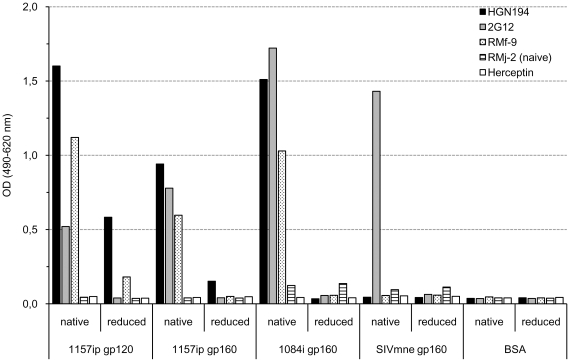
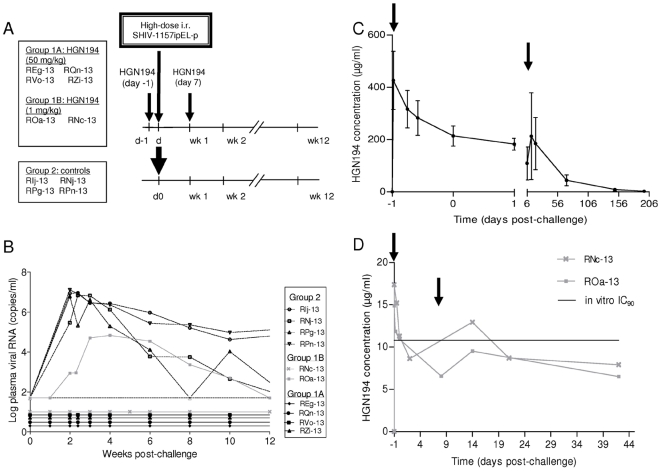
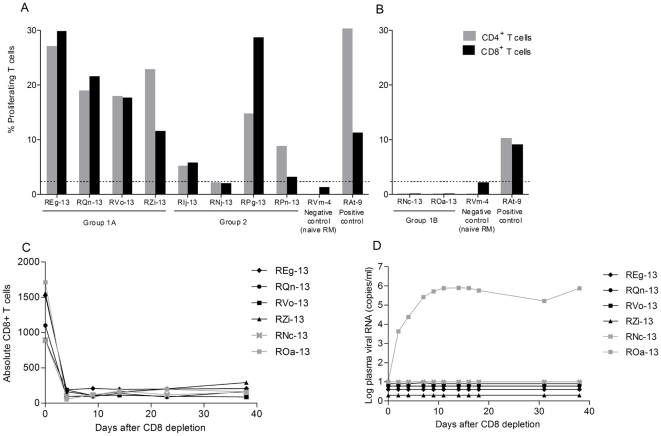
Neutralizing antibodies have been shown to protect macaques against SHIV challenge. However, genetically diverse HIV-1 clades have evolved, and a key question left unanswered is whether neutralizing antibodies can confer cross-clade protection in vivo. The novel human monoclonal antibody HGN194 was isolated from an individual infected with an HIV-1 clade AG recombinant circulating recombinant form (CRF). HGN194 targets an epitope in the third hypervariable loop (V3) of HIV-1 gp120 and neutralizes a range of relatively neutralization-sensitive and resistant viruses. We evaluated the potential of HGN194 to protect infant rhesus monkeys against a SHIV encoding a primary CCR5-tropic HIV-1 clade C envelope. After high-dose mucosal challenge, all untreated controls became highly viremic while all HGN194-treated animals (50 mg/kg) were completely protected. When HGN194 was given at 1 mg/kg, one out of two monkeys remained aviremic, whereas the other had delayed, lower peak viremia. Interestingly, all protected monkeys given high-dose HGN194 developed Gag-specific proliferative responses of both CD4+ and CD8+ T cells. To test whether generation of the latter involved cryptic infection, we ablated CD8+ cells after HGN194 clearance. No viremia was detected in any protected monkeys, thus ruling out virus reservoirs. Thus, induction of CD8 T-cell immunity may have resulted from transient "Hit and Run" infection or cross priming via Ag-Ab-mediated cross-presentation. Together, our data identified the HGN194 epitope as protective and provide proof-of-concept that this anti-V3 loop mAb can prevent infection with sterilizing immunity after challenge with virus of a different clade, implying that V3 is a potential vaccine target.
Conflict of interest statement
Figures
References
-
- Mascola JR, Snyder SW, Weislow OS, Belay SM, Belshe RB, et al. Immunization with envelope subunit vaccine products elicits neutralizing antibodies against laboratory-adapted but not primary isolates of human immunodeficiency virus type 1. The National Institute of Allergy and Infectious Diseases AIDS Vaccine Evaluation Group. J Infect Dis. 1996;173:340–348. - PubMed
-
- Flynn NM, Forthal DN, Harro CD, Judson FN, Mayer KH, et al. Placebo controlled phase 3 trial of a recombinant glycoprotein 120 vaccine to prevent HIV-1 infection. J Infect Dis. 2005;191:654–665. - PubMed
-
- Pitisuttithum P, Gilbert P, Gurwith M, Heyward W, Martin M, et al. Randomized, double-blind, placebo-controlled efficacy trial of a bivalent recombinant glycoprotein 120 HIV-1 vaccine among injection drug users in Bangkok, Thailand. J Infect Dis. 2006;194:1661–1671. - PubMed
-
- Baba TW, Liska V, Hofmann-Lehmann R, Vlasak J, Xu W, et al. Human neutralizing monoclonal antibodies of the IgG1 subtype protect against mucosal simian-human immunodeficiency virus infection. Nat Med. 2000;6:200–206. - PubMed
Publication types
MeSH terms
Substances
Grants and funding
LinkOut - more resources
Full Text Sources
Other Literature Sources
Research Materials
