Review
. 2011 Jun;60(1-2):3-11.
doi: 10.1007/s12013-011-9184-6.

An emerging model for BAP1's role in regulating cell cycle progression

Affiliations
Review

An emerging model for BAP1's role in regulating cell cycle progression

Ziad M Eletr et al. Cell Biochem Biophys. 2011 Jun.

Abstract

BRCA1-associated protein-1 (BAP1) is a 729 residue, nuclear-localized deubiquitinating enzyme (DUB) that displays tumor suppressor properties in the BAP1-null NCI-H226 lung carcinoma cell line. Studies that have altered BAP1 cellular levels or enzymatic activity have reported defects in cell cycle progression, notably at the G1/S transition. Recently BAP1 was shown to associate with the transcriptional regulator host cell factor 1 (HCF-1). The BAP1/HCF-1 interaction is mediated by the HCF-1 Kelch domain and an HCF-1 binding motif (HBM) within BAP1. HCF-1 is modified with ubiquitin in vivo, and ectopic studies suggest BAP1 deubiquitinates HCF-1. HCF-1 is a chromatin-associated protein thought to both activate and repress transcription by linking appropriate histone-modifying enzymes to a subset of transcription factors. One known role of HCF-1 is to promote cell cycle progression at the G1/S boundary by recruiting H3K4 histone methyltransferases to the E2F1 transcription factor so that genes required for S-phase can be transcribed. Given the robust associations between BAP1/HCF-1 and HCF-1/E2Fs, it is reasonable to speculate that BAP1 influences cell proliferation at G1/S by co-regulating transcription from HCF-1/E2F-governed promoters.


Figures
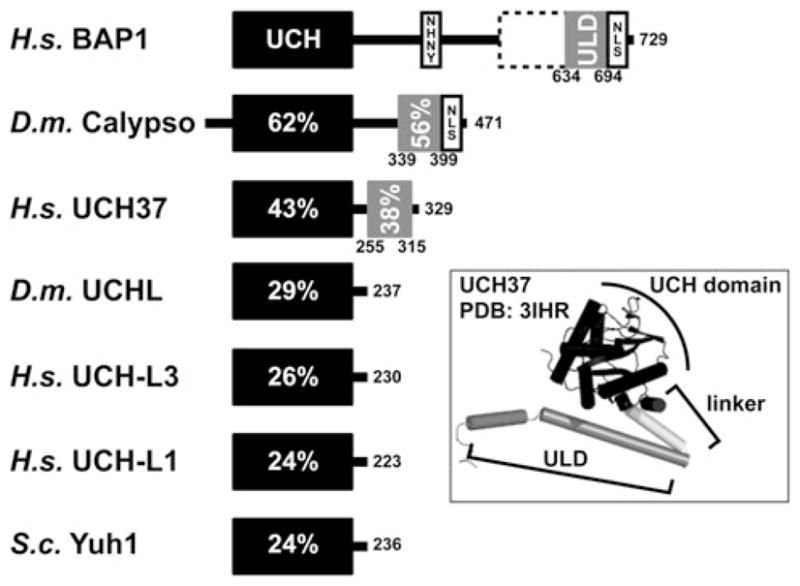
Fig. 1
Fig. 1
Domain architecture and sequence conservation of human, fruit fly, and yeast UCH DUBs. Human BAP1 is composed of an N-terminal UCH domain (res. 1–250), an HBM (NHNY, res. 363–366), a region that mediates association with BRCA1 (res. 596–721), a 60 residue helical motif that shares conservation with UCH37 (ULD for UCH37-like domain, res. 634–694), and a bona fide nuclear localization signal (NLS, RRRKGR, res. 717–722). The UCH domains of other human, yeast, and fruit fly DUBs are depicted by black bars and percentages reflect the sequence identity compared to BAP1. Calypso and UCH37 also contain ULDs (gray bars) and Calypso contains a putative NLS at its C-terminus (RRRKGR, res. 459–464). The inset maps the UCH and ULD domains of UCH37 onto its crystal structure. The UCH domain, shown in black, is connected to the helical ULD, shown in gray, by a short helical linker
Fig. 2
Fig. 2
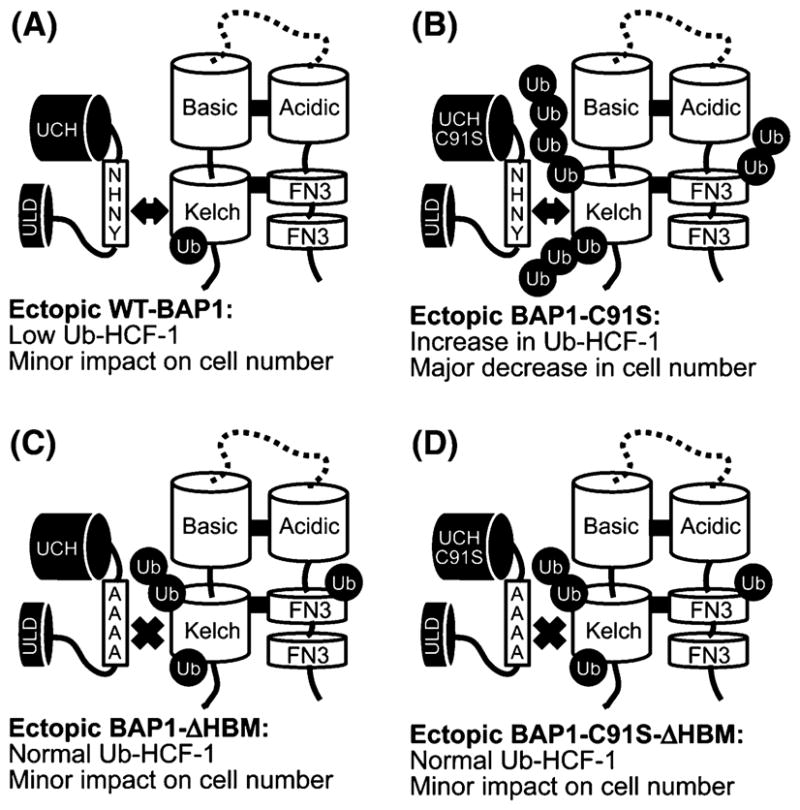
Model summarizing data from BAP1 overexpression studies. The report by Machida et al. [4] showed that knockdown of BAP1 levels by siRNA and overexpression of catalytically inactive BAP1 (C91S) both resulted in growth inhibition of MCF10a cells. To investigate the effects of BAP1 overexpression on the ubiquitination status of HCF-1, the authors co-overexpressed Flag-Kelch domain and HA-Ubiquitin and used anti-Flag immunoprecipitations to isolate the Kelch domain and any associated ubiquitin. Immunoblots revealed that WT BAP1 reduced the amount of ubiquitin that copurified with Flag-Kelch compared to cells lacking exogenous BAP1 (a). Expression of BAP1-C91S resulted in an increase in ubiquitin/Ub-Kelch (b) and thus the dominant negative effect on cell growth could be a product of inactive BAP1 saturating HCF-1 binding sites preventing endogenous, active BAP1 from deubiquitinating HCF-1. This model was tested by disrupting the BAP1/HCF-1 association, done by incorporating the ΔHBM alanine mutations with inactive BAP1 (BAP1-C91S-ΔHBM). When overexpressed the BAP1-C91S-ΔHBM protein resulted in a reduced amount of ubiquitin/Ub-Kelch that copurifies compared to BAP1-C91S (d). The BAP1-C91S-ΔHBM protein also rescued growth defects caused by overexpression of BAP1-C91S

References

    1. Ventii KH, Devi NS, Friedrich KL, Chernova TA, Tighiouart M, Van Meir EG, et al. BRCA1-associated protein-1 is a tumor suppressor that requires deubiquitinating activity and nuclear localization. Cancer Research. 2008;68:6953–6962. - PMC - PubMed
    1. Jensen DE, Proctor M, Marquis ST, Gardner HP, Ha SI, Chodosh LA, et al. BAP1: a novel ubiquitin hydrolase which binds to the BRCA1 RING finger and enhances BRCA1-mediated cell growth suppression. Oncogene. 1998;16:1097–1112. - PubMed
    1. Nishikawa H, Wu W, Koike A, Kojima R, Gomi H, Fukuda M, et al. BRCA1-associated protein 1 interferes with BRCA1/BARD1 RING heterodimer activity. Cancer Research. 2009;69:111–119. - PubMed
    1. Machida YJ, Machida Y, Vashisht AA, Wohlschlegel JA, Dutta A. The deubiquitinating enzyme BAP1 regulates cell growth via interaction with HCF-1. Journal of Biological Chemistry. 2009;284:34179–34188. - PMC - PubMed
    1. Sowa ME, Bennett EJ, Gygi SP, Harper JW. Defining the human deubiquitinating enzyme interaction landscape. Cell. 2009;138:389–403. - PMC - PubMed

MeSH terms