Randomized Controlled Trial
. 2012 Feb;42(2):278-93.
doi: 10.1007/s10803-011-1243-8.

The effects of face expertise training on the behavioral performance and brain activity of adults with high functioning autism spectrum disorders

Affiliations
Randomized Controlled Trial

The effects of face expertise training on the behavioral performance and brain activity of adults with high functioning autism spectrum disorders

Susan Faja et al. J Autism Dev Disord. 2012 Feb.

Abstract

The effect of expertise training with faces was studied in adults with ASD who showed initial impairment in face recognition. Participants were randomly assigned to a computerized training program involving either faces or houses. Pre- and post-testing included standardized and experimental measures of behavior and event-related brain potentials (ERPs), as well as interviews after training. After training, all participants met behavioral criteria for expertise with the specific stimuli on which they received training. Scores on standardized measures improved after training for both groups, but only the face training group showed an increased face inversion effect behaviorally and electrophysiological changes to faces in the P100 component. These findings suggest that individuals with ASD can gain expertise in face processing through training.


Figures
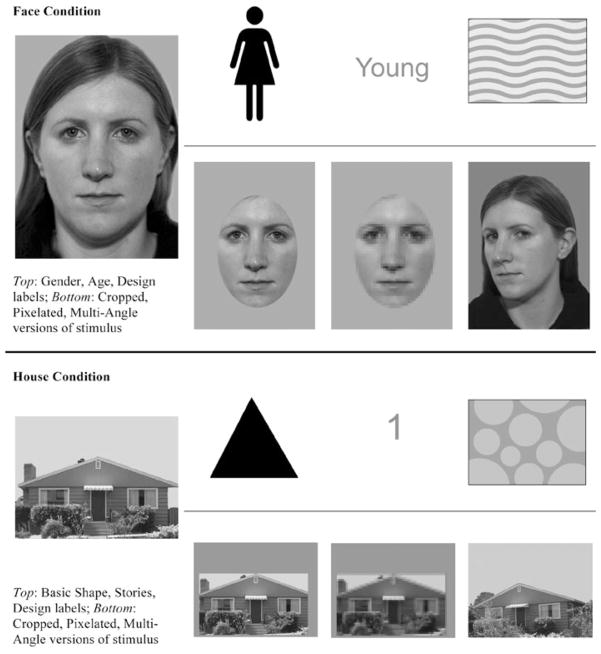
Fig. 1
Fig. 1
Examples of face and house training stimuli and labels
Fig. 2
Fig. 2
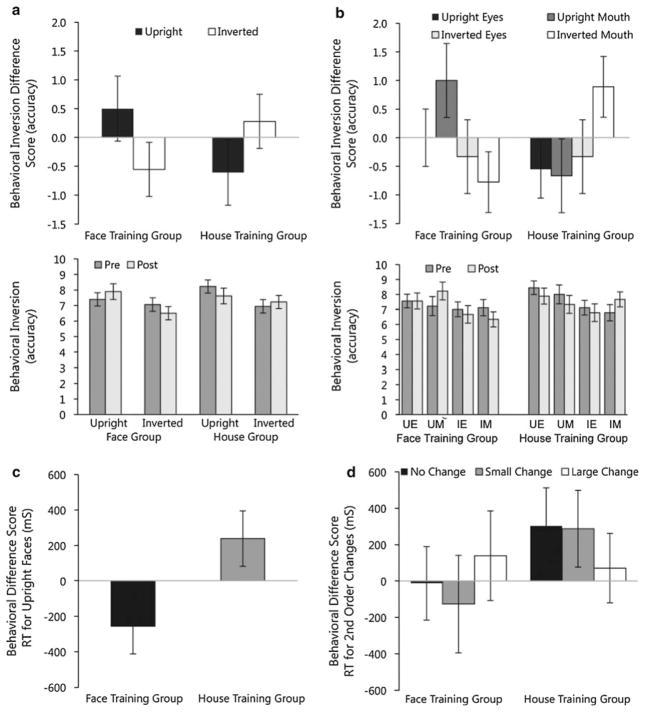
Main behavioral responses to training. Top Accuracy changes for each training group to faces as a result of training (post-training minus baseline) a for the whole face inversion effect and b by feature within whole faces. Middle Comparison of accuracy scores at baseline and after training corresponding to change scores in the top row. Bottom Reaction time changes from baseline to post-training for each training group c for upright faces and d by the degree of second order configural manipulation of faces. Standard error bars are shown
Fig. 3
Fig. 3
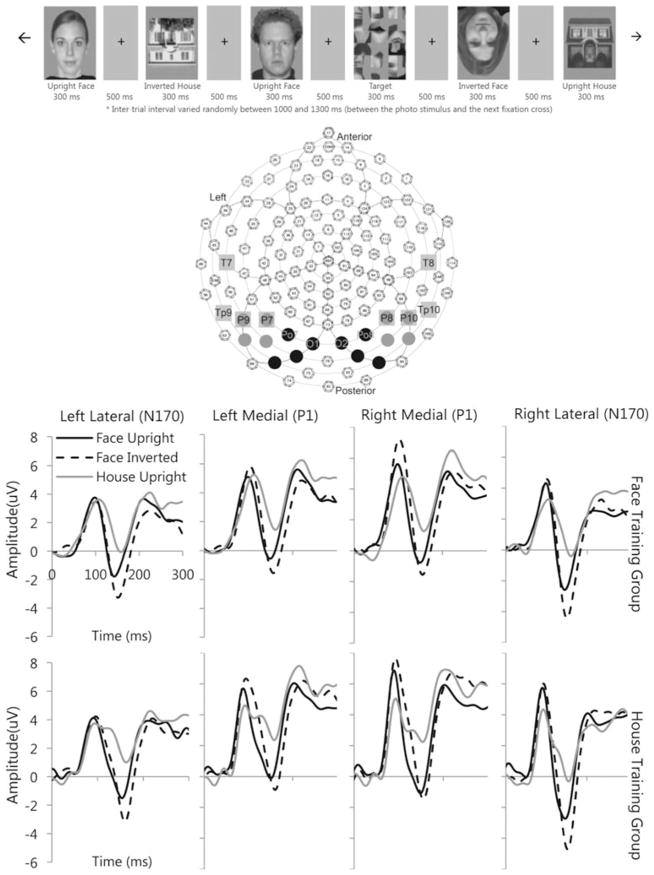
Top Examples of stimuli from ERP task. Middle Geodesic Sensor Net with 128 channels. P1 medial posterior electrodes in black circles; N170 lateral posterior electrodes in dark grey circles; N250 posterior-temporal electrodes in light grey squares. Bottom Baseline ERP responses to upright (black line) and inverted faces (dotted lines) and upright houses (grey line) in the Face Training (upper row) and House Training (lower row) groups by region. P1 was analyzed over left and right medial electrode groups; N170 was analyzed across left and right lateral electrode groups
Fig. 4
Fig. 4
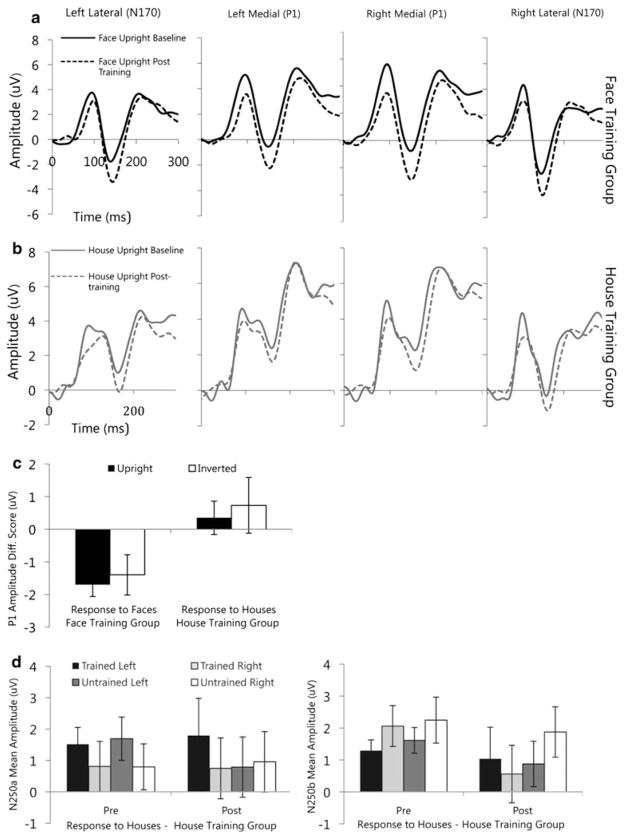
Top Effects of training on ERP responses to a upright faces (black lines) in the Face Training group and b upright houses (grey lines) in the House Training group by region. P1 was analyzed over left and right medial electrode groups; N170 was analyzed across left and right lateral electrode groups. Bottom Main ERP responses to training. c P1 amplitude changes in response to training (post-training minus baseline) to faces in the Face Training group, and houses in the House Training group. Laterality of baseline and post-training N250 responses d to trained and untrained houses in the House Training group

References

    1. American Psychiatric Association. Diagnostic and statistical manual of mental disorders. 4. Washington, DC: Author; 1994.
    1. Balas B, Nelson CA. The role of face shape and pigmentation in other-race face perception: An electrophysiological study. Neuropsychologia. 2010;48:498–506. - PMC - PubMed
    1. Bentin S, Allison T, Puce A, Perez E, McCarthy G. Electrophysiological studies of face perception in humans. Journal of Cognitive Neuroscience. 1996;8:551–565. - PMC - PubMed
    1. Benton AL, Sivan AB, de Hamsher KS, Varney NR, Spreen O. Facial recognition: Stimulus and multiple choice pictures. New York, NY: Oxford University Press; 1983.
    1. Bölte S, Feineis-Matthews S, Leber S, Dierks T, Hubl D, Poustka F. The development and evaluation of a computer-based program to test and to teach the recognition of facial affect. International Journal of Circumpolar Health. 2002;61:61–68. - PubMed

Publication types