. 2011 May 4;133(17):6545-8.
doi: 10.1021/ja201734z. Epub 2011 Apr 12.

OMP decarboxylase: phosphodianion binding energy is used to stabilize a vinyl carbanion intermediate

Affiliations

OMP decarboxylase: phosphodianion binding energy is used to stabilize a vinyl carbanion intermediate

Bogdana Goryanova et al. J Am Chem Soc. .

Abstract

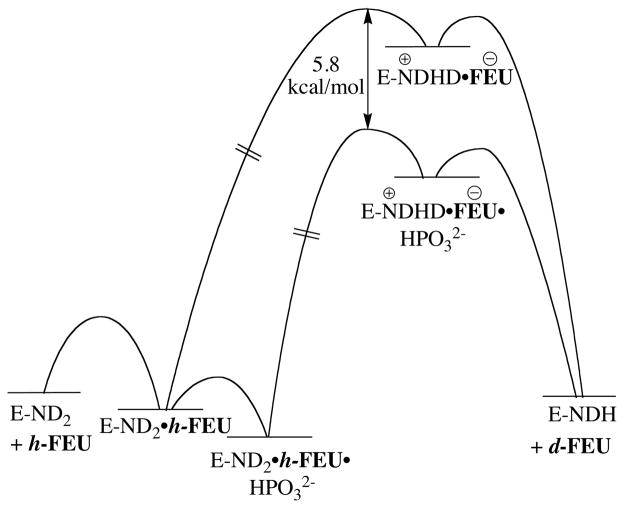
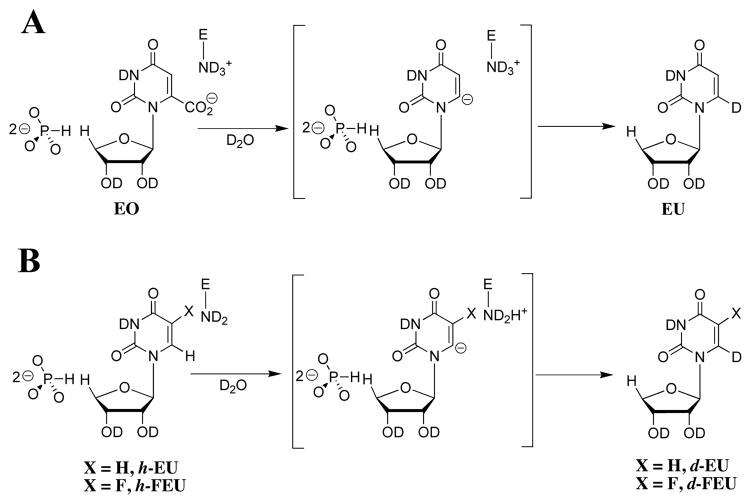
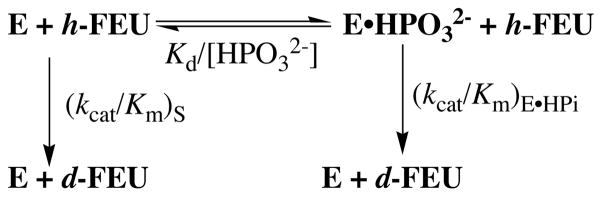
Orotidine 5'-monophosphate decarboxylase (OMPDC) catalyzes the exchange for deuterium from solvent D(2)O of the C-6 proton of 1-(β-d-erythrofuranosyl)-5-fluorouracil (FEU), a phosphodianion truncated product analog. The deuterium exchange reaction of FEU is accelerated 1.8 × 10(4)-fold by 1 M phosphite dianion (HPO(3)(2-)). This corresponds to a 5.8 kcal/mol stabilization of the vinyl carbanion-like transition state, which is similar to the 7.8 kcal/mol stabilization of the transition state for OMPDC-catalyzed decarboxylation of a truncated substrate analog by bound HPO(3)(2-). These results show that the intrinsic binding energy of phosphite dianion is used in the stabilization of the vinyl carbanion-like transition state common to the decarboxylation and deuterium exchange reactions.


Figures

Figure 1
Figure 1
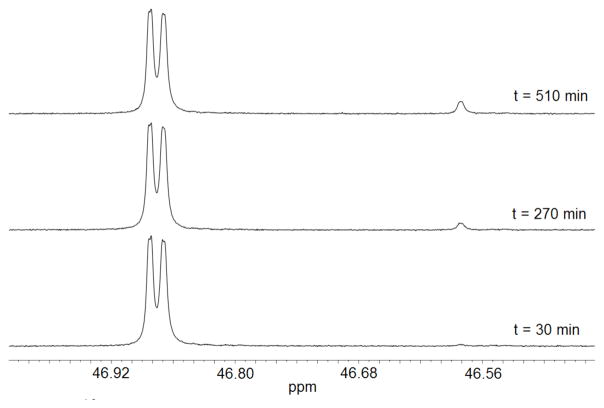
19F NMR spectra obtained during the OMPDC-catalyzed deuterium exchange reaction of FEU (4.2 mM) in the presence of 4.7 mM phosphite dianion in D2O at pD 8.1 and 25 °C.
Figure 2
Figure 2
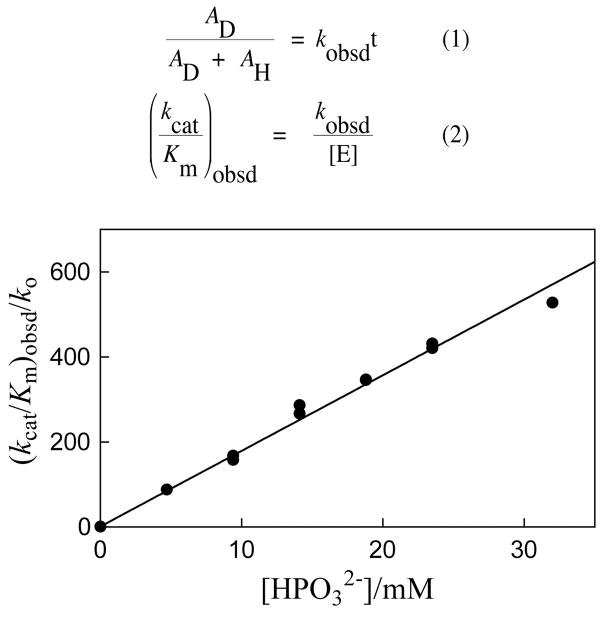
The dependence of (kcat/Km)obsd/ko for the OMPDC-catalyzed deuterium exchange reaction of FEU on the concentration of phosphite dianion in D2O at pD 8.1, 25 °C and I = 0.14 (NaCl).
Figure 3
Figure 3
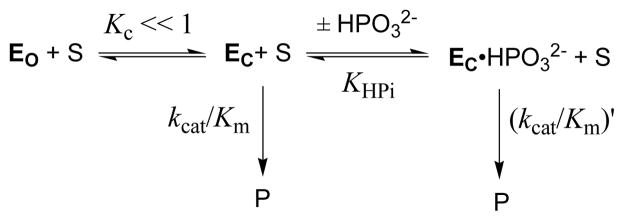
Partial free energy profiles for the unactivated and phosphite-activated OMPDC-catalyzed deuterium exchange reactions of the truncated substrate h-FEU in D2O. The slowest step for the enzyme-catalyzed reaction is deprotonation of substrate by the alkyl amino side chain of Lys-93 to form the enzyme bound carbanion. The carbanion-like transition state is stabilized by 5.8 kcal/mol by the binding of phosphite dianion. In this figure, the barrier to formation of the enzyme-bound carbanion also includes rotation of the CH2-ND2H+ bond at Lys-93 that is required to exchange the positions of the substrate derived –H and the solvent derived –D prior to hydron transfer to form d-FEU.,,
Scheme 1
Scheme 1
Scheme 2
Scheme 2
Scheme 3
Scheme 3
Scheme 4
Scheme 4

References

    1. Callahan BP, Miller BG. Bioorg Chem. 2007;35:465–469. - PubMed
    1. Miller BG, Wolfenden R. Ann Rev Biochem. 2002;71:847–885. - PubMed
    1. Radzicka A, Wolfenden R. Science. 1995;267:90–93. - PubMed
    1. Amyes TL, Wood BM, Chan K, Gerlt JA, Richard JP. J Am Chem Soc. 2008;130:1574–1575. - PMC - PubMed
    1. Chan KK, Wood BM, Fedorov AA, Fedorov EV, Imker HJ, Amyes TL, Richard JP, Almo SC, Gerlt JA. Biochemistry. 2009;48:5518–5531. - PMC - PubMed

Publication types

MeSH terms

LinkOut - more resources