


The APOL1 gene and allograft survival after kidney transplantation
- PMID: 21486385
- PMCID: PMC3083491
- DOI: 10.1111/j.1600-6143.2011.03513.x
The APOL1 gene and allograft survival after kidney transplantation
Abstract
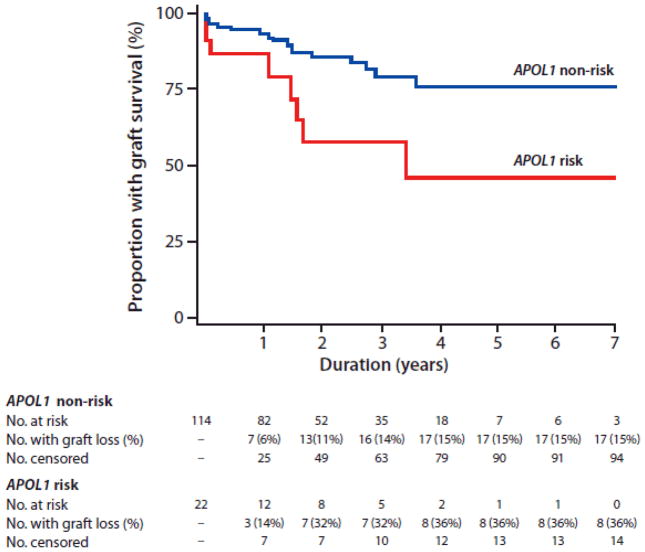
Coding variants in the apolipoprotein L1 gene (APOL1) are strongly associated with nephropathy in African Americans (AAs). The effect of transplanting kidneys from AA donors with two APOL1 nephropathy risk variants is unknown. APOL1 risk variants were genotyped in 106 AA deceased organ donors and graft survival assessed in 136 resultant kidney transplants. Cox-proportional hazard models tested for association between time to graft failure and donor APOL1 genotypes. The mean follow-up was 26.4 ± 21.8 months. Twenty-two of 136 transplanted kidneys (16%) were from donors with two APOL1 nephropathy risk variants. Twenty-five grafts failed; eight (32%) had two APOL1 risk variants. A multivariate model accounting for donor APOL1 genotype, overall African ancestry, expanded criteria donation, recipient age and gender, HLA mismatch, CIT and PRA revealed that graft survival was significantly shorter in donor kidneys with two APOL1 risk variants (hazard ratio [HR] 3.84; p = 0.008) and higher HLA mismatch (HR 1.52; p = 0.03), but not for overall African ancestry excluding APOL1. Kidneys from AA deceased donors harboring two APOL1 risk variants failed more rapidly after renal transplantation than those with zero or one risk variants. If replicated, APOL1 genotyping could improve the donor selection process and maximize long-term renal allograft survival.
©2011 The Authors Journal compilation©2011 The American Society of Transplantation and the American Society of Transplant Surgeons.
Figures
Comment in
-
Mechanism of action of APOL1 in renal allograft survival (and Native CKD) remains unclear.Am J Transplant. 2011 Oct;11(10):2258-9; author reply 2260. doi: 10.1111/j.1600-6143.2011.03673.x. Epub 2011 Aug 3. Am J Transplant. 2011. PMID: 21812922 No abstract available.
References
-
- Meier-Kriesche HU, Port FK, Ojo AO, et al. Effect of waiting time on renal transplant outcome. Kidney Int. 2000;58(3):1311–1317. - PubMed
Publication types
MeSH terms
Substances
Grants and funding
LinkOut - more resources
Full Text Sources
Other Literature Sources
Medical
Research Materials
Miscellaneous
