


doi: 10.1136/amiajnl-2010-000068.
Epub 2011 Apr 12.
Minimizing electronic health record patient-note mismatches
Affiliations
- PMID: 21486875
- PMCID: PMC3128397
- DOI: 10.1136/amiajnl-2010-000068
Item in Clipboard
Minimizing electronic health record patient-note mismatches
J Am Med Inform Assoc.
2011 Jul-Aug.
Abstract
We measured the prevalence (or rate) of patient-note mismatches (clinical notes judged to pertain to another patient) in the electronic medical record. The rate ranged from 0.5% (95% CI 0.2% to 1.7%) before a pop-up window intervention to 0.3% (95% CI 0.1% to 1.1%) after the intervention. Clinicians discovered patient-note mismatches in 0.05-0.03% of notes, or about 10% of actual mismatches. The reduction in rates after the intervention was statistically significant. Therefore, while the patient-note mismatch rate is low compared to published rates of other documentation errors, it can be further reduced by the design of the user interface.
Conflict of interest statement
Figures
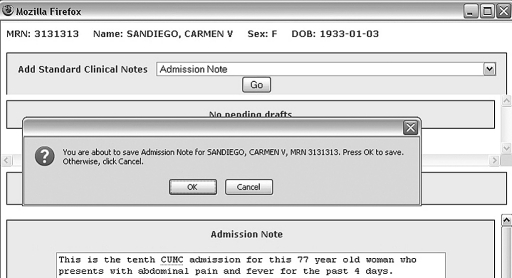
Intervention pop-up window. The top of the note editing screen always displayed the medical record number, name, gender, and date of birth. The intervention added a pop-up window (center) that reiterated the name and medical record number when a note was submitted. (A fictional patient is shown.)
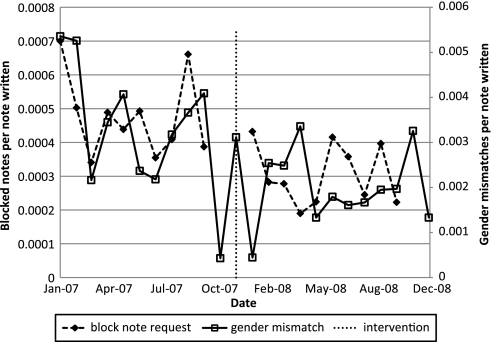
Monthly rate of mismatches before and after intervention. The rate of clinician-reported patient-note mismatches (block note requests) and the estimated rate of gender mismatches (parser positive rate) are shown for the months preceding and following the intervention.
References
-
- Blumenthal D. Launching HITECH. N Engl J Med 2010;362:382–5 - PubMed
-
- Koppel R, Metlay JP, Cohen A, et al. Role of computerized physician order entry systems in facilitating medication errors. JAMA 2005;293:1197–203 - PubMed
-
- Wachter RM. Expected and unanticipated consequences of the quality and information technology revolutions. JAMA 2006;295:2780–3 - PubMed
-
- Egerman P, Probst M. HIT Policy Committee: Certification Adoption Workgroup Review of February 25th HIT Safety Hearing. 2010. http://healthit.hhs.gov/portal/server.pt/gateway/PTARGS_0_11673_911100_0... (accessed 11 Oct 2010).
