


Mechanisms controlling Th17 cytokine expression and host defense
- PMID: 21486905
- PMCID: PMC3133441
- DOI: 10.1189/jlb.0211099
Mechanisms controlling Th17 cytokine expression and host defense
Abstract
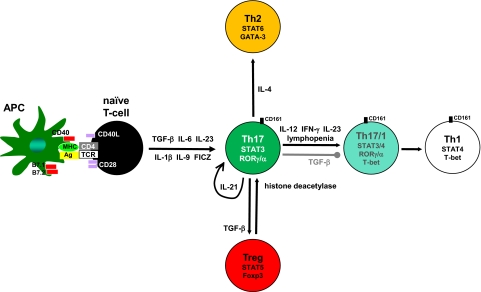
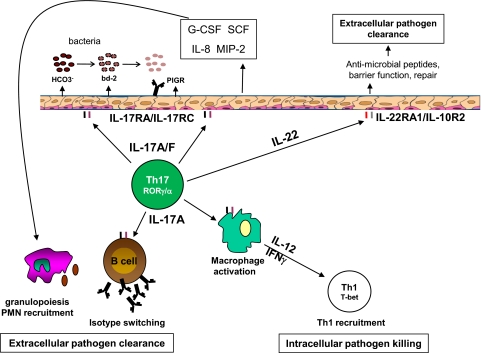
Th17 cells contribute to mucosal immunity by stimulating epithelial cells to induce antimicrobial peptides, granulopoiesis, neutrophil recruitment, and tissue repair. Recent studies have identified important roles for commensal microbiota and Ahr ligands in stabilizing Th17 gene expression in vivo, linking environmental cues to CD4 T cell polarization. Epigenetic changes that occur during the transition from naïve to effector Th17 cells increase the accessibility of il17a, il17f, and il22 loci to transcription factors. In addition, Th17 cells maintain the potential for expressing T-bet, Foxp3, or GATA-binding protein-3, explaining their plastic nature under various cytokine microenvironments. Although CD4 T cells are major sources of IL-17 and IL-22, innate cell populations, including γδ T cells, NK cells, and lymphoid tissue-inducer cells, are early sources of these cytokines during IL-23-driven responses. Epithelial cells and fibroblasts are important cellular targets for IL-17 in vivo; however, recent data suggest that macrophages and B cells are also stimulated directly by IL-17. Thus, Th17 cells interact with multiple populations to facilitate protection against intracellular and extracellular pathogens.
Figures
References
-
- Hsu H. C., Yang P., Wang J., Wu Q., Myers R., Chen J., Yi J., Guentert T., Tousson A., Stanus A. L., et al. (2008) Interleukin 17-producing T helper cells and interleukin 17 orchestrate autoreactive germinal center development in autoimmune BXD2 mice. Nat. Immunol. 9, 166–175 - PubMed
Publication types
MeSH terms
Substances
Grants and funding
LinkOut - more resources
Full Text Sources
Other Literature Sources
Research Materials
