


Review
doi: 10.18632/oncotarget.260.
INPP4B: the new kid on the PI3K block
Affiliations
- PMID: 21487159
- PMCID: PMC3248162
- DOI: 10.18632/oncotarget.260
Item in Clipboard
Review
INPP4B: the new kid on the PI3K block
Oncotarget.
2011 Apr.
Abstract
Dysregulation of phosphatidyl inositol signaling occurs in many cancers and other disorders. The lipid and protein phosphatase, PTEN (Phosphatase and Tensin homology protein on chromosome 10), is a known tumor suppressor whose function is frequently lost in various malignancies due to mutations in the coding region or genomic deletions. Recently, another lipid phosphatase, Inositol Polyphosphate 4-phosphatase type II (INPP4B), has emerged as a potential tumor suppressor in prostate, breast, and ovarian cancers and possibly in leukemia. We will review its structure and function, crosstalk with androgen receptor signaling, and regulation of INPP4B expression, as well as existing data about its role in cancer.
Figures
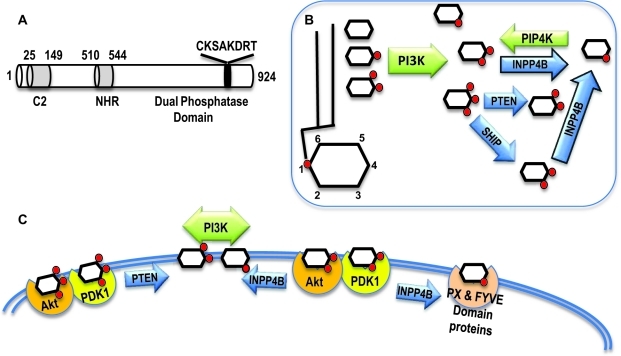
A. Functional domains of INPP4B: C2 lipid binding domain amino acids 25-149, NHR domain amino acids 510-544, and putative Dual Phosphatase domain with the catalytic region C(X)5R. B. Network of kinases and phosphatases modifying inositol mono- and polyphosphates. Kinases are depicted in green and phosphatases in blue. C. The substrate and product of INPP4B enzymatic activity interact with various proteins changing their localization and activity.
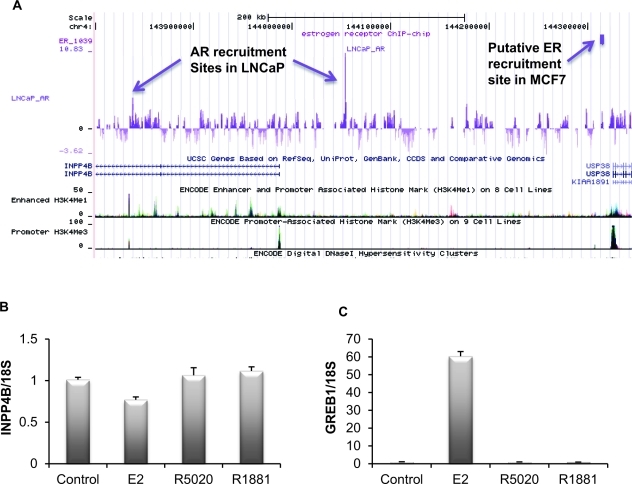
A. Interrogation of the AR and ER recruitment sites in the vicinity of the INPP4B locus. Note AR recruitment in LNCaP cells upstream of the INPP4B promoter and in intron 2. Recruitment site for ERα in MCF7 cells is over 200 kb upstream and is immediately upstream of USP36 promoter as marked by the promoter methylation signature (H3K4Me). B. INPP4B expression is not hormonally induced in MCF-7 cells. MCF-7 cells grown in 10% charcoal stripped serum (CSS) for 48 hours were treated with ethanol (control), 10 nM estradiol (E2), 10 nM R5020, or 10 nM R1881. Cells were harvested 24 hours post-treatment, RNA was extracted, and INPP4B and 18S expression was analyzed by quantitative RT-PCR. C. To control for estradiol gene regulation, GREB1 expression was analyzed by quantitative RT-PCR (error bars denote ± S. E.) and normalized by 18S expression.
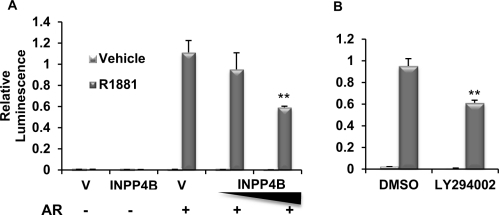
A. PC-3 cells were transfected for 24 hours with vector control, 50 or 100 ng INPP4B, and the androgen-responsive GRE-luciferase reporter construct. Cells were then treated with ethanol or R1881, harvested, luciferase activity measured, and normalized for protein concentration. B. Cells were transfected as in A and treated with vehicle or R1881 with either DMSO or 20 nM LY294002. Activity was normalized to total protein. ** indicates statistically significant difference with p<0.01.
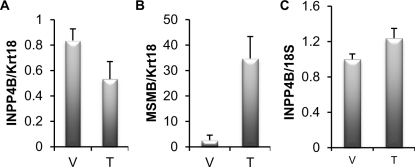
A. Four month old male castrated mice were treated with vehicle (V) (n=5) or 1 μg testosterone (T) (n=9). Prostates were isolated 24 hours following treatment, RNA extracted and Inpp4b and Krt18 expression was analyzed by quantitative RT-PCR. Inpp4b expression was correlated to Krt18, an epithelial specific marker and expression normalized to the castrated group. B. Brain tissue from the same mice were collected in parallel and analyzed for Inpp4b and 18S expression. C. To control for testosterone gene regulation, Msmb expression was analyzed by quantitative RT-PCR (error bars denote ± S. E.).
References
-
- Ferron M, Vacher J. Characterization of the murine Inpp4b gene and identification of a novel isoform. Gene. 2006;376(1):152–161. - PubMed
-
- Hiebert SW, Lutterbach B, Amann J. Role of co-repressors in transcriptional repression mediated by the t(8;21), t(16;21), t(12;21), and inv(16) fusion proteins. Curr Opin Hematol. 2001;8(4):197–200. - PubMed
-
- Hug BA, Lee SY, Kinsler EL, Zhang J, Lazar MA. Cooperative function of Aml1-ETO corepressor recruitment domains in the expansion of primary bone marrow cells. Cancer Res. 2002;62(10):2906–2912. - PubMed
-
- Liu Y, Cheney MD, Gaudet JJ, Chruszcz M, Lukasik SM, Sugiyama D, Lary J, Cole J, Dauter Z, Minor W, et al. The tetramer structure of the Nervy homology two domain, NHR2, is critical for AML1/ETO's activity. Cancer Cell. 2006;9(4):249–260. - PubMed
Publication types
MeSH terms
Substances
Grants and funding
LinkOut - more resources
Full Text Sources
Research Materials
