


Analysis of nevirapine resistance in HIV-infected infants who received extended nevirapine or nevirapine/zidovudine prophylaxis
- PMID: 21487249
- PMCID: PMC3261770
- DOI: 10.1097/QAD.0b013e328344fedc
Analysis of nevirapine resistance in HIV-infected infants who received extended nevirapine or nevirapine/zidovudine prophylaxis
Abstract
Background: In the Post Exposure Prophylaxis of Infants (PEPI)-Malawi trial, infants received up to 14 weeks of extended nevirapine (NVP) or extended NVP with zidovudine (NVP + ZDV) to prevent postnatal HIV transmission. We examined emergence and persistence of NVP resistance in HIV-infected infants who received these regimens prior to HIV diagnosis.
Methods: Infant plasma samples collected at 14 weeks of age were tested using the ViroSeq HIV Genotyping System and a sensitive point mutation assay, LigAmp (for K103N and Y181C). Samples collected at 6 and 12 months of age were analyzed using LigAmp.
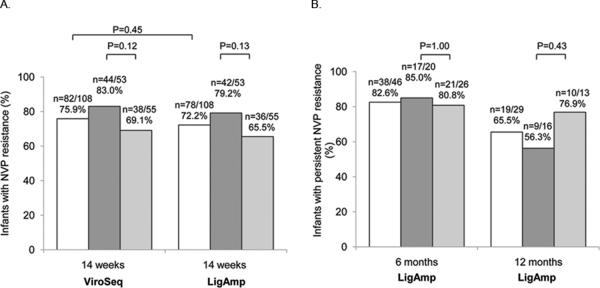
Results: At 14 weeks of age, NVP resistance was detected in samples from 82 (75.9%) of 108 HIV-infected infants. Although the frequency of NVP resistance detected by ViroSeq was lower in the extended NVP + ZDV arm than in the extended NVP arm, the difference was not statistically significant (38/55 = 69.1% vs. 44/53 = 83.0%, P = 0.12). Similar results were obtained using LigAmp. Using LigAmp, the proportion of infants who still had detectable NVP resistance at 6 and 12 months was similar among infants in the two study arms (at 6 months: 17/20 = 85.0% for extended NVP vs. 21/26 = 80.8% for extended NVP + ZDV, P = 1.00; at 12 months: 9/16 = 56.3% for extended NVP vs.10/13 = 76.9% for extended NVP + ZDV, P = 0.43).
Conclusion: Infants exposed to extended NVP or extended NVP + ZDV had high rates of NVP resistance at 14 weeks of age, and resistant variants frequently persisted for 6-12 months. Frequency and persistence of NVP resistance did not differ significantly among infants who received extended NVP only vs. extended NVP + ZDV prophylaxis.
Figures
Comment in
-
Resistance, resistance, go away: persistence of nevirapine-resistant HIV mutations in HIV-infected infants.AIDS. 2011 Apr 24;25(7):997-9. doi: 10.1097/QAD.0b013e3283463d44. AIDS. 2011. PMID: 21487253 No abstract available.
References
-
- Six Week Extended-Dose Nevirapine (SWEN) Study Team Extended-dose nevirapine to 6 weeks of age for infants to prevent HIV transmission via breastfeeding in Ethiopia, India, and Uganda: an analysis of three randomised controlled trials. Lancet. 2008;372:300–13. - PubMed
-
- Kumwenda NI, Hoover DR, Mofenson LM, et al. Extended antiretroviral prophylaxis to reduce breast-milk HIV-1 transmission. N Engl J Med. 2008;359:119–29. - PubMed
-
- World Health Organization (WHO) Use of antiretroviral drugs for treating pregnant women and preventing HIV infection in infants. [Accessed May 28, 2010];Rapid advice. 2009 Available at: http://www.who.int/hiv/pub/mtct/rapid_advice_mtct.pdf. - PubMed
-
- Eshleman SH, Mracna M, Guay LA, et al. Selection and fading of resistance mutations in women and infants receiving nevirapine to prevent HIV-1 vertical transmission (HIVNET 012) AIDS. 2001;15:1951–7. - PubMed
Publication types
MeSH terms
Substances
Grants and funding
LinkOut - more resources
Full Text Sources
Medical
