Review
. 2011 Apr 12:7:483.
doi: 10.1038/msb.2011.16.

Social interaction in synthetic and natural microbial communities

Affiliations
Review

Social interaction in synthetic and natural microbial communities

Joao B Xavier. Mol Syst Biol. .

Abstract

Social interaction among cells is essential for multicellular complexity. But how do molecular networks within individual cells confer the ability to interact? And how do those same networks evolve from the evolutionary conflict between individual- and population-level interests? Recent studies have dissected social interaction at the molecular level by analyzing both synthetic and natural microbial populations. These studies shed new light on the role of population structure for the evolution of cooperative interactions and revealed novel molecular mechanisms that stabilize cooperation among cells. New understanding of populations is changing our view of microbial processes, such as pathogenesis and antibiotic resistance, and suggests new ways to fight infection by exploiting social interaction. The study of social interaction is also challenging established paradigms in cancer evolution and immune system dynamics. Finding similar patterns in such diverse systems suggests that the same 'social interaction motifs' may be general to many cell populations.


Conflict of interest statement

The author declares that he has no conflict of interest.

Figures
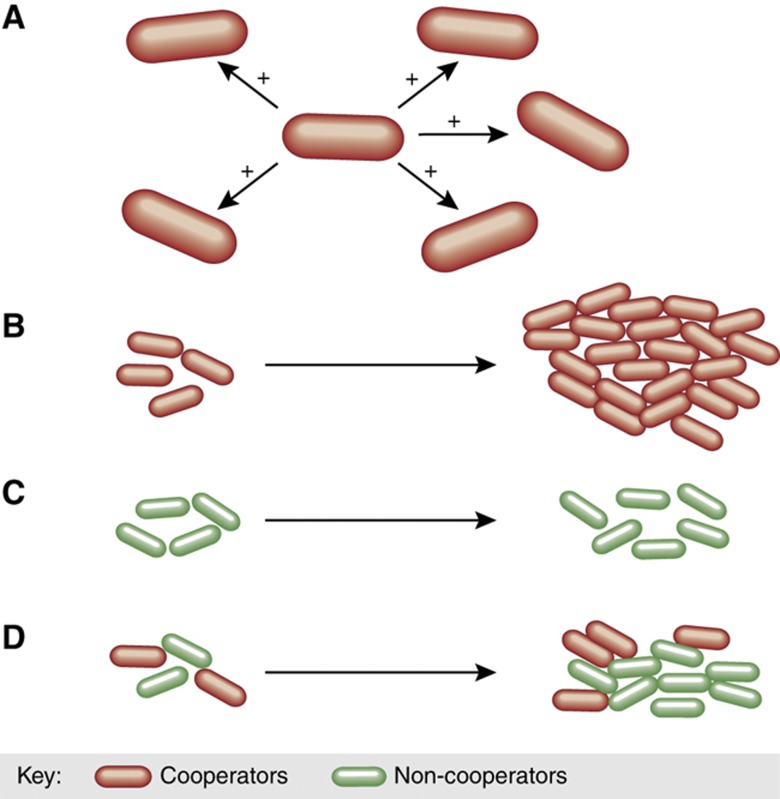
Figure 1
Figure 1
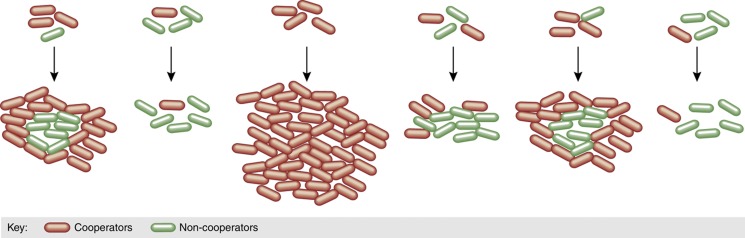
Cooperative social interactions that provide a population-level benefit often come at a cost to individual's cells. (A) A cooperative interaction provides a fitness benefit to recipients. (B) A population of cooperators has a higher productivity than (C) a population of non-cooperators. (D) Non-cooperators can exploit cooperators in mixed populations by benefiting from cooperation without contributing.
Figure 2
Figure 2
Multilevel selection is essential for the evolution of cooperation among microbes. Cooperative strategies can have an evolutionary advantage in the global population, even though the same strategy is disadvantageous in local sub-populations. This happens because groups with a higher proportion of cooperators are more productive and therefore contribute more to the global gene pool.
Figure 3
Figure 3
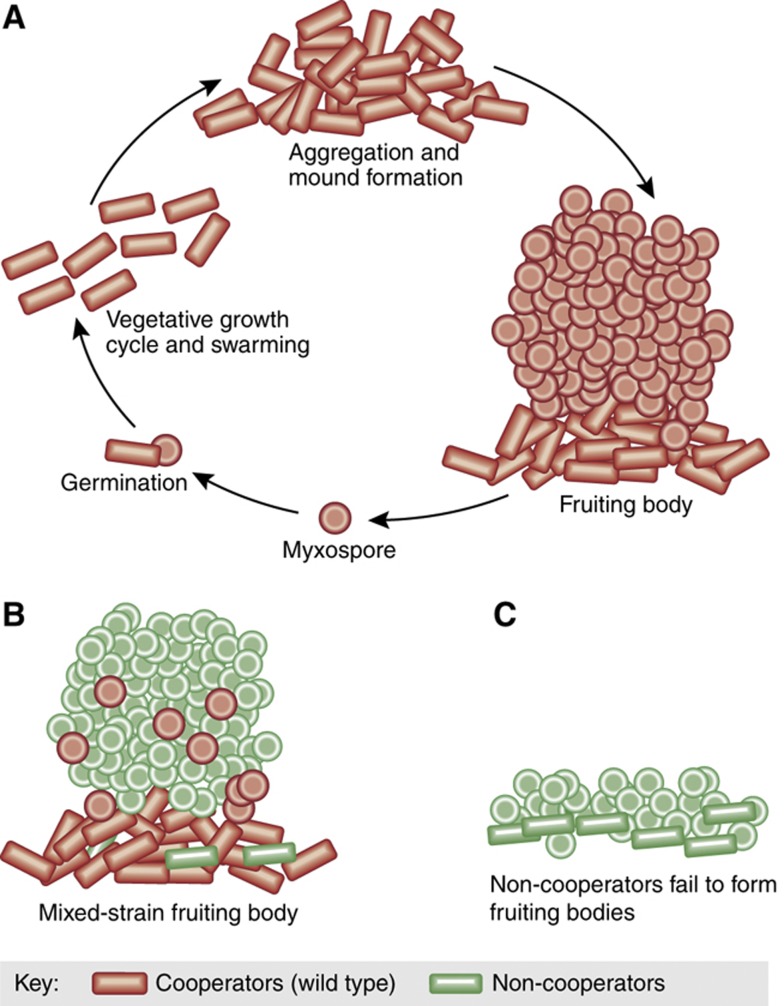
Cooperation and conflict in fruiting body formation. (A) The life cycle of M. xanthus (Zusman et al, 2007). (B) Non-cooperators preferentially differentiate into spores and have an advantage when mixed with wild-type cooperators. (C) Non-cooperators fail to form proper fruiting bodies when alone.
Figure 4
Figure 4
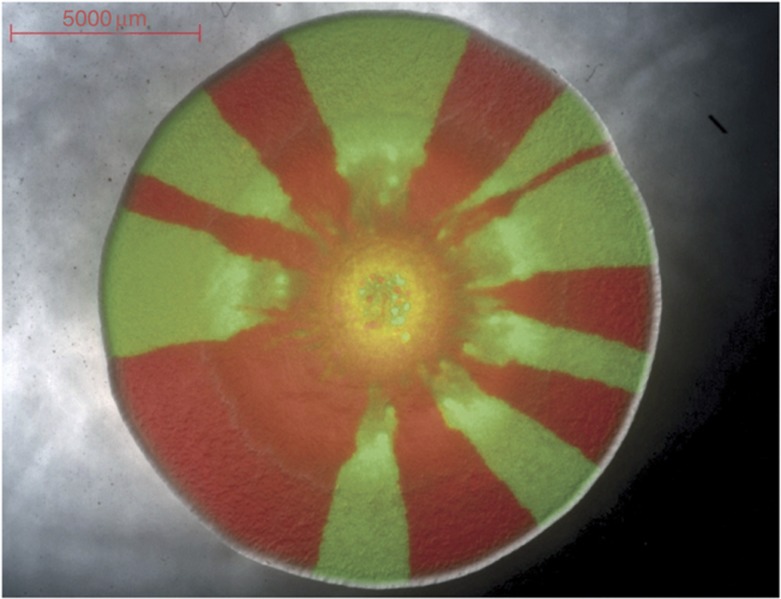
Genetic drift in an expanding bacterial colony. The colony shown here was prepared by mixing two strains of P. aeruginosa labeled with green and red fluorescent markers, respectively. Besides the fluorescent label, the two strains have identical phenotypes and therefore are neutral. Nevertheless, they segregate into sectors as the colony expands. This method was first used in E. coli colonies (Hallatschek et al, 2007).
Figure 5
Figure 5
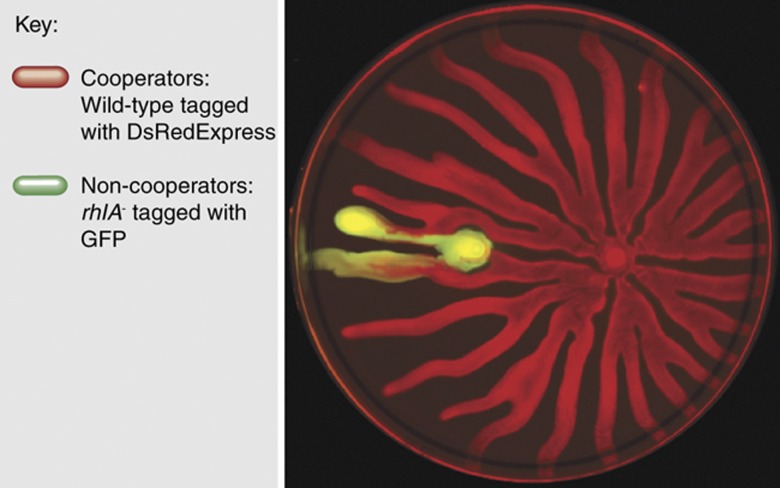
Social exploitation in P. aeruginosa swarming. Colonies of P. aeruginosa swarm over soft agar, but this collective trait requires that individual cells synthesize and secrete massive amounts of rhamnolipid biosurfactants. Cells lacking the synthesis gene rhlA are capable of swarming using the biosurfactants produced by others. Wild-type cells restrict rhlA expression to times when carbon source is in excess of that needed for growth, which lowers the cost that biosurfactant synthesis has on their fitness. This mechanism, called metabolic prudence, prevents exploitation by non-cooperator rhlA mutants (Xavier et al, 2011).
Figure 6
Figure 6
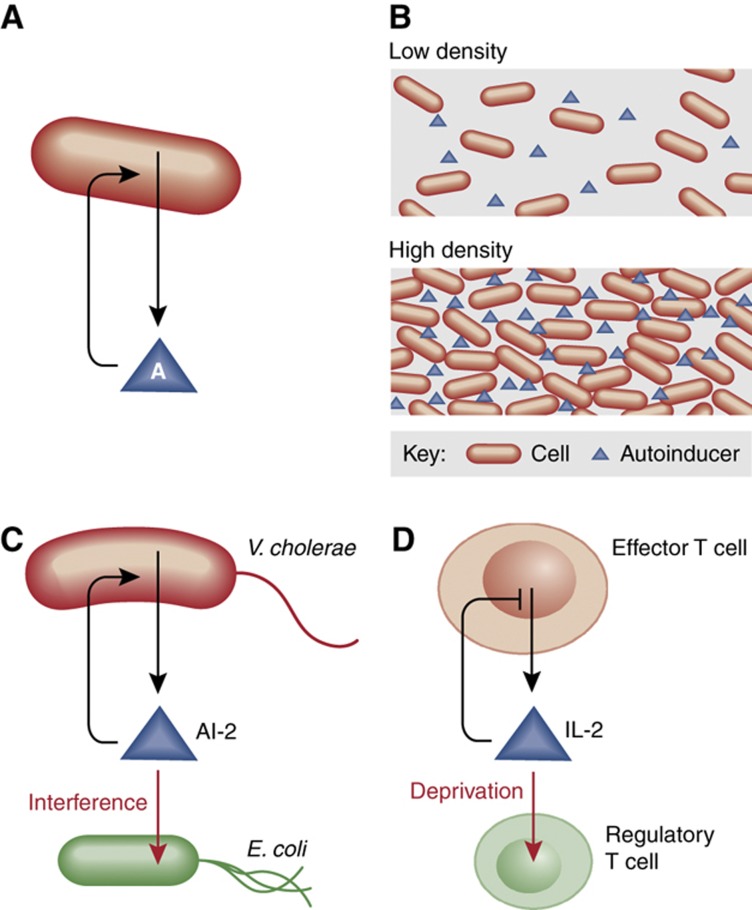
Quorum sensing as a social interaction motif. (A) The ability of a cell to produce a signaling molecule (an autoinducer) and sense its extracellular concentration can enable the cell to sense changes in population density (B). Quorum sensing can be found in diverse systems such as (C) pathogenic bacteria (Vibrio cholerae) and (D) the adaptive immune system of mammals with common principles but different molecular players. Interestingly, quorum sensing in both V. cholerae and effector T cells is perturbed by competitor cells that sequester the signaling molecule. The enteric E. coli interferes with V. cholerae by taking up the autoinducer AI-2 (Xavier and Bassler, 2005). The immune response is mediated by IL-2 quorum sensing in effector T cells, but IL-2 deprivation by regulatory T cells is important to prevent autoimmune responses. An important difference between the T-cell system and others is that the feedback on signal production is negative (Feinerman et al, 2010).

References

    1. Alon U (2007) An Introduction to Systems Biology: Design Principles of Biological Circuits. Boca Raton: Taylor & Francis
    1. Axelrod R, Axelrod DE, Pienta KJ (2006) Evolution of cooperation among tumor cells. Proc Natl Acad Sci USA 103: 13474–13479 - PMC - PubMed
    1. Balaban NQJ, Merrin J, Chait R, Kowalik L, Leibler S (2004) Bacterial persistence as a phenotypic switch. Science 305: 1622–1625 - PubMed
    1. Balagaddé FK, Song H, Ozaki J, Collins CH, Barnet M, Arnold FH, Quake SR, You L (2008) A synthetic Escherichia coli predator-prey ecosystem. Mol Syst Biol 4: 187. - PMC - PubMed
    1. Bassler B, Losick R (2006) Bacterially Speaking. Cell 125: 237–246 - PubMed

Publication types