


Functional microarray analysis suggests repressed cell-cell signaling and cell survival-related modules inhibit progression of head and neck squamous cell carcinoma
- PMID: 21489260
- PMCID: PMC3095999
- DOI: 10.1186/1755-8794-4-33
Functional microarray analysis suggests repressed cell-cell signaling and cell survival-related modules inhibit progression of head and neck squamous cell carcinoma
Abstract
Background: Cancer shows a great diversity in its clinical behavior which cannot be easily predicted using the currently available clinical or pathological markers. The identification of pathways associated with lymph node metastasis (N+) and recurrent head and neck squamous cell carcinoma (HNSCC) may increase our understanding of the complex biology of this disease.
Methods: Tumor samples were obtained from untreated HNSCC patients undergoing surgery. Patients were classified according to pathologic lymph node status (positive or negative) or tumor recurrence (recurrent or non-recurrent tumor) after treatment (surgery with neck dissection followed by radiotherapy). Using microarray gene expression, we screened tumor samples according to modules comprised by genes in the same pathway or functional category.
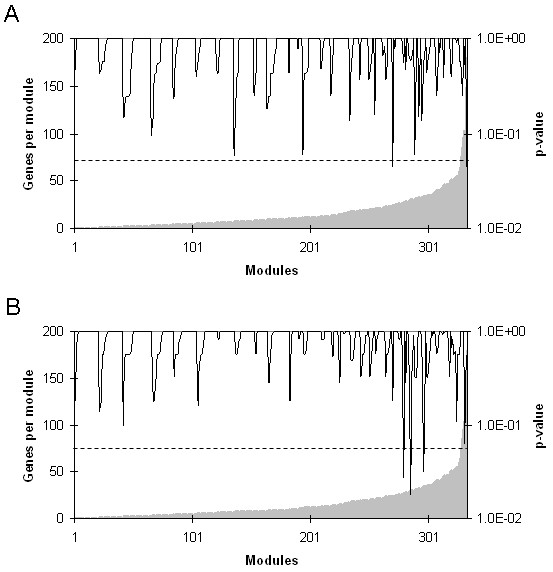
Results: The most frequent alterations were the repression of modules in negative lymph node (N0) and in non-recurrent tumors rather than induction of modules in N+ or in recurrent tumors. N0 tumors showed repression of modules that contain cell survival genes and in non-recurrent tumors cell-cell signaling and extracellular region modules were repressed.
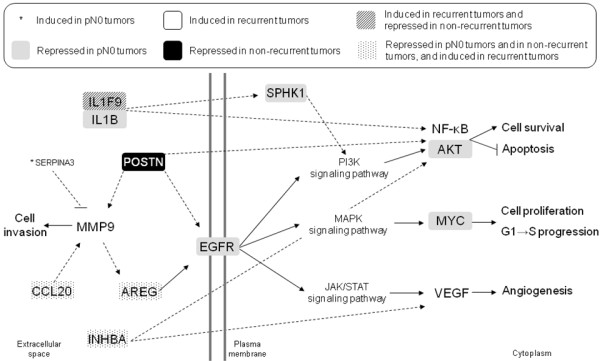
Conclusions: The repression of modules that contain cell survival genes in N0 tumors reinforces the important role that apoptosis plays in the regulation of metastasis. In addition, because tumor samples used here were not microdissected, tumor gene expression data are represented together with the stroma, which may reveal signaling between the microenvironment and tumor cells. For instance, in non-recurrent tumors, extracellular region module was repressed, indicating that the stroma and tumor cells may have fewer interactions, which disable metastasis development. Finally, the genes highlighted in our analysis can be implicated in more than one pathway or characteristic, suggesting that therapeutic approaches to prevent tumor progression should target more than one gene or pathway, specially apoptosis and interactions between tumor cells and the stroma.
Figures
References
-
- Haberal I, Celik H, Gocmen H, Akmansu H, Yoruk M, Ozeri C. Which is important in the evaluation of metastatic lymph nodes in head and neck cancer: Palpation, ultrasonography, or computed tomography? Otolaryngology-Head and Neck Surgery. 2004;130(2):197–201. doi: 10.1016/j.otohns.2003.08.025. - DOI - PubMed
-
- Shoaib T, Soutar DS, MacDonald DG, Camilleri IG, Dunaway DJ, Gray HW, McCurrach GM, Bessent RG, MacLeod TIF, Robertson AG. The accuracy of head and neck carcinoma sentinel lymph node biopsy in the clinically NO neck. Cancer. 2001;91(11):2077–2083. doi: 10.1002/1097-0142(20010601)91:11<2077::AID-CNCR1235>3.0.CO;2-E. - DOI - PubMed
-
- Khafif RA, Gelbfish GA, Tepper P, Attie JN. Elective Radical Neck Dissection in Epidermoid Cancer of The Head and Neck - A Retrospective Analysis of 853 Cases of Mouth, Pharynx, and Larynx Cancer. Cancer. 1991;67(1):67–71. doi: 10.1002/1097-0142(19910101)67:1<67::AID-CNCR2820670113>3.0.CO;2-A. - DOI - PubMed
Publication types
MeSH terms
LinkOut - more resources
Full Text Sources
Medical
Molecular Biology Databases
