


Prescription patterns and appropriateness of NSAID therapy according to gastrointestinal risk and cardiovascular history in patients with diagnoses of osteoarthritis
- PMID: 21489310
- PMCID: PMC3101123
- DOI: 10.1186/1741-7015-9-38
Prescription patterns and appropriateness of NSAID therapy according to gastrointestinal risk and cardiovascular history in patients with diagnoses of osteoarthritis
Abstract
Background: Prescription of non-steroidal anti-inflammatory drugs (NSAIDs) should be based on the assessment of both gastrointestinal (GI) and cardiovascular (CV) risk for the individual patient. We aimed to assess the GI/CV risk profile and the pharmacological management of patients with osteoarthritis (OA) in clinical practice.
Methods: We conducted a cross-sectional, multicentre, observational study of consecutive OA patients that visited 1,760 doctors throughout the Spanish National Health System (NHS) in a single day. The presence of GI risk factors, CV histories, hypertension and current pharmacological treatments was recorded.
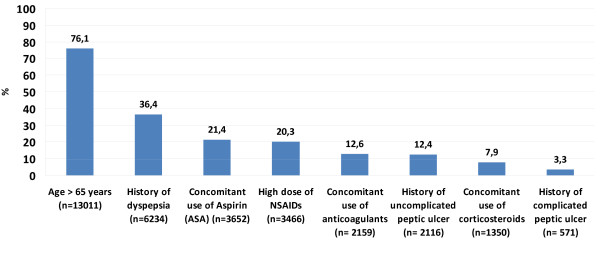
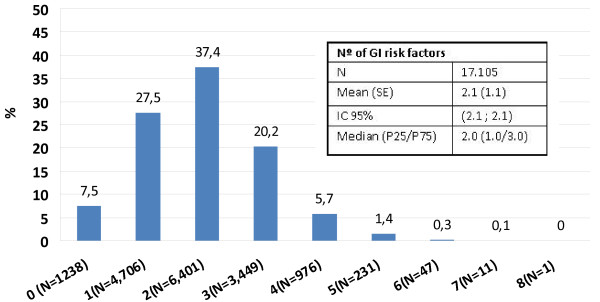
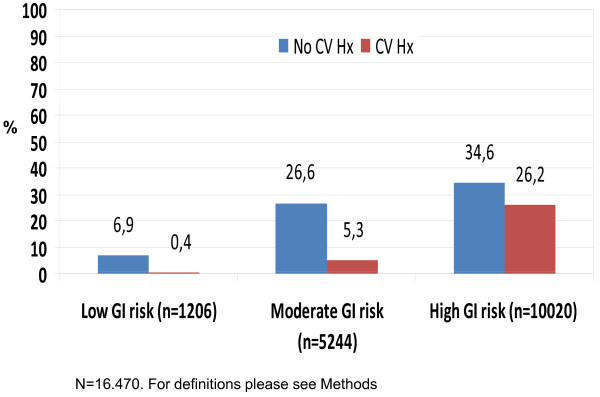
Results: Of the 60,868 patients, 17,105 had a diagnosis of OA and were evaluable. The majority (93.4%) had more than one GI risk factor and 60.3% were defined to be at high-GI risk. Thirty-two percent had a history of CV events, 57.6% were treated with anti-hypertensive therapy and 22.6% had uncontrolled hypertension. One-fifth of patients were treated with non-NSAID therapies, whereas the remaining patients received NSAIDs. Non-selective NSAIDs (nsNSAID) plus proton pump inhibitor (PPI) or cyclooxigenase-2 (COX-2)-selective NSAIDs alone were more frequently prescribed in patients at increased GI risk. Patients with a positive CV history received nsNSAIDs or COX-2-selective NSAIDs in 41.3% and 31.7% of cases, respectively. When both the GI and CV histories were combined, 51% of the overall population was being prescribed drugs that were either not recommended or contraindicated.
Conclusions: Over 90% of patients with OA are at increased GI and/or CV risk. In over half of these patients, the prescription of NSAIDs was not in accordance with current guidelines or recommendations made by regulatory agencies.
Figures
References
-
- Pendleton A, Arden N, Dougados M, Doherty M, Bannwarth B, Bijlsma JW, Cluzeau F, Cooper C, Dieppe PA, Günther KP, Hauselmann HJ, Herrero-Beaumont G, Kaklamanis PM, Leeb B, Lequesne M, Lohmander S, Mazieres B, Mola EM, Pavelka K, Serni U, Swoboda B, Verbruggen AA, Weseloh G, Zimmermann-Gorska. EULAR recommendations for the management of knee osteoarthritis: report of a task force of the Standing Committee for International Clinical Studies Including Therapeutic Trials (ESCISIT) Ann Rheum Dis. 2000;9:936–944. doi: 10.1136/ard.59.12.936. - DOI - PMC - PubMed
-
- Kearney PM, Baigent C, Godwin J, Halls H, Emberson JR, Patrono C. Do selective cyclo-oxygenase-2 inhibitors and traditional non-steroidal anti-infl ammatory drugs increase the risk of atherothrombosis? Meta-analysis of randomised trials. BMJ. 2006;332:1302–1308. doi: 10.1136/bmj.332.7553.1302. - DOI - PMC - PubMed
Publication types
MeSH terms
Substances
LinkOut - more resources
Full Text Sources
Other Literature Sources
Medical
Research Materials
