Review
. 2011 Jun;15(3):435-42.
doi: 10.1016/j.cbpa.2011.03.008. Epub 2011 Apr 12.

Toward mechanistic classification of enzyme functions

Affiliations
Review

Toward mechanistic classification of enzyme functions

Daniel E Almonacid et al. Curr Opin Chem Biol. 2011 Jun.

Abstract

Classification of enzyme function should be quantitative, computationally accessible, and informed by sequences and structures to enable use of genomic information for functional inference and other applications. Large-scale studies have established that divergently evolved enzymes share conserved elements of structure and common mechanistic steps and that convergently evolved enzymes often converge to similar mechanisms too, suggesting that reaction mechanisms could be used to develop finer-grained functional descriptions than provided by the Enzyme Commission (EC) system currently in use. Here we describe how evolution informs these structure-function mappings and review the databases that store mechanisms of enzyme reactions along with recent developments to measure ligand and mechanistic similarities. Together, these provide a foundation for new classifications of enzyme function.


Figures

Figure 1
Figure 1
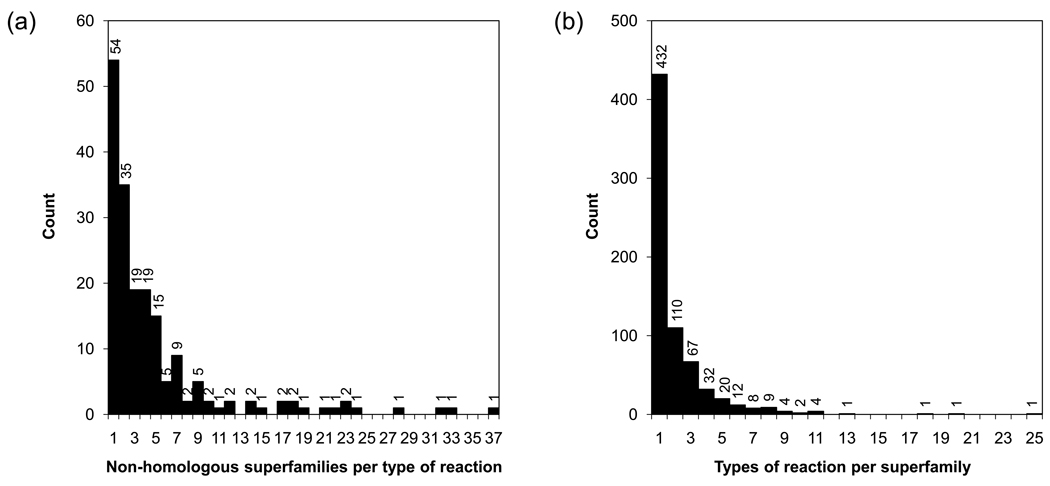
Estimation of divergent and convergent function evolution in enzymes. In analogy to previous studies within and across genomes [59,60], we have used PDBSprotEC and SCOP to map EC sub-subclasses to structural superfamilies. EC sub-subclasses (first three numbers in the EC system) were used rather than EC serial numbers (all four numbers) to capture reaction specificities irrespective of substrate specificities. (a) The number of different EC sub-subclasses (types of chemical reactions) associated to members of structurally characterized enzyme superfamilies indicates that over one third of superfamilies (272 out of 704) are functionally diverse. (b) The minimum number of non-homologous superfamilies associated to each type of chemical reaction indicates that in over two thirds of the EC sub-subclasses (131 out of 185) Nature has convergently evolved independent enzymes to carry out the same function.
Figure 2
Figure 2
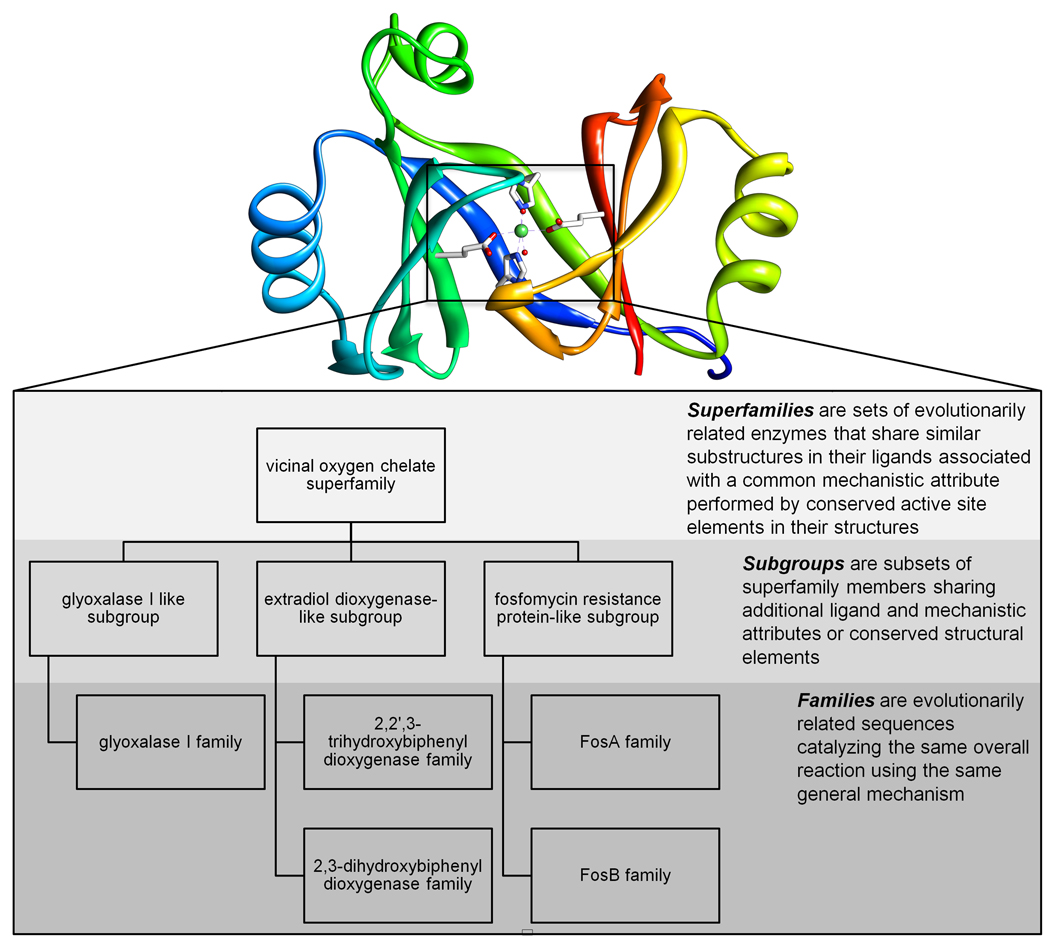
Organization of a subset of subgroups and families of the vicinal oxygen chelate superfamily in the SFLD. The SFLD stores structure-function relationships for functionally diverse enzyme superfamilies at three levels of granularity: superfamilies, subgroups, and families. The structure corresponds to a member of the glyoxalase I family depicting the conserved positioning of the metal binding ligands in many of the members of the superfamily.
Figure 3
Figure 3
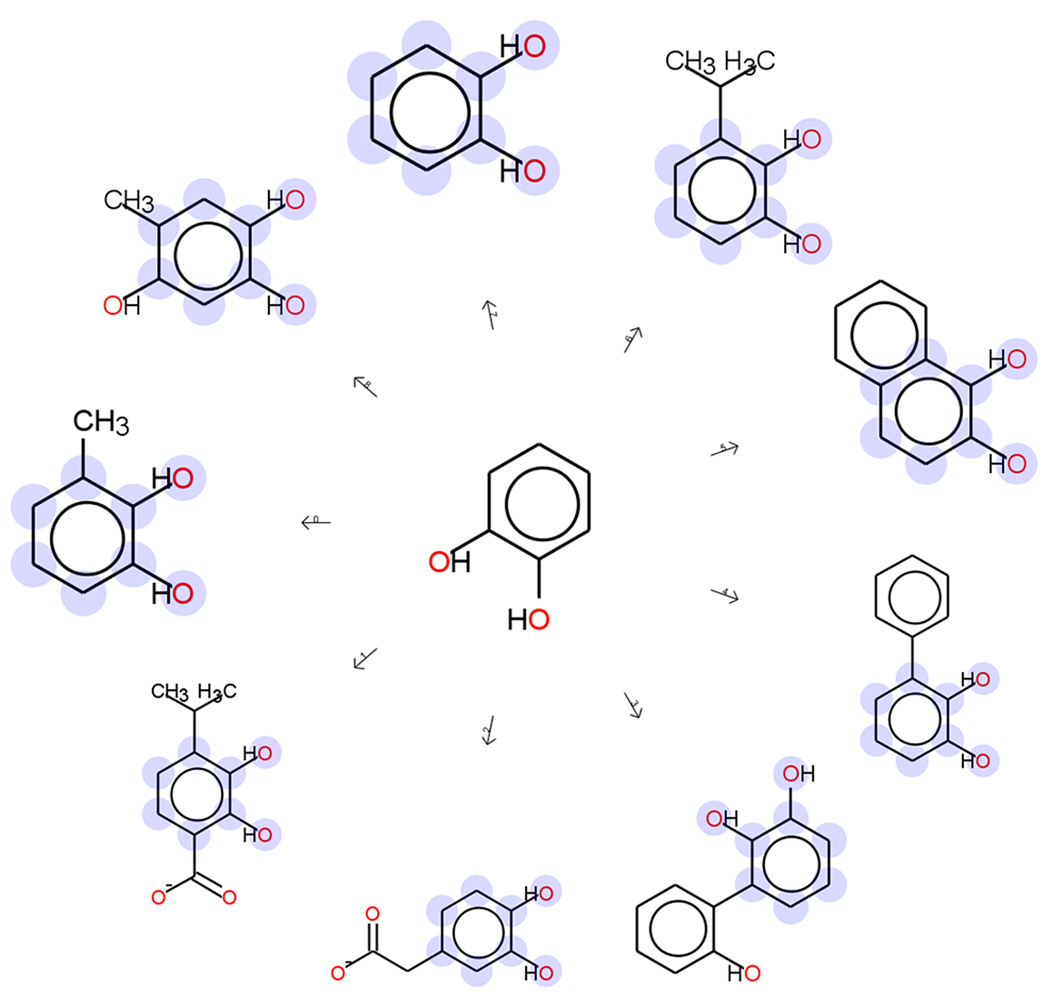
Common substructure shared among some substrates of enzymes from the extradiol dioxygenase-like subgroup of the vicinal oxygen chelate superfamily curated by the SFLD. The maximum common substructure was computed using the Small Molecule Subgraph Detector (SMDS) toolkit [49]. Highlighting shows the substructures common in all of the substrates.
Figure 4
Figure 4
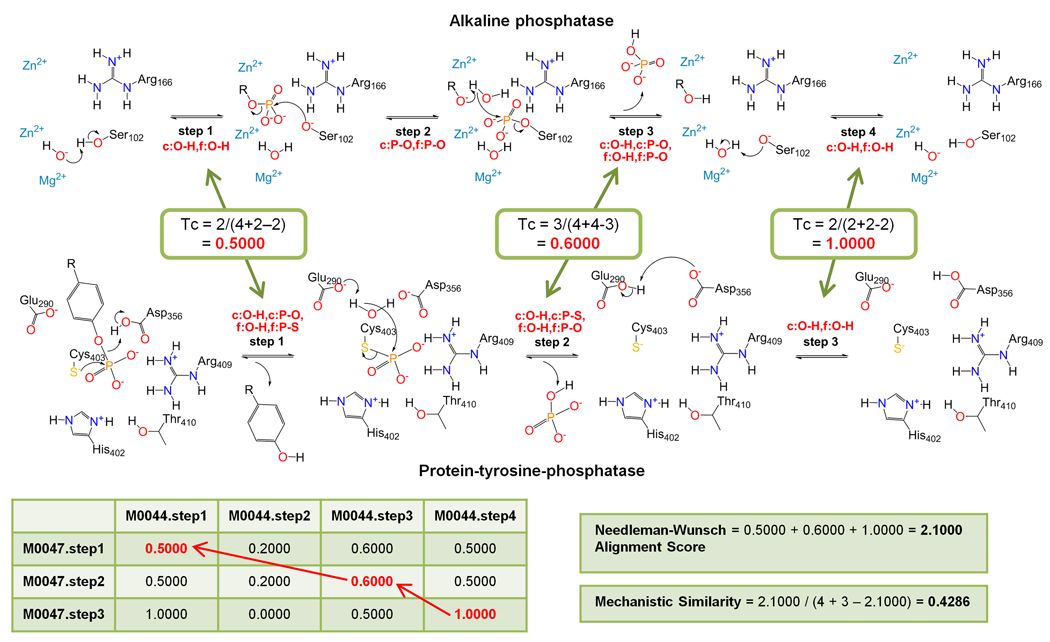
Quantification of mechanistic similarity (adapted from [23]). The convergently evolved reactions catalyzed by alkaline phosphatase (MACiE M0044, EC 3.1.3.1, PDB ID: 1alk), and protein-tyrosine-phosphatase (MACiE M0047, EC 3.1.3.48, PDB ID: 1ytw) are used as examples. Mechanistic step are represented as the set of bond changes occurring in the transformation from substrates to products in that step, with c: bond cleaved, d: bond decreased in order, f: bond formed, and i: bond increased in order. Similarities between the sets of bond changes of the steps of the reactions compared are computed using Tanimoto coefficients (Tc) and stored in a similarity matrix. The maximum-match pathway is then obtained using the Needleman-Wunsch algorithm, and mechanistic similarity is computed as a new Tanimoto coefficient using the number of steps in each reaction and the Needleman-Wunsch alignment score as inputs.

References

    1. IUBMB. Enzyme Nomenclature 1992: Recommendations of the Nomenclature Committee of the International Union of Biochemistry and Molecular Biology on the nomenclature and classification of enzymes. Academic Press; 1992.
    1. Babbitt PC. Definitions of enzyme function for the structural genomics era. Curr Opin Chem Biol. 2003;7:230–237. - PubMed
    1. Gerlt JA, Babbitt PC. Divergent evolution of enzymatic function: mechanistically diverse superfamilies and functionally distinct suprafamilies. Annu Rev Biochem. 2001;70:209–246. - PubMed
    1. Glasner ME, Gerlt JA, Babbitt PC. Evolution of enzyme superfamilies. Curr Opin Chem Biol. 2006;10:492–497. - PubMed
    1. Omelchenko MV, Galperin MY, Wolf YI, Koonin EV. Non-homologous isofunctional enzymes: a systematic analysis of alternative solutions in enzyme evolution. Biol Direct. 2010;5:31. This is an updated survey of convergently evolved enzymes that identifies 186 groups of non-homologous enzymes that catalyze identical chemical transformations.

Publication types

LinkOut - more resources