. 2011 Jun 3;286(22):19392-8.
doi: 10.1074/jbc.M111.229781. Epub 2011 Apr 13.

5'-methylthioadenosine nucleosidase is implicated in playing a key role in a modified futalosine pathway for menaquinone biosynthesis in Campylobacter jejuni

Affiliations

5'-methylthioadenosine nucleosidase is implicated in playing a key role in a modified futalosine pathway for menaquinone biosynthesis in Campylobacter jejuni

Xu Li et al. J Biol Chem. .

Abstract

Menaquinone (vitamin K(2)) serves as an electron carrier in the electron transport chain required for respiration in many pathogenic bacteria. Most bacteria utilize a common menaquinone biosynthetic pathway as exemplified by Escherichia coli. Recently, a novel biosynthetic pathway, the futalosine pathway, was discovered in Streptomyces. Bioinformatic analysis strongly suggests that this pathway is also operative in the human pathogens Campylobacter jejuni and Helicobacter pylori. Here, we provide compelling evidence that a modified futalosine pathway is operative in C. jejuni and that it utilizes 6-amino-6-deoxyfutalosine instead of futalosine. A key step in the Streptomyces pathway involves a nucleosidase called futalosine hydrolase. The closest homolog in C. jejuni has been annotated as a 5'-methylthioadenosine nucleosidase (MTAN). We have shown that this C. jejuni enzyme has MTAN activity but negligible futalosine hydrolase activity. However, the C. jejuni MTAN is able to hydrolyze 6-amino-6-deoxyfutalosine at a rate comparable with that of its known substrates. This suggests that the adenine-containing version of futalosine is the true biosynthetic intermediate in this organism. To demonstrate this in vivo, we constructed a C. jejuni mutant strain deleted for mqnA2, which is predicted to encode for the enzyme required to synthesize 6-amino-6-deoxyfutalosine. Growth of this mutant was readily rescued by the addition of 6-amino-6-deoxyfutalosine, but not futalosine. This provides the first direct evidence that a modified futalosine pathway is operative in C. jejuni. It also highlights the tremendous versatility of the C. jejuni MTAN, which plays key roles in S-adenosylmethionine recycling, the biosynthesis of autoinducer molecules, and the biosynthesis of menaquinone.


Figures
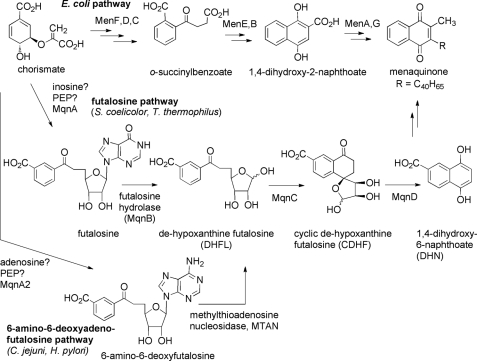
FIGURE 1.
FIGURE 1.
Pathways for menaquinone biosynthesis in bacteria. The upper pathway shows the biosynthesis of menaquinone in E. coli. The middle pathway shows the futalosine pathway employed by S. coelicolor and T. thermophilus. The lower pathway shows the modified futalosine pathway employed by C. jejuni and H. pylori. PEP, phosphoenolpyruvate.
FIGURE 2.
FIGURE 2.
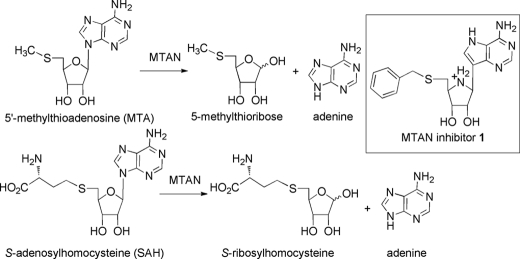
Reactions catalyzed by MTAN. The inset shows the structure of the potent MTAN inhibitor 1.
FIGURE 3.
FIGURE 3.
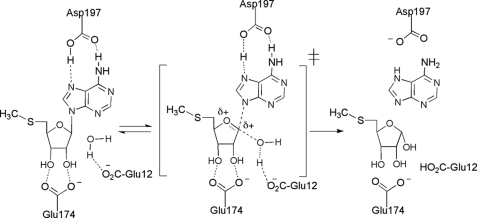
Proposed mechanism for the reaction catalyzed by the E. coli MTAN and the roles of key active site residues.
FIGURE 4.
FIGURE 4.
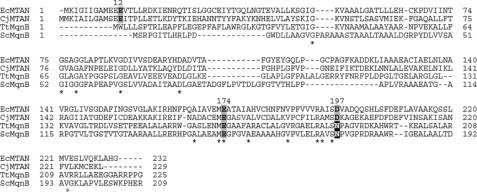
Alignment of the E. coli MTAN (EcMTAN), the C. jejuni MTAN (CjMTAN), the T. thermophilus futalosine hydrolase (TtMqnB), and the S. coelicolor futalosine hydrolase (ScMqnB). Accession numbers are P0AF14, Q0PC20, Q5SKT7, and Q9KXN0, respectively. Numbered residues correspond to key active site residues identified in the E. coli MTAN. Boldface residues with a gray background correspond to key active site residues identified in the E. coli MTAN and their corresponding conserved homologs. White residues with a black background indicate the replacement of the E. coli MTAN Glu-197 with Gln. Asterisks identify residues conserved in all four sequences. The alignment was performed using COBALT (33).
FIGURE 5.
FIGURE 5.
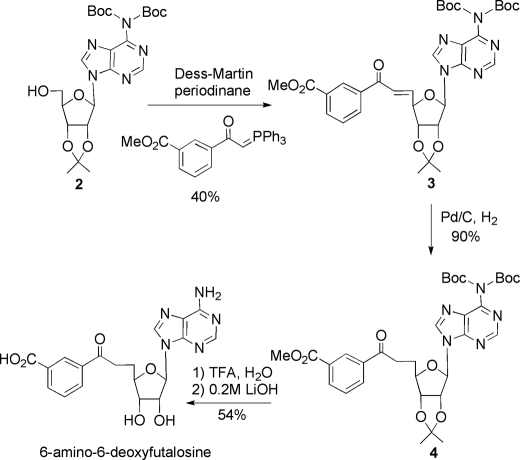
Synthetic route used to prepare 6-amino-6-deoxyfutalosine. Boc, t-butoxycarbonyl.
FIGURE 6.
FIGURE 6.
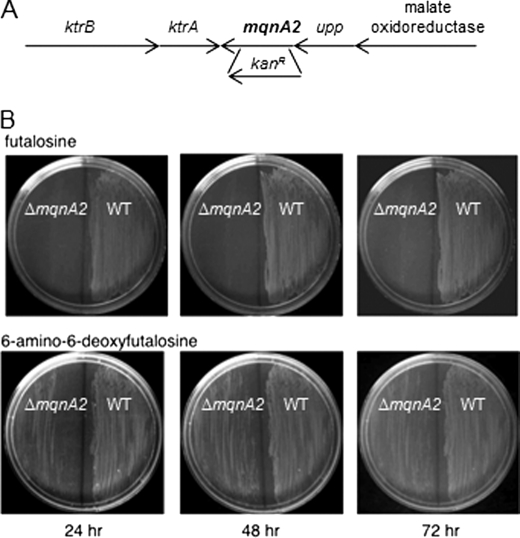
Genomic context of mqnA2 and growth of wild-type C. jejuni 81-176 and ΔmqnA2 on plates supplemented with either futalosine or 6-amino-6-deoxyfutalosine. A, the genomic organization surrounding mqnA2 showing that the gene is positioned at the end of an operon. The position of insertion of the kanamycin resistance cassette is indicated. B, growth of ΔmqnA2 (left) and the wild type (right) C. jejuni 81-176 is shown on plates supplemented with either futalosine (upper) or 6-amino-6-deoxyfutalosine (lower) as a function of time.

References

    1. Furie B., Bouchard B. A., Furie B. C. (1999) Blood 93, 1798–1808 - PubMed
    1. Kurosu M., Begari E. (2010) Molecules 15, 1531–1553 - PMC - PubMed
    1. Unden G., Bongaerts J. (1997) Biochim. Biophys. Acta 1320, 217–234 - PubMed
    1. Collins M. D., Jones D. (1981) Microbiol. Rev. 45, 316–354 - PMC - PubMed
    1. Dhiman R. K., Mahapatra S., Slayden R. A., Boyne M. E., Lenaerts A., Hinshaw J. C., Angala S. K., Chatterjee D., Biswas K., Narayanasamy P., Kurosu M., Crick D. C. (2009) Mol. Microbiol. 72, 85–97 - PMC - PubMed

Publication types

MeSH terms

LinkOut - more resources