. 2011 Jul;39(12):e81.
doi: 10.1093/nar/gkr217. Epub 2011 Apr 13.

A method for counting PCR template molecules with application to next-generation sequencing

Affiliations

A method for counting PCR template molecules with application to next-generation sequencing

James A Casbon et al. Nucleic Acids Res. 2011 Jul.

Abstract

Amplification by polymerase chain reaction is often used in the preparation of template DNA molecules for next-generation sequencing. Amplification increases the number of available molecules for sequencing but changes the representation of the template molecules in the amplified product and introduces random errors. Such changes in representation hinder applications requiring accurate quantification of template molecules, such as allele calling or estimation of microbial diversity. We present a simple method to count the number of template molecules using degenerate bases and show that it improves genotyping accuracy and removes noise from PCR amplification. This method can be easily added to existing DNA library preparation techniques and can improve the accuracy of variant calling.


Figures
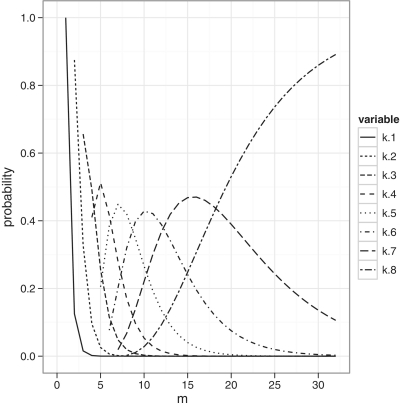
Figure 1.
Figure 1.
Likelihood of observing k counters from m molecules for a counter with eight possible DBRs. If we know m, we can look at this point on the x-axis to see the probability of observing k counter sequences. Alternatively, if we know k we can follow the individual curve to check which value of m maximizes the likelihood of k, i.e. the MLE of m. The curves for k = 1, 2, 3 all peak at m = k and show that if we observe 1, 2 or 3 counter sequences, we are most likely to have sequenced 1, 2 or 3 molecules, respectively.
Figure 2.
Figure 2.
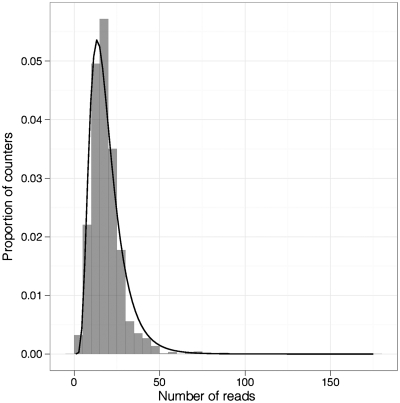
Histogram of the number of reads of different counters from an unamplified library. Line shows log normal fit.
Figure 3.
Figure 3.
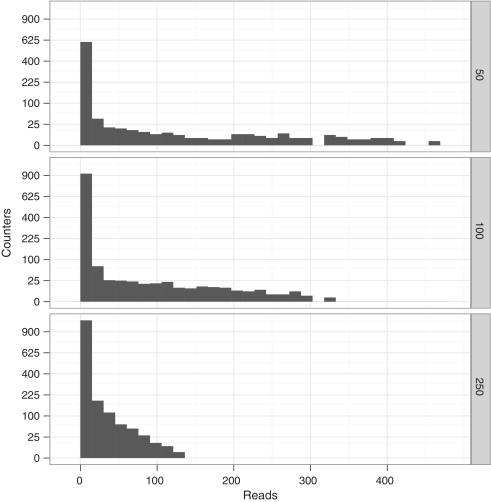
Histogram of reads of counters of amplified libraries with different input masses (top to bottom). Y scale has been scaled with the square root so that low numbers of counters are visible.
Figure 4.
Figure 4.
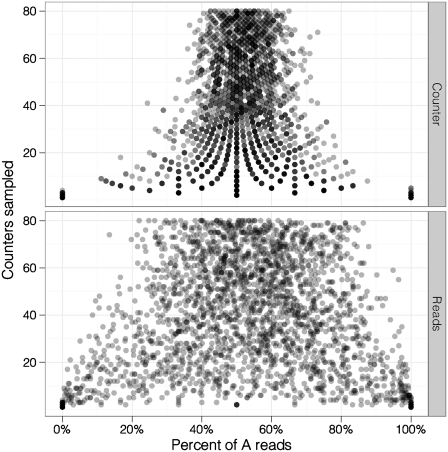
Allelic bias for random samples using counter numbers (top) and read numbers (bottom). Y-axis shows the number of counters sampled. Points are slightly transparent to show overplotting.
Figure 5.
Figure 5.
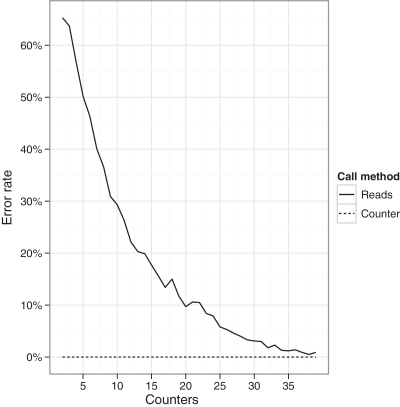
Proportion of samples showing errors (error rate) when called using counter consensus sequences or read numbers alone. X-axis shows the number of counters sampled.

References

    1. Kozarewa I, Ning Z, Quail MA, Sanders MJ, Berriman M, Turner DJ. Amplification-free Illumina sequencing-library preparation facilitates improved mapping and assembly of (G+C)-biased genomes. Nat. Methods. 2009;6:291–295. - PMC - PubMed
    1. Bentley DR, Balasubramanian S, Swerdlow HP, Smith GP, Milton J, Brown CG, Hall KP, Evers DJ, Barnes CL, Bignell HR, et al. Accurate whole human genome sequencing using reversible terminator chemistry. Nature. 2008;456:53–59. - PMC - PubMed
    1. Korbel JO, Urban AE, Affourtit JP, Godwin B, Grubert F, Simons JF, Kim PM, Palejev D, Carriero NJ, Du L, et al. Paired-end mapping reveals extensive structural variation in the human genome. Science. 2007;318:420–426. - PMC - PubMed
    1. Gnirke A, Melnikov A, Maguire J, Rogov P, LeProust EM, Brockman W, Fennell T, Giannoukos G, Fisher S, Russ C, et al. Solution hybrid selection with ultra-long oligonucleotides for massively parallel targeted sequencing. Nat. Biotechnol. 2009;27:182–189. - PMC - PubMed
    1. Johnson DS, Mortazavi A, Myers RM, Wold B. Genome-wide mapping of in vivo protein-DNA interactions. Science. 2007;316:1497–1502. - PubMed

Publication types