. 2011 Jul;85(13):6442-52.
doi: 10.1128/JVI.00129-11. Epub 2011 Apr 13.

Immunization with recombinant HLA classes I and II, HIV-1 gp140, and SIV p27 elicits protection against heterologous SHIV infection in rhesus macaques

Affiliations

Immunization with recombinant HLA classes I and II, HIV-1 gp140, and SIV p27 elicits protection against heterologous SHIV infection in rhesus macaques

Andreas Mörner et al. J Virol. 2011 Jul.

Abstract

Major histocompatibility complex (MHC) molecules expressed on the surface of human immunodeficiency virus (HIV) are potential targets for neutralizing antibodies. Since MHC molecules are polymorphic, nonself MHC can also be immunogenic. We have used combinations of novel recombinant HLA class I and II and HIV/simian immunodeficiency virus (SIV) antigens, all linked to dextran, to investigate whether they can elicit protective immunity against heterologous simian/human immunodeficiency virus (SHIV) challenge in rhesus macaques. Three groups of animals were immunized with HLA (group 1, n = 8), trimeric YU2 HIV type 1 (HIV-1) gp140 and SIV p27 (HIV/SIV antigens; group 2, n = 8), or HLA plus HIV/SIV antigens (group 3, n = 8), all with Hsp70 and TiterMax Gold adjuvant. Another group (group 4, n = 6) received the same vaccine as group 3 without TiterMax Gold. Two of eight macaques in group 3 were completely protected against intravenous challenge with 18 50% animal infective doses (AID(50)) of SHIV-SF162P4/C grown in human cells expressing HLA class I and II lineages represented in the vaccine, while the remaining six macaques showed decreased viral loads compared to those in unimmunized animals. Complement-dependent neutralizing activity in serum and high levels of anti-HLA antibodies were elicited in groups 1 and 3, and both were inversely correlated with the plasma viral load at 2 weeks postchallenge. Antibody-mediated protection was strongly supported by the fact that transfer of pooled serum from the two challenged but uninfected animals protected two naïve animals against repeated low-dose challenge with the same SHIV stock. This study demonstrates that immunization with recombinant HLA in combination with HIV-1 antigens might be developed into an alternative strategy for a future AIDS vaccine.


Figures
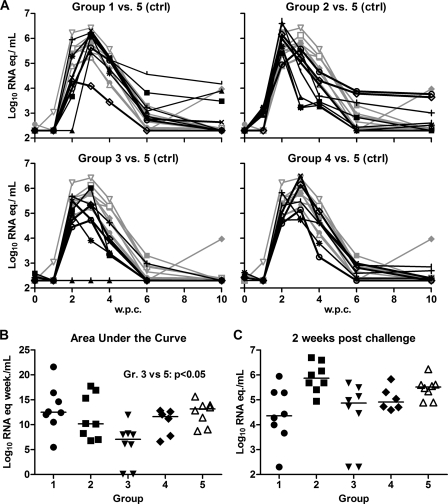
Fig. 1.
Fig. 1.
Plasma viral load after i.v. SHIV-SF162P4/C challenge in immunized animals (groups 1, 2, 3, and 4) and control animals (group 5). (A) Individual viral load kinetics at 0 to 10 weeks postchallenge (w.p.c.). Black lines, group 1 to 4 animals; gray lines, group 5 control animals. (B) Area-under-the-curve (AUC) viral load, representing cumulative viral load over 10 weeks. The infected macaques in group 3 had a significantly lower median AUC than the macaques in group 5 (P < 0.05). (C) Viral load at 2 w.p.c. Horizontal bars indicate medians.
Fig. 2.
Fig. 2.
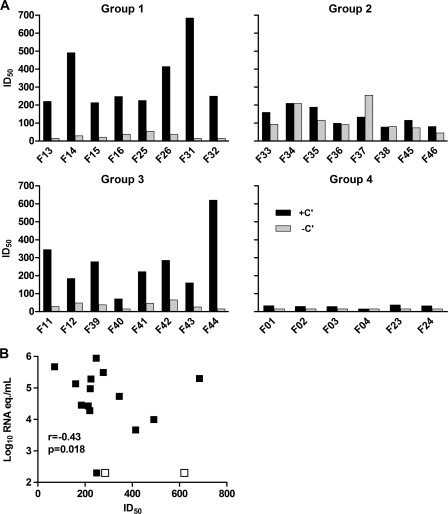
Serum neutralizing activity in immunized animals (groups 1, 2, 3, and 4) at the time of challenge, presented as 50% inhibitory dilution (ID50). (A) Neutralizing activity in the presence or absence of complement (+C′ or −C′, respectively). (B) Neutralizing activity in the presence of complement versus plasma viral load at 2 w.p.c. The protected animals (F42 and F44) are denoted by empty symbols.
Fig. 3.
Fig. 3.
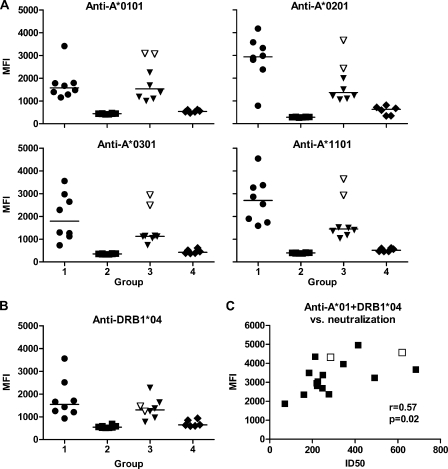
Serum anti-HLA IgG levels in immunized animals (groups 1, 2, 3, and 4) at the time of challenge, measured by Luminex at a 1/1,000 dilution. The protected animals (F42 and F44) are denoted by empty symbols. (A) IgG antibodies directed against the vaccine HLA class I antigens. (B) IgG antibodies directed against the vaccine HLA class II antigen. (C) Correlation between anti-A*01 and -DRB1*04 IgG and neutralizing antibodies, in the presence of complement, in groups 1 and 3.
Fig. 4.
Fig. 4.
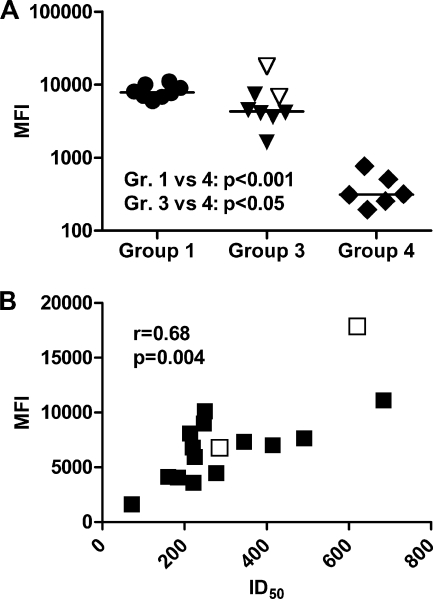
Serum anti-C8166-CCR5 IgG in immunized animals that received HLA-containing vaccine (groups 1, 3, and 4). Anti-C8166-CCR5 IgG was detected by FITC-conjugated anti-human IgG secondary antibody, and the mean fluorescence intensity (MFI) was measured. (A) Anti-C8166-CCR5 at the time of challenge. (B) Correlation between anti-C8166-CCR5 IgG and neutralizing antibodies, in the presence of complement, in groups 1 and 3. The protected animals F42 and F44 are denoted with empty symbols.
Fig. 5.
Fig. 5.
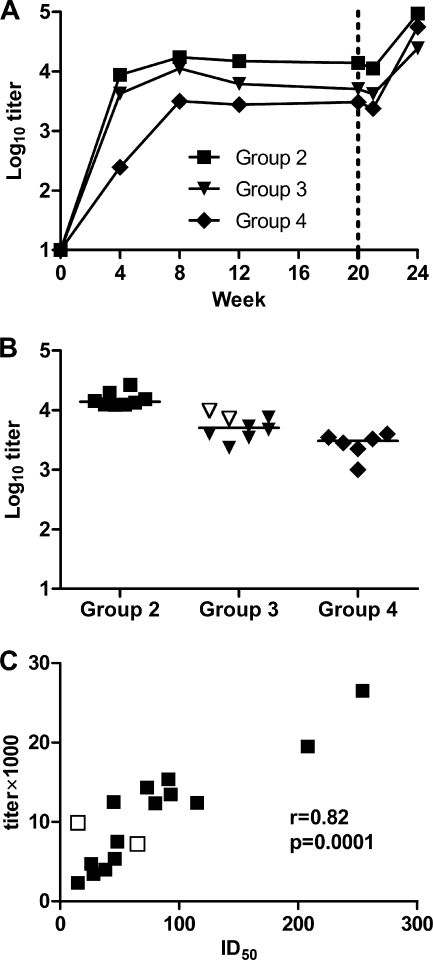
Serum anti-gp120 IgG in immunized animals that received HIV/SIV antigen-containing vaccine (groups 2, 3, and 4). (A) Median endpoint titers over time. The dashed line indicates the time of challenge. (B) Individual endpoint titers at the time of challenge. (C) Correlation between anti-gp120 IgG levels (log10 titer) and neutralizing activity in the absence of complement (ID50) at the time of challenge in groups 2 and 3. The protected animals (F42 and F44) are denoted with empty symbols.
Fig. 6.
Fig. 6.
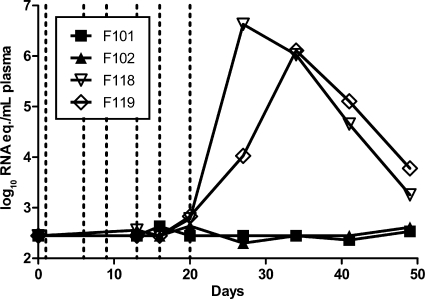
Plasma viral load in passively immunized macaques after repeated i.v. SHIV-SF162P4/C challenge. Immune sera from protected animals F42 and F44 were transferred to naïve animals F101 and F102, while control serum was given to F118 and F119. Starting the following day, all animals were challenged i.v. twice weekly for 3 weeks with 0.6 AID50 of SHIV-SF162P4/C (dashed lines).
Fig. 7.
Fig. 7.
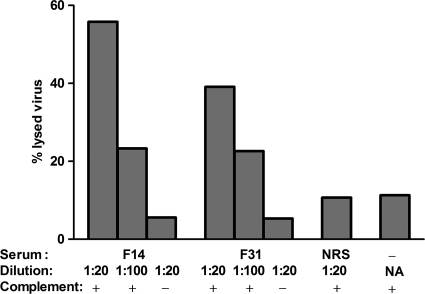
Anti-HLA antibody- and complement-mediated virion lysis. Lysis of SHIV-SF162P4/C virions in the presence of complement and immune sera from HLA immunized animals is shown. Sera from group 1 animals (F14 and F31), normal rhesus serum (NRS) or medium only (−) was incubated with SHIV-SF162P4/C in the presence (+) or absence (−) of complement. NA, not applicable.

References

    1. Arthur L. O., et al. 1995. Macaques immunized with HLA-DR are protected from challenge with simian immunodeficiency virus. J. Virol. 69:3117–3124 - PMC - PubMed
    1. Babaahmady K., Oehlmann W., Singh M., Lehner T. 2007. Inhibition of human immunodeficiency virus type 1 infection of human CD4+ T cells by microbial HSP70 and the peptide epitope 407-426. J. Virol. 81:3354–3360 - PMC - PubMed
    1. Brown E. J. 1991. Complement receptors and phagocytosis. Curr. Opin. Immunol. 3:76–82 - PubMed
    1. Carroll M. C. 2004. The complement system in regulation of adaptive immunity. Nat. Immunol. 5:981–986 - PubMed
    1. Chan W. L., et al. 1995. Immunization with class I human histocompatibility leukocyte antigen can protect macaques against challenge infection with SIVmac-32H. AIDS 9:223–228 - PubMed

Publication types

MeSH terms

Substances

Associated data