


Ghrelin enhances olfactory sensitivity and exploratory sniffing in rodents and humans
- PMID: 21490225
- PMCID: PMC3089941
- DOI: 10.1523/JNEUROSCI.5680-10.2011
Ghrelin enhances olfactory sensitivity and exploratory sniffing in rodents and humans
Abstract
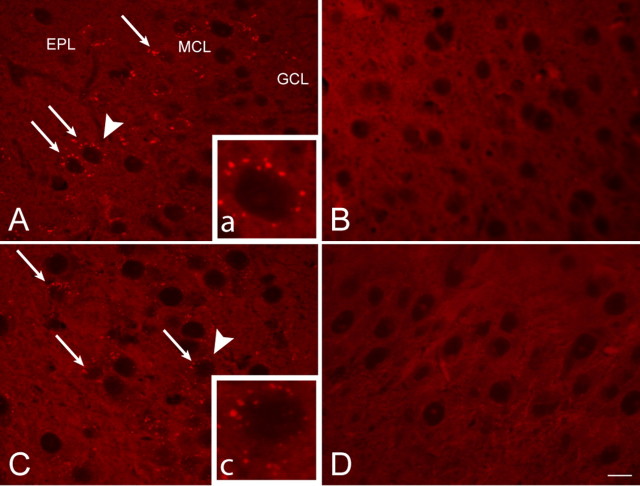
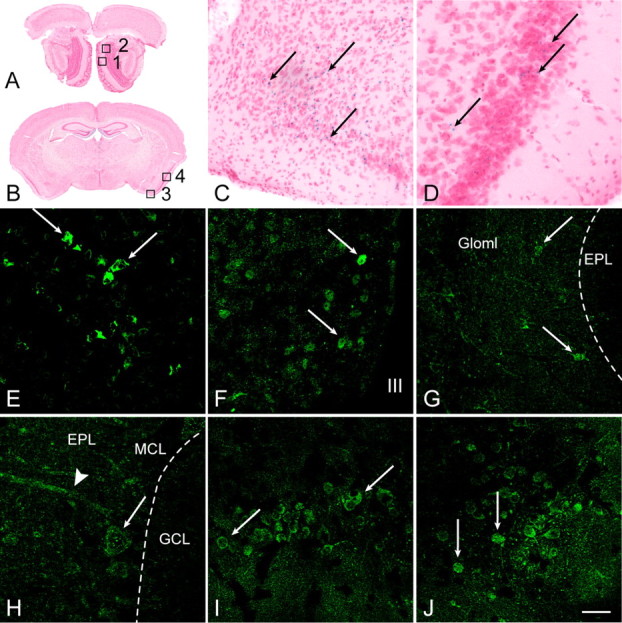
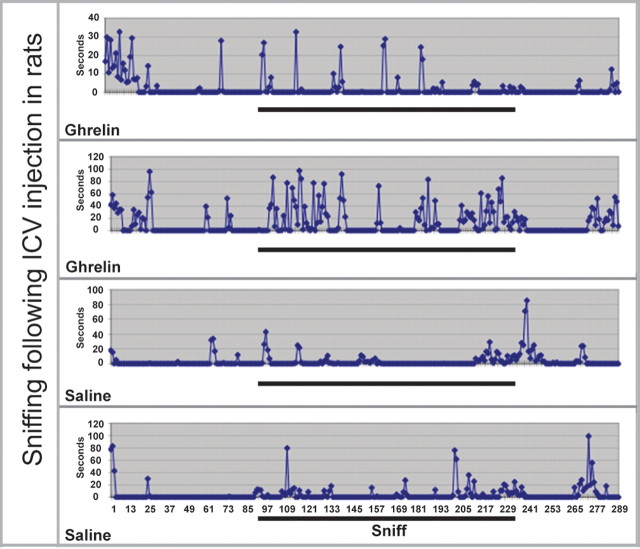
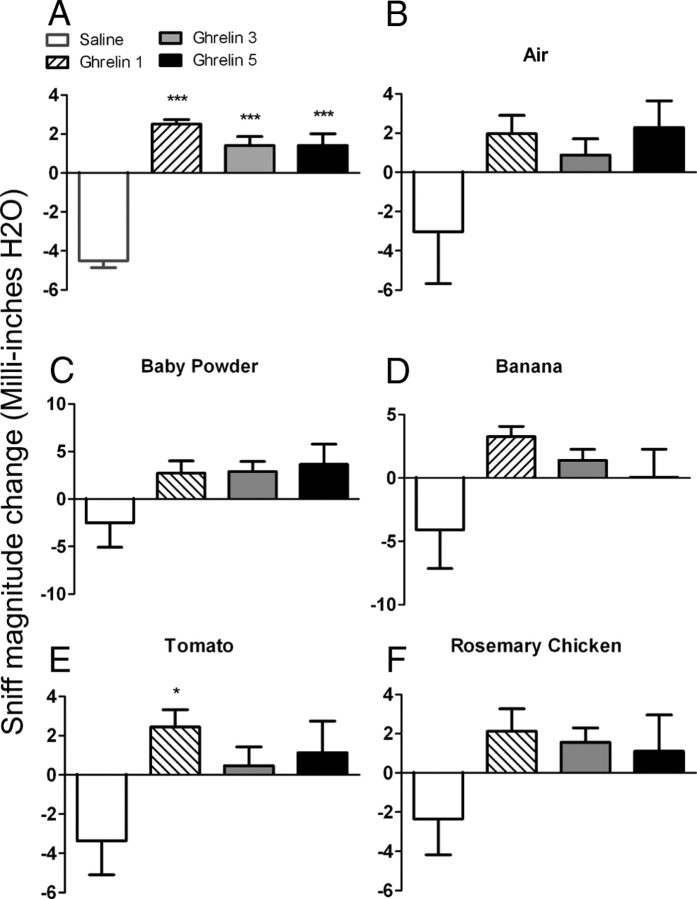
Olfaction is an integral part of feeding providing predictive cues that anticipate ingestion. Although olfactory function is modulated by factors such as prolonged fasting, the underlying neural mechanisms remain poorly understood. We recently identified ghrelin receptors in olfactory circuits in the brain. We therefore investigated the role of the appetite-stimulating hormone ghrelin in olfactory processing in rodents and humans, testing the hypothesis that ghrelin lowers olfactory detection thresholds and enhances exploratory sniffing, both being related to food seeking. In rats, intracerebroventricular ghrelin decreased odor detection thresholds and increased sniffing frequency. In humans, systemic ghrelin infusions significantly enhanced sniff magnitudes in response to both food and nonfood odorants and air in comparison to control saline infusions but did not affect the pleasantness ratings of odors. This is consistent with a specific effect on odor detection and not the hedonic value of odors. Collectively, our findings indicate that ghrelin stimulates exploratory sniffing and increases olfactory sensitivity, presumably enhancing the ability to locate, identify, and select foods. This novel role is consistent with ghrelin's overall function as a signal amplifier at the molecular interface between environmental and nutritional cues and neuroendocrine circuits controlling energy homeostasis.
Figures
References
-
- Aimé P, Duchamp-Viret P, Chaput MA, Savigner A, Mahfouz M, Julliard AK. Fasting increases and satiation decreases olfactory detection for a neutral odor in rats. Behav Brain Res. 2007;179:258–264. - PubMed
-
- Cowley MA, Smith RG, Diano S, Tschöp M, Pronchuk N, Grove KL, Strasburger CJ, Bidlingmaier M, Esterman M, Heiman ML, Garcia-Segura LM, Nillni EA, Mendez P, Low MJ, Sotonyi P, Friedman JM, Liu H, Pinto S, Colmers WF, Cone RD, et al. The distribution and mechanism of action of ghrelin in the CNS demonstrates a novel hypothalamic circuit regulating energy homeostasis. Neuron. 2003;37:649–661. - PubMed
-
- Critchley HD, Rolls ET. Hunger and satiety modify the responses of olfactory and visual neurons in the primate orbitofrontal cortex. J Neurophysiol. 1996;75:1673–1686. - PubMed
-
- Cummings DE. Ghrelin and the short- and long-term regulation of appetite and body weight. Physiol Behav. 2006;89:71–84. - PubMed
-
- Cummings DE, Purnell JQ, Frayo RS, Schmidova K, Wisse BE, Weigle DS. A preprandial rise in plasma ghrelin levels suggests a role in meal initiation in humans. Diabetes. 2001;50:1714–1719. - PubMed
Publication types
MeSH terms
Substances
Grants and funding
LinkOut - more resources
Full Text Sources
Other Literature Sources
Medical
