


doi: 10.1126/scitranslmed.3001626.
Community health care: therapeutic opportunities in the human microbiome
Affiliations
- PMID: 21490274
- PMCID: PMC3287364
- DOI: 10.1126/scitranslmed.3001626
Item in Clipboard
Community health care: therapeutic opportunities in the human microbiome
Sci Transl Med.
.
Abstract
We are never alone. Humans coexist with diverse microbial species that live within and upon us--our so-called microbiota. It is now clear that this microbial community is essentially another organ that plays a fundamental role in human physiology and disease. Basic and translational research efforts have begun to focus on deciphering mechanisms of microbiome function--and learning how to manipulate it to benefit human health. In this Perspective, we discuss therapeutic opportunities in the human microbiome.
Figures
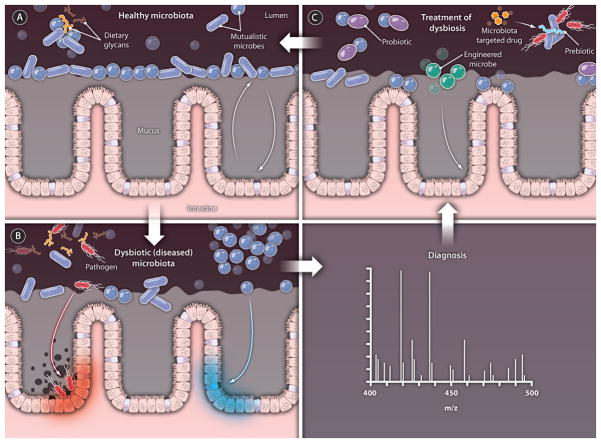
Many factors can cause a shift in the microbiota from (A) a healthy state to (B) a dysbiotic or diseased state. Detection of small molecules that serve as reporters of community membership and function can be used to diagnose the perturbed community and to determine the appropriate treatment (C). In the healthy state (A), a dense population of microbes inhabits the intestine. Resident microbes (tktk) compete for nutrients [such as dietary polysaccharides] (tktk), and an ecologically stable state is maintained through a complex and poorly understood network of host-host and host-microbe interactions. As shown in (B), diverse factors contribute to community disruption and disease, such as pathogen emergence, other alterations in the microbiota composition, and changes in microbiota function and interaction with the mucosa. Treatment of dysbiosis (C) can be accomplished with probiotics (tktk), prebiotics (tktk), microbes that confer gain-of-function, and microbiota-targeted drugs. CREDIT: C. BICKEL/SCIENCE TRANSLATIONAL MEDICINE
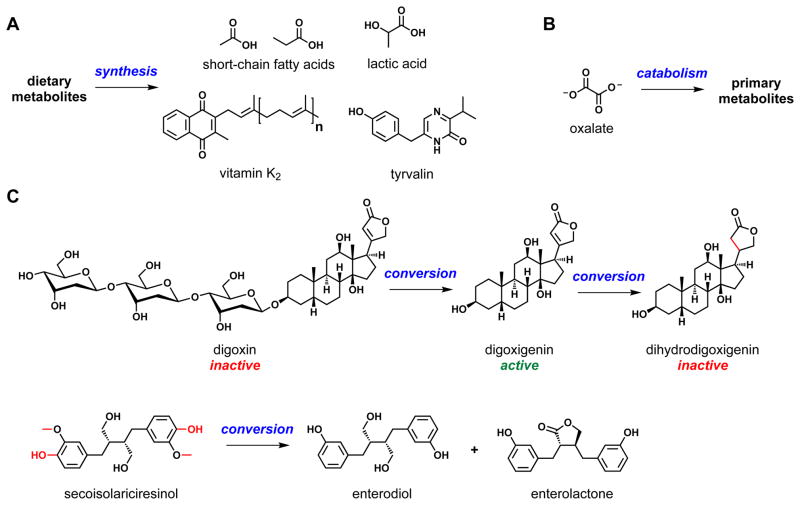
Shown are three examples of chemical transformations catalyzed by human-associated bacteria. (A) Human microbiota use dietary metabolites as raw material for the synthesis of a variety of small molecules, including short-chain fatty acids, lactic acid, vitamin K2, and tyrvalin. (B) Oxalobacter formigines, a resident gut species that degrades dietary oxalates, is associated with protection from hyperoxaluria and calcium oxalate kidney stones. (C) Gut bacteria chemically convert drugs and dietary molecules such as digoxin and secoisolariciresinol (an antioxidant found in a variety of seeds), respectively, into metabolites with important differences in biological activity. CREDIT: C. BICKEL/SCIENCE TRANSLATIONAL MEDICINE
References
Publication types
MeSH terms
Grants and funding
LinkOut - more resources
Full Text Sources
Other Literature Sources
