. 2011 May;29(5):443-8.
doi: 10.1038/nbt.1862. Epub 2011 Apr 13.

Multiple targets of miR-302 and miR-372 promote reprogramming of human fibroblasts to induced pluripotent stem cells

Affiliations

Multiple targets of miR-302 and miR-372 promote reprogramming of human fibroblasts to induced pluripotent stem cells

Deepa Subramanyam et al. Nat Biotechnol. 2011 May.

Abstract

The embryonic stem cell-specific cell cycle-regulating (ESCC) family of microRNAs (miRNAs) enhances reprogramming of mouse embryonic fibroblasts to induced pluripotent stem cells. Here we show that the human ESCC miRNA orthologs hsa-miR-302b and hsa-miR-372 promote human somatic cell reprogramming. Furthermore, these miRNAs repress multiple target genes, with downregulation of individual targets only partially recapitulating the total miRNA effects. These targets regulate various cellular processes, including cell cycle, epithelial-mesenchymal transition (EMT), epigenetic regulation and vesicular transport. ESCC miRNAs have a known role in regulating the unique embryonic stem cell cycle. We show that they also increase the kinetics of mesenchymal-epithelial transition during reprogramming and block TGFβ-induced EMT of human epithelial cells. These results demonstrate that the ESCC miRNAs promote dedifferentiation by acting on multiple downstream pathways. We propose that individual miRNAs generally act through numerous pathways that synergize to regulate and enforce cell fate decisions.


Conflict of interest statement

COMPETING FINANCIAL INTERESTS

The authors declare no competing financial interests.

Figures
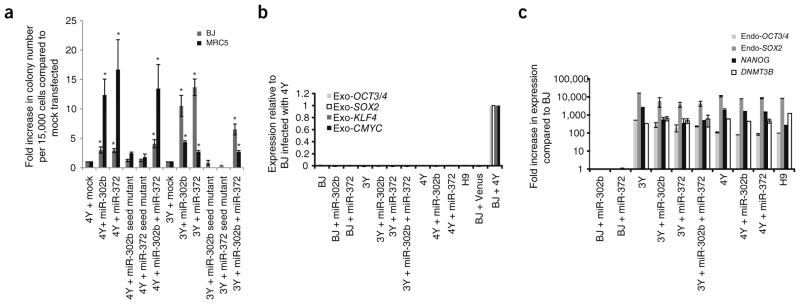
Figure 1
Figure 1
Hsa-miR-302b and/or hsa-miR-372 enhances reprogramming efficiency of human somatic cells. (a) Fold increase in number of human ESC-like colonies obtained per 15,000 cells compared to mock-transfected cells. Cells infected with 4Y ± miRNA were counted on day 21 after infection, whereas cells infected with 3Y ± miRNA were counted on day 31 after infection. *, a significant difference when compared to mock-transfected; P < 0.05; N = 6. Error bars represent mean ± s.e.m. (b) Expression of exogenous factors in iPSC lines that were picked and expanded after 3Y or 4Y infection and the indicated miRNA. Expression was determined by RT-qPCR using primers specific to only the exogenous factors. Data were normalized to BJ cells 3 d after retroviral infection with 4Y. (c) Expression of pluripotency markers in iPSC lines that were picked and expanded after 3Y or 4Y infection and the indicated miRNA. H9 hESCs shown as control. Expression was determined by RT-qPCR. Data were normalized to expression observed in BJ cells.
Figure 2
Figure 2
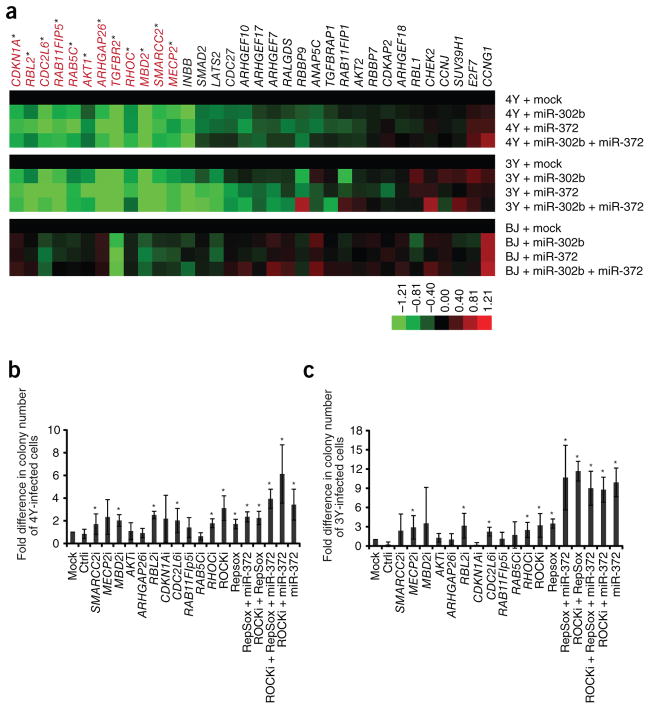
Hsa-miR-302b and hsa-miR-372 regulate expression of a number of targets that influence reprogramming of human somatic cells. (a) Heat map showing average expression from three independent experiments of 34 predicted targets of hsa-miR-302b and hsa-miR-372 on day 7 in the process of reprogramming. Expression was determined by qRT-PCR and was first normalized to GAPDH followed by normalization to mock-transfected cells. Statistically significant genes (P < 0.05; ANOVA) are labeled red. (b) Fold increase in reprogramming of human somatic cells infected with 4Y upon introduction of siRNAs against specific targets. Human ESC-like colonies were counted on day 21 after infection. N = 4. Error bars represent s.d. *, significant difference when compared to mock transfected; P < 0.05; measured by Kruskal-Wallis test. i, siRNA; ROCKi, ROCK inhibitor. (c ) Fold increase in reprogramming of human somatic cells infected with 3Y upon introduction of siRNAs against specific targets. Human ESC-like colonies were counted on day 31 after infection. N = 3. Error bars represent s.d. *, significant difference when compared to mock-transfected; P < 0.05; measured by Kruskal-Wallis test. i, siRNA; ROCKi, ROCK inhibitor.
Figure 3
Figure 3
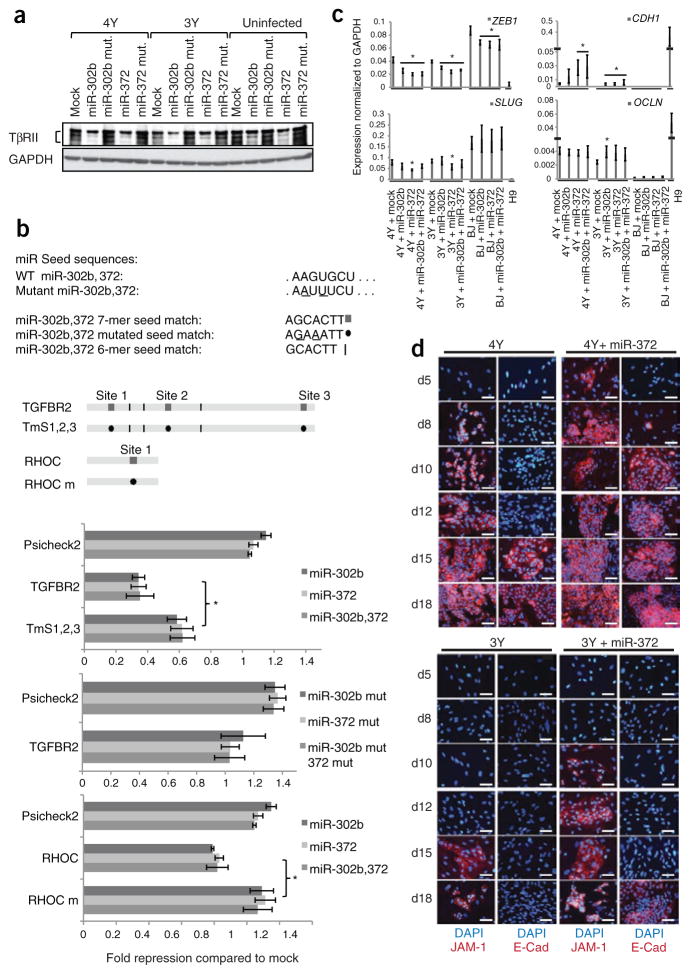
Hsa-miR-302b and hsa-miR-372 enhance reprogramming by regulating mesenchymal-epithelial transition. (a ) Western blot showing levels of TβRII from lysates prepared from BJ cells infected with either 4Y or 3Y, or uninfected cells plus the indicated miRNAs. N= 3. (b) luciferase analysis of TGFBR2 and RHOC 3′UTRs. Seed matches for ESCC miRNAs in the 3′UTRs along with different mutant constructs are shown in the top panel. luciferase results after co-transfection with ESCC miRNAs relative to mock transfection are shown in the lower panel after normalization to firefly luciferase values. All data are represented as mean ± s.d. *P < 0.05 by t-test. (c) RT-qPCR showing relative expression levels of mesenchymal (ZEB1 and SLUG) and epithelial (E-cadherin, CDH1, and occludin, OCLN) markers at day 7 after infection in the process of reprogramming normalized to GAPDH. N = 3. Error bars represent s.e.m. *, significant difference when compared to mock-transfected cells within each group (P < 0.05) by t-test. (d) Immunocytochemistry performed at different days during the course of reprogramming with 4Y or 3Y ± hsa-miR-372. Representative portions of the well are shown in each image. N = 2. Scale bars, 25 μm.
Figure 4
Figure 4
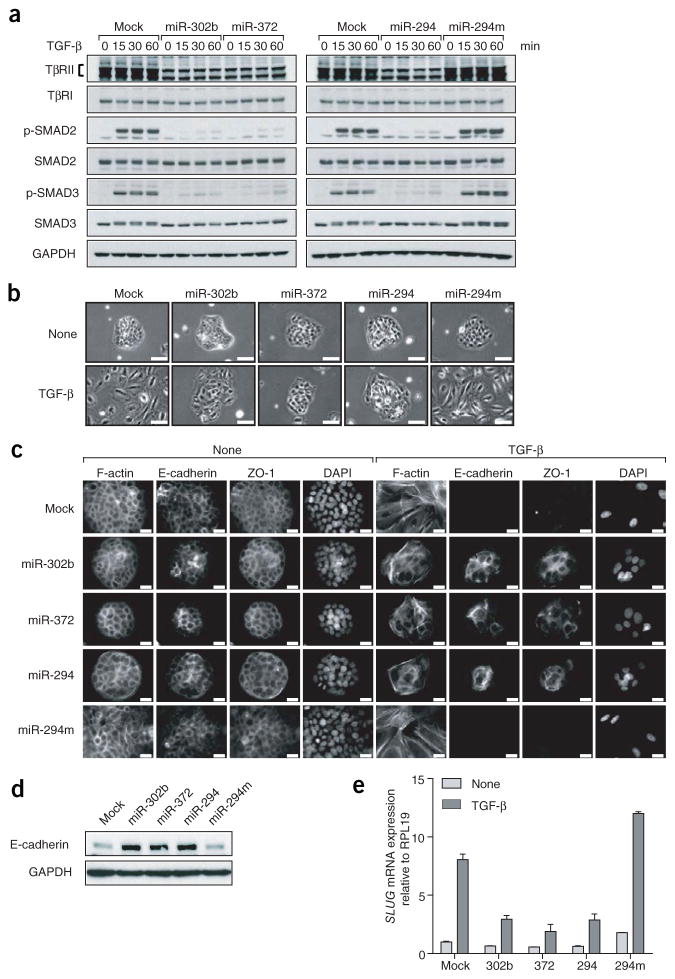
Hsa-miR-302b, hsa-miR-372 and mmu-miR-294 inhibit TGF-β–induced epithelial-mesenchymal transition in human cells. (a) Western blot showing levels of TGF-β receptors, phospho-SMAD2 and phospho-SMAD3 in HaCaT cells 0–60 min after TGF-β exposure in the presence of miRNA mimics. Cells were transfected with the indicated miRNAs 48 h before TGF-β treatment. miR-294m, mmu-miR-294 seed mutant mimic. Representative blot of N= 2. (b,c) HaCaT cells were transfected with the indicated miRNAs, then treated or not with TGF-β for 72 h and observed by phase contrast microscopy (b), or fixed and subjected to immunostaining for F-actin, E-cadherin and ZO-1 (c). N = 2. Scale bars, 100 μm (b), 20 μm (c). (d) HaCaT cells were transfected with the indicated miRNAs, then treated with TGF-β for 48 h before lysis and immunoblotting with the indicated antibodies. N= 2. ( e) HaCaT cells were transfected with the indicated miRNAs treated or not with TGF-β for 24 h, before RNA was extracted and analyzed by RT-qPCR. Expression was normalized to RPl19. Representative graph of two independent experiments is shown. Error bars represent mean ± s.e.m.

Comment in

  • MicroRNAs and reprogramming.
    Chang HM, Gregory RI. Chang HM, et al. Nat Biotechnol. 2011 Jun 7;29(6):499-500. doi: 10.1038/nbt.1889. Nat Biotechnol. 2011. PMID: 21654668 No abstract available.

References

    1. Judson RL, Babiarz JE, Venere M, Blelloch R. Embryonic stem cell-specific microRNAs promote induced pluripotency. Nat Biotechnol. 2009;27:459–461. - PMC - PubMed
    1. Qi J, et al. microRNAs regulate human embryonic stem cell division. Cell Cycle. 2009;8:3729–3741. - PMC - PubMed
    1. Wang Y, et al. Embryonic stem cell-specific microRNAs regulate the G1-S transition and promote rapid proliferation. Nat Genet. 2008;40:1478–1483. - PMC - PubMed
    1. Hochedlinger K, Plath K. Epigenetic reprogramming and induced pluripotency. Development. 2009;136:509–523. - PMC - PubMed
    1. Gonzalez F, Boue S, Belmonte JC. Methods for making induced pluripotent stem cells: reprogramming a la carte. Nat Rev Genet. 2011;12:231–242. - PubMed

Publication types

MeSH terms