


doi: 10.1053/j.sembd.2008.03.004.
MR Spectroscopy in the diagnosis and treatment of breast cancer
Affiliations
- PMID: 21490877
- PMCID: PMC3073311
- DOI: 10.1053/j.sembd.2008.03.004
Item in Clipboard
MR Spectroscopy in the diagnosis and treatment of breast cancer
Semin Breast Dis.
.
Abstract
In vivo proton magnetic resonance spectroscopy ((1)H MRS) is rapidly becoming useful as a clinical tool for diagnosing and characterizing breast cancers. Alterations of the levels of choline-containing metabolites are associated with malignancy. High-field MR scanners at 1.5 T, 3 T, 4 T, and 7 T have been used to evaluate the role of (1)H MRS measurements of total choline containing compounds in patients with breast cancer. This article will review clinical use of MRI/MRS in vivo. Newer developments in high field MR scanning and quantitative MRS may help breast imagers improve sensitivity and specificity in diagnosing and treating breast cancer.
Figures
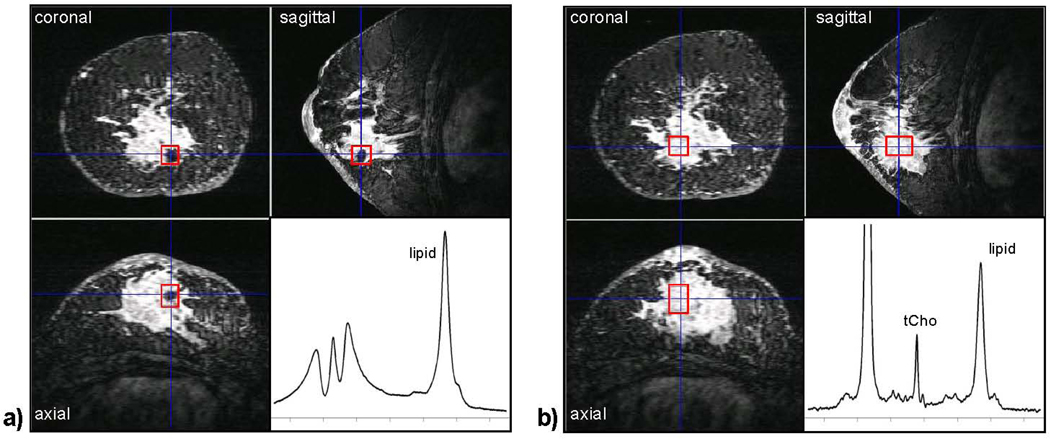
The effect of radiographic markers on shim quality. Both (a) and (b) show a three-view multi-planar reconstruction of a 3D, fat-suppressed, post-contrast image acquired at 4 T in a patient with an invasive ductal carcinoma. The voxel ROI (box) in (a) is placed directly over a metallic radiographic marker. Even after manual adjustment of the linear B0 shims, the spectral quality is very poor. In (b) the voxel ROI was repositioned in the center of the lesion away from the marker, and a high-quality spectrum showing tCho and other metabolites could be obtained. We now use a carbon coated ceramic marker for this reason. (Figure previously published in NMR Biomed. Haddadin et al 2007).
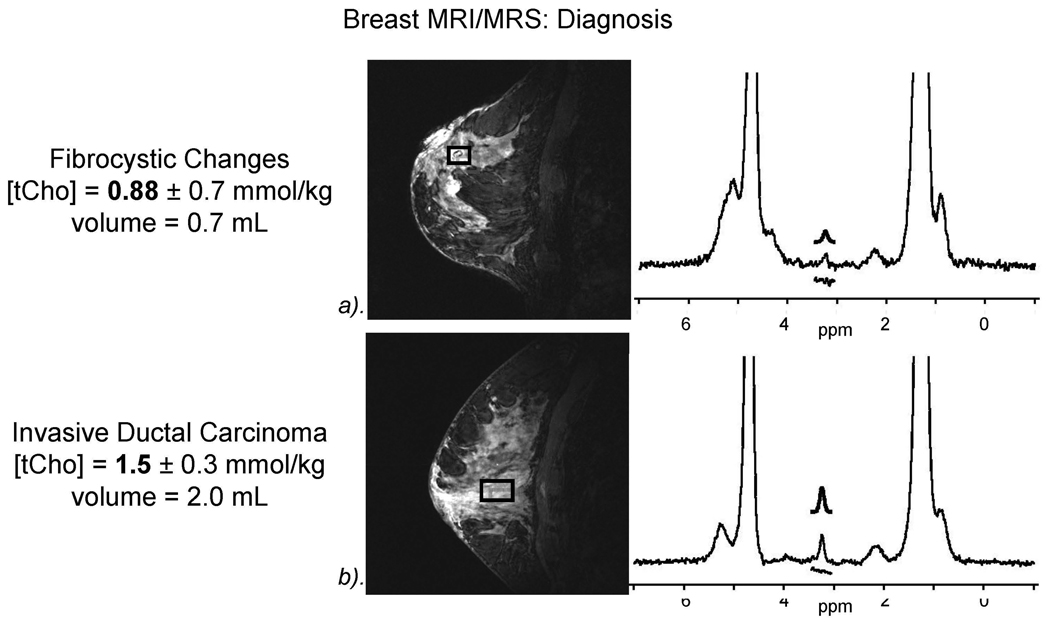
Breast MRI/MRs showing increased diagnostic accuracy which helps avoid unnecessary biopsies. a). Example of benign fibrocystic breast changes with tCho=.88 mmol/kg; b). Example of IDC with elevated tCho 1.5 mmol/kg.
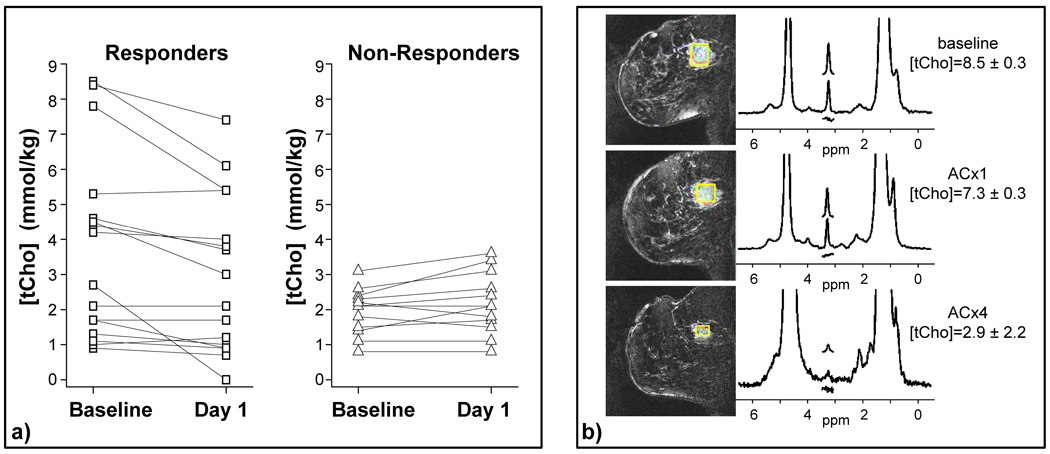
Monitoring response to treatment with 4 T quantitative breast MRS. This is an update of findings previously reported in Meisamy et al. (11). These data include 28 patients measured with 4 T breast MRI/MRS before the start of chemotherapy, 1 day after the first dose of therapy, and after the complete course of treatment. The tCho measurements are shown for the baseline and day-1 measurements in (a): 75% of the objective responders showed a decrease in tCho at day 1 after therapy, whereas 92% of non-responders showed no change or an increase at the same time point. (b) An example of an objective responder, showing decreased tCho at day 1, and a clear anatomical response by the end of therapy (ACx4). (Figure previously published in NMR Biomed. Haddadin et al 2007).
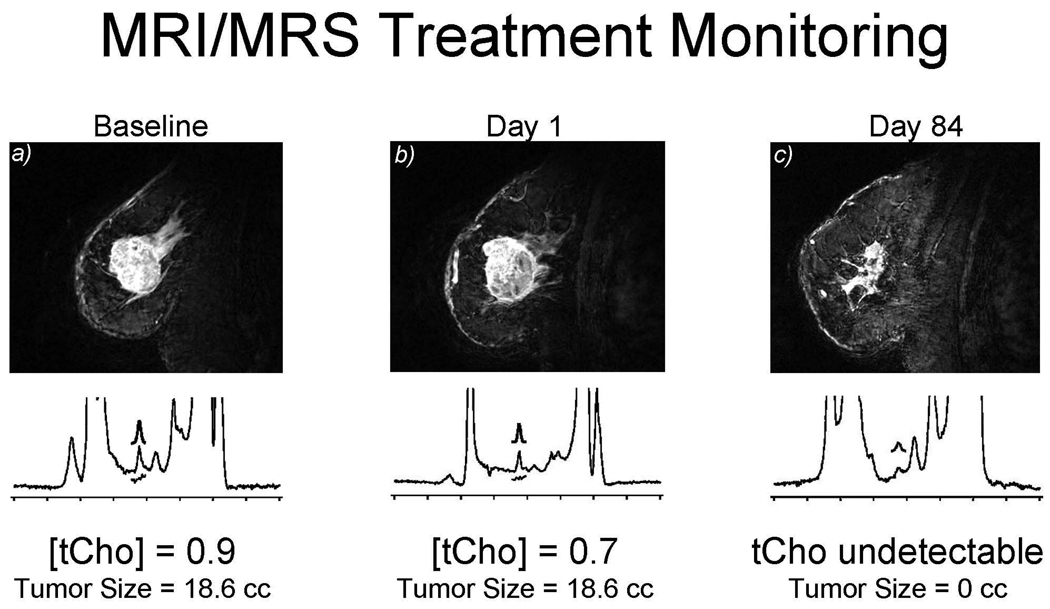
Baseline before treatment showing 0.9 mm mmol/kg. After 1 dose of adriamycin-cytoxan (AC), the tCho decreases to 0.7. Note that the tumor does not show a change in size. After 4 AC treatments at day 84, no choline is detectable in the lesion. This illustrates early response at 24-hours. Clinical oncologists could predict at 24-hours that this tumor would respond to chemotherapy.
References
-
- Ries LAG, Eisner MP, Kosary CL, et al., editors. SEER Cancer Statistics Review 1975–2002. Bethesda, MD: National Cancer Institute; http://seer.cancer.gov/csr/1975_2002/, based on November 2004 SEER data submission, posted online 2005.
-
- Aboagye EO, Bhujwalla ZM. Malignant transformation alters membrane choline phospholipid metabolism of human mammary epithelial cells. Cancer Res. 1999;59(1):80–84. - PubMed
-
- Podo F. Tumour phospholipid metabolism. NMR Biomed. 1999;12(7):413–439. - PubMed
-
- Ramirez de Molina A, Rodriguez-Gonzalez A, Lacal JC. Ras signalling to ChoK inhibitors: a further advance in anticancer drug design. Cancer Lett. 2004;206(2):137–148. - PubMed
-
- Glunde K, Jie C, Bhujwalla ZM. Molecular causes of the aberrant choline phospholipid metabolism in breast cancer. Cancer Res. 2004;64(12):4270–4276. - PubMed
Grants and funding
LinkOut - more resources
Full Text Sources