. 2011 May 15;83(10):3758-64.
doi: 10.1021/ac200213b. Epub 2011 Apr 22.

Quantitative label-free phosphoproteomics strategy for multifaceted experimental designs

Affiliations
Free PMC article

Quantitative label-free phosphoproteomics strategy for multifaceted experimental designs

Erik J Soderblom et al. Anal Chem. .
Free PMC article

Abstract

Protein phosphorylation is a critical regulator of signaling in nearly all eukaryotic cellular pathways and dysregulated phosphorylation has been implicated in an array of diseases. The majority of MS-based quantitative phosphorylation studies are currently performed from transformed cell lines because of the ability to generate large amounts of starting material with incorporated isotopically labeled amino acids during cell culture. Here we describe a general label-free quantitative phosphoproteomic strategy capable of directly analyzing relatively small amounts of virtually any biological matrix, including human tissue and biological fluids. The strategy utilizes a TiO(2) enrichment protocol in which the selectivity and recovery of phosphopeptides were optimized by assessing a twenty-point condition matrix of binding modifier concentrations and peptide-to-resin capacity ratios. The quantitative reproducibility of the TiO(2) enrichment was determined to be 16% RSD through replicate enrichments of a wild-type Danio rerio (zebrafish) lysate. Measured phosphopeptide fold-changes from alpha-casein spiked into wild-type zebrafish lysate backgrounds were within 5% of the theoretical value. Application to a morpholino induced knock-down of G protein-coupled receptor kinase 5 (GRK5) in zebrafish embryos resulted in the quantitation of 719 phosphorylated peptides corresponding to 449 phosphorylated proteins from 200 μg of zebrafish embryo lysates.


Figures
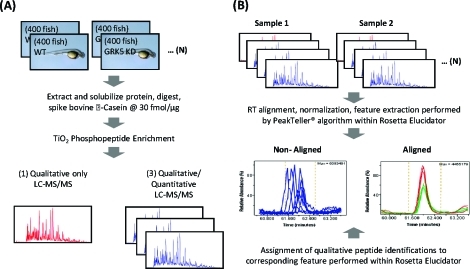
Figure 1
Figure 1
General overview of (A) sample preparation and data acquisition strategy and (B) data analysis workflow utilized in the label-free quantitative phosphoproteomic analysis of WT vs GRK5 knock-down zebrafish embryos.
Figure 2
Figure 2
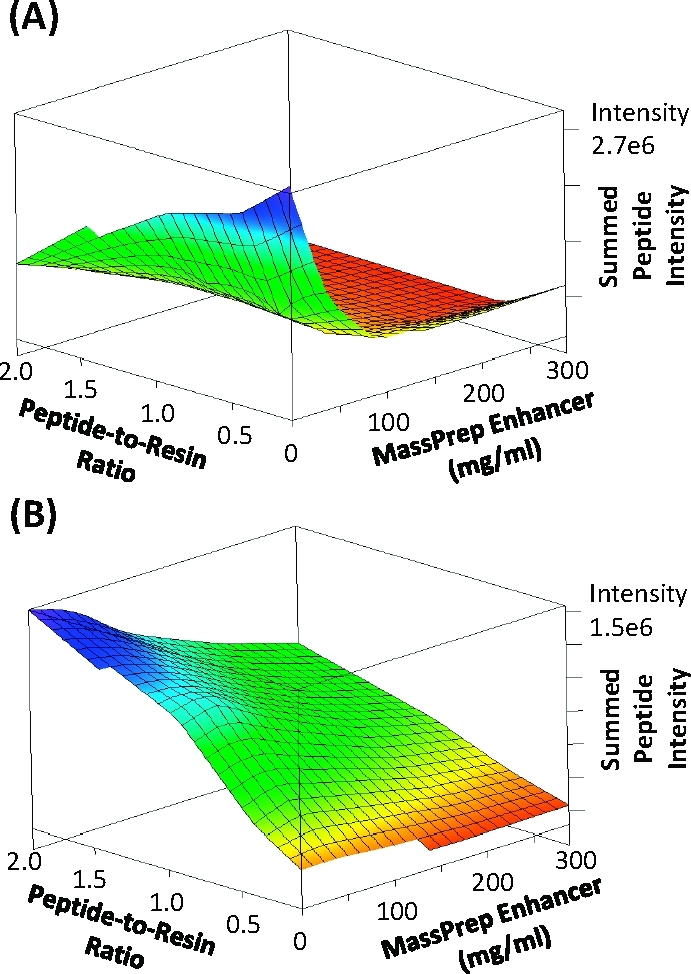
Three-dimensional surface plots of the summed areaunder-curve extracted ion chromatograms intensities for all (A) unique nonphosphorylated peptides (n = 665) or (B) unique phosphorylated peptides (n = 205) from WT zebrafish embryo lysates subjected to twenty unique TiO2 enrichment conditions.
Figure 3
Figure 3
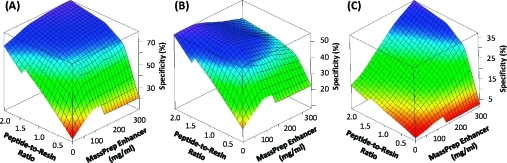
Phosphorylated peptide TiO2 enrichment specificity across a twenty-point matrix of enrichment conditions. Specificity was determined by calculating the percentage of the summed area-under-curve extracted ion chromatogram intensities for (A) all unique phosphopeptides (n = 205), (B) phosphopeptides containing 1 phosphate (n = 164), or (C) phosphopeptides containing more than 1 phosphate (n = 41) as a part of the summed area-under-curve extracted ion chromatogram intensities for all identified peptides (n = 871).
Figure 4
Figure 4
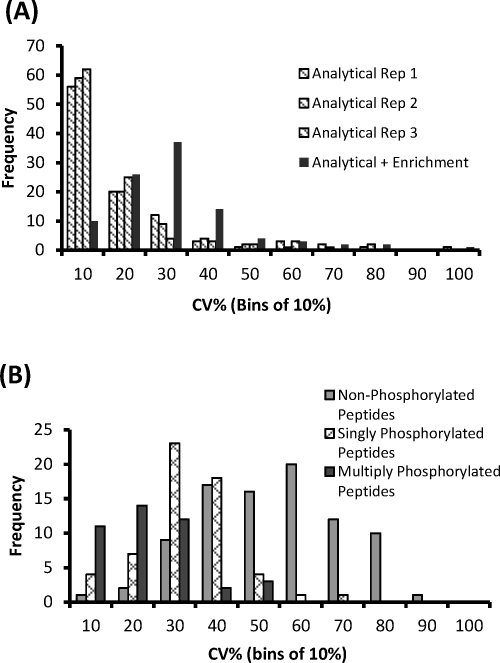
Analytical and TiO2 enrichment variation from three 350 ug WT zebrafish embryo lysates subjected to independent TiO2 enrichments followed by triplicate LC-MS/MS analysis. (A) Coefficient of variation (CV%) distributions for all phosphorylated peptide extracted ion chromatogram intensities (n = 99) for each set of analytical replicates (average median CV 7.0%) or across all three TiO2 enrichments (median CV 23.5%). (B) Coefficient of variation distributions of nonphosphorylated (n = 88, median CV 44.0%), singly phosphorylated (n = 57, median CV 23.4%), and multiply phosphorylated (n = 42, median CV 19.7%) peptide intensities across all three TiO2 enrichments.

References

    1. Tedford N. C.; Hall A. B.; Graham J. R.; Murphy C. E.; Gordon N. F.; Radding J. A. Proteomics 2009, 9, 1469–1487. - PubMed
    1. Nita-Lazar A.; Saito-Benz H.; White F. M. Proteomics 2008, 8, 4433–4443. - PMC - PubMed
    1. Schreiber T. B.; Mausbacher N.; Breitkopf S. B.; Grundner-Culemann K.; Daub H. Proteomics 2008, 8, 4416–4432. - PubMed
    1. Looso M.; Borchardt T.; Kruger M.; Braun T. Mol. Cell Proteomics 2010, 9, 1157–1166. - PMC - PubMed
    1. Sury M. D.; Chen J. X.; Selbach M. Mol. Cell Proteomics 2010, 9, 2173–2183. - PMC - PubMed

Publication types

MeSH terms

LinkOut - more resources