. 2011 Aug;39(14):6056-68.
doi: 10.1093/nar/gkr221. Epub 2011 Apr 14.

Distinct patterns of somatic alterations in a lymphoblastoid and a tumor genome derived from the same individual

Affiliations

Distinct patterns of somatic alterations in a lymphoblastoid and a tumor genome derived from the same individual

Pedro A F Galante et al. Nucleic Acids Res. 2011 Aug.

Abstract

Although patterns of somatic alterations have been reported for tumor genomes, little is known on how they compare with alterations present in non-tumor genomes. A comparison of the two would be crucial to better characterize the genetic alterations driving tumorigenesis. We sequenced the genomes of a lymphoblastoid (HCC1954BL) and a breast tumor (HCC1954) cell line derived from the same patient and compared the somatic alterations present in both. The lymphoblastoid genome presents a comparable number and similar spectrum of nucleotide substitutions to that found in the tumor genome. However, a significant difference in the ratio of non-synonymous to synonymous substitutions was observed between both genomes (P = 0.031). Protein-protein interaction analysis revealed that mutations in the tumor genome preferentially affect hub-genes (P = 0.0017) and are co-selected to present synergistic functions (P < 0.0001). KEGG analysis showed that in the tumor genome most mutated genes were organized into signaling pathways related to tumorigenesis. No such organization or synergy was observed in the lymphoblastoid genome. Our results indicate that endogenous mutagens and replication errors can generate the overall number of mutations required to drive tumorigenesis and that it is the combination rather than the frequency of mutations that is crucial to complete tumorigenic transformation.


Figures
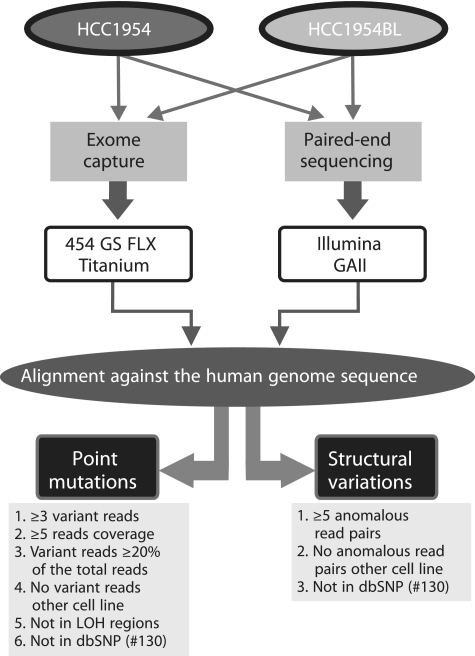
Figure 1.
Figure 1.
Sequencing strategy. Outline of the sequencing strategy and bioinformatics algorithms used for the identification of point mutations and structural chromosomal rearrangements in the HCC1954 and HCC1954BL genomes.
Figure 2.
Figure 2.
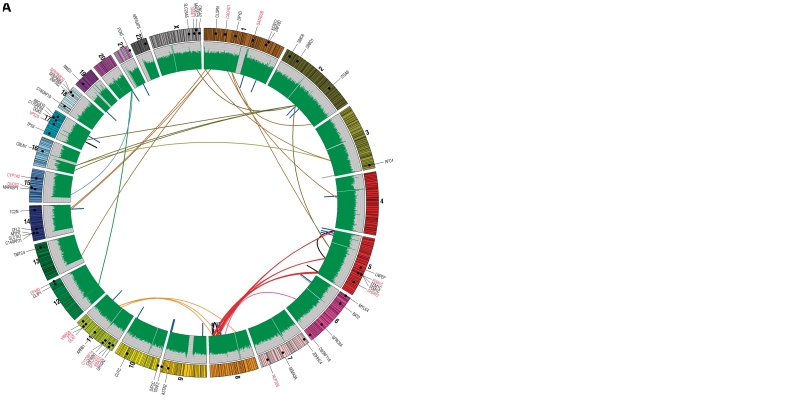
Circos plot representing somatic point mutations and structural variations in the (A) HCC1954 and (B) HCC1954BL genomes. Chromosome representations are shown around the outer ring and are oriented in a clockwise direction. Other tracks contain (from outside to inside) point mutations as dots (non-synonymous labeled in back and synonymous labeled in red), physical coverage of the genome by paired-end reads in green, interchromosomal rearrangements represented by colored lines linking two chromosomes (different colors representing interchromosomal rearrangements are determined by the first chromosome in the circos in the clockwise direction starting with chromosome 1), intrachromosomal deletions as blue lines, inversions as black lines and duplications as gray lines.
Figure 3.
Figure 3.
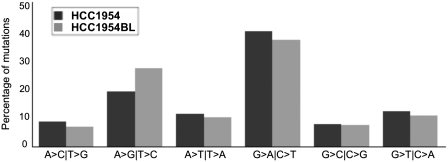
Spectrum of nucleotide substitutions in the HCC1954 and HCC1954BL genomes. Frequency of point mutations in each of the six possible nucleotide substitution classes (A > C|T > G, A > G|T > C, A > T|T > A, G > A|C > T, G > C|C > G, G > T|C > A) observed in the HCC1954 (blue) and HCC1954BL (orange) genomes.
Figure 4.
Figure 4.
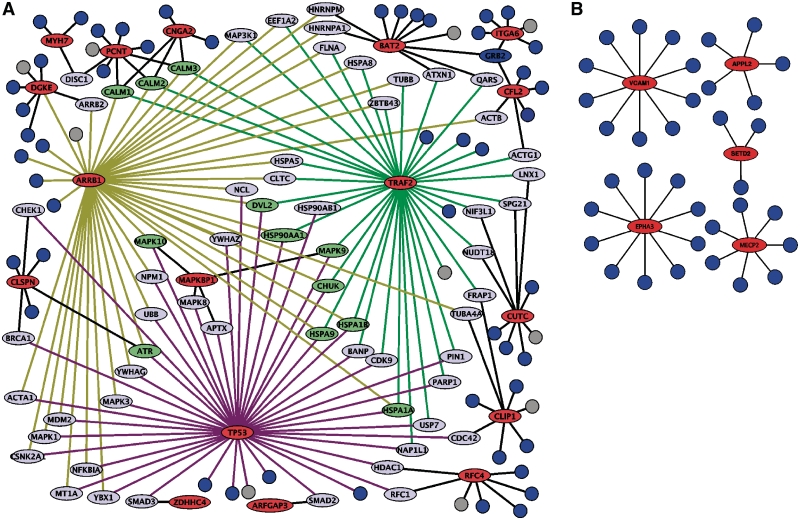
Protein–protein interactions networks for mutated genes in HCC1954 (A) and HCC1954BL (B). Proteins with validated non-synonymous mutations are represented as red circles and each line represents a confident interaction. Interaction partners with mutated genes are represented in green if they interact with three mutated proteins or in light blue if they interact with two mutated proteins.

References

    1. Futreal PA, Coin L, Marshall M, Down T, Hubbard T, Wooster R, Rahman N, Stratton MR. A census of human cancer genes. Nat. Rev. Cancer. 2004;4:177–183. - PMC - PubMed
    1. Greenman C, Stephens P, Smith R, Dalgliesh GL, Hunter C, Bignell G, Davies H, Teague J, Butler A, Stevens C, et al. Patterns of somatic mutation in human cancer genomes. Nature. 2007;446:153–158. - PMC - PubMed
    1. Clark MJ, Homer N, O'Connor BD, Chen Z, Eskin A, Lee H, Merriman B, Nelson SF. U87MG decoded: the genomic sequence of a cytogenetically aberrant human cancer cell line. PLoS Genet. 2010;6:e1000832. - PMC - PubMed
    1. Ding L, Ellis MJ, Li S, Larson DE, Chen K, Wallis JW, Harris CC, McLellan MD, Fulton RS, Fulton LL, et al. Genome remodelling in a basal-like breast cancer metastasis and xenograft. Nature. 2010;464:999–1005. - PMC - PubMed
    1. Ley TJ, Mardis ER, Ding L, Fulton B, McLellan MD, Chen K, Dooling D, Dunford-Shore BH, McGrath S, Hickenbotham M, et al. DNA sequencing of a cytogenetically normal acute myeloid leukaemia genome. Nature. 2008;456:66–72. - PMC - PubMed

Publication types